The mental load · August 1, 2026 · 7 min read
Realistic Cleaning Schedule for Working Moms
Use this free realistic cleaning schedule for working moms to name a weekly minimum, assign each job, and skip busy days without a catch-up pile.

A missed Tuesday shouldn't create two Wednesdays. But that's what many weekly cleaning plans do: unchecked jobs keep sliding forward until they form a second shift on the weekend.
A realistic cleaning schedule for working moms needs a written way to let work go. The version on this page works for any working parent. It separates the small reset that keeps the week usable from the deeper job that can be dropped or deliberately moved when the day fills up.
Download the free realistic cleaning schedule
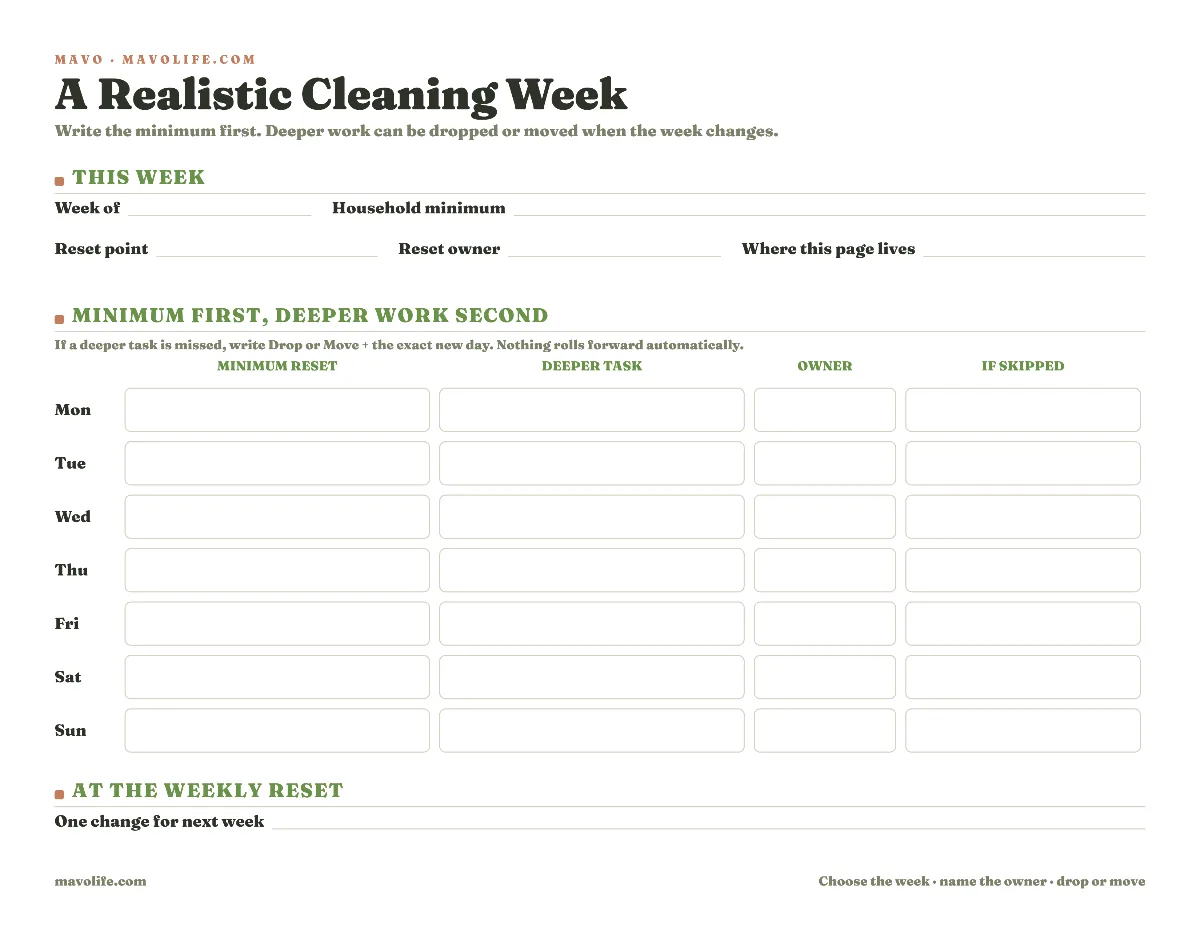
Download the fillable weekly cleaning schedule (PDF)
The one-page PDF works typed or handwritten. Fill it in at the start of the week. Post it where the people named on it can read it, then replace it at the next weekly reset. No account is required.
The printable organizes tasks your household has already chosen. It doesn't set a required cleaning cadence or choose products. It also doesn't decide which jobs belong to a child.
Choose the minimum before you choose the days
Write one sentence in the Household minimum line. This is the small visible condition that makes
the week feel usable even when the optional work waits. It might be dishes contained and walking paths clear or shared room reset before bed. Use words everyone in the household already
understands.
The minimum isn't a complete standard for the home. It's the line below which the household wants to act this week. A week with travel or late shifts may need a smaller line than a quiet week.
Keep the sentence observable. Stay on top of the house leaves every reader making a different
guess. Return shoes and bags to the entry bench gives the owner a finish they can recognize.
Then choose the reset point. This is when the old page comes down and the next week gets written. Sunday evening may fit one household. Friday afternoon or a rotating workweek boundary may fit another. The day matters less than naming who brings the page back.
Build the week in two speeds
Each day has a Minimum reset and a Deeper task. The minimum is the small job that supports the household's written line. The deeper task is one additional piece of work that would be useful if the day allows it.
Here is an ordinary example. These are illustrations, not recommendations about what another home needs:
| Day | Minimum reset | Deeper task | Owner | If skipped |
|---|---|---|---|---|
| Monday | Clear the entry bench | Sort the coat hooks | Rowan | Drop |
| Tuesday | Put dinner things away | Clear one pantry shelf | Casey | Move to Friday |
| Wednesday | Return shared-room items | Vacuum the living room | Rowan | Drop |
| Thursday | Contain the laundry | Fold the towel load | Casey | Drop |
| Friday | Reset the kitchen table | Tuesday's pantry shelf | Rowan | Drop |
Notice that Friday doesn't hold every unfinished row. It holds one moved task that the household chose to keep. The rest are allowed to disappear.
One deeper task per day is enough for this sheet. If three projects are competing for Tuesday, pick one for this week and keep the others somewhere else. A schedule with every possible job is an inventory, and an inventory can't tell a tired person what matters now.
Name the owner while the page is still being written
Write one name in each owner cell. Everyone can work only when the household has a reliable shared
moment and already knows what each person will do. Otherwise it usually means the person who notices
first must organize the work again.
The owner cell records the arrangement the household chose. It doesn't decide whether the split is fair. Nor can it know who has more available time or what work a particular person can safely do. Those decisions belong to the people using the page.
If the same person owns every row, the printable will at least make that visible. If the household wants to change the broader handoff, the guide to sharing the mental load with a partner explains how to transfer an ongoing area instead of passing out isolated errands.
The mental load guides collect more ways to make household ownership visible when the weekly cleaning plan is only one part of the problem.
For stable jobs that repeat under the same name week after week, the family chore list template may be a better fit. That page groups recurring work by person. This one is for a week whose available time and optional jobs change.
When the weekly minimum is already settled but deeper room work needs a repeating cycle, use the zone cleaning list to map those tasks across four weeks.
Write the missed-day rule before the day gets missed
The last column offers two honest choices: drop or move.
Drop means the task leaves this week's page. It doesn't hide on a mental list and it doesn't
automatically return on Saturday. The household can choose it again during a future reset, but this
version is finished with it.
Move needs a destination. Write move to Friday or another exact day. A blank move is only a
delay with no new owner or place. If the destination already has a deeper task, choose which one
stays. Do not stack both unless the person who owns that day deliberately agrees.
This is where an ordinary sheet can prevent an invisible task snowbank. Without the last column, every missed job rolls downhill. By the weekend, a tidy seven-row plan can become a silent demand to finish fourteen rows.


Reset the page instead of repairing the whole house
At the named reset point, read the page once. Check what happened. Cross out any moved task that no longer matters, then write one change for next week.
The review is about the schedule, not a score for the people on it. Ask practical questions:
- Was the household minimum clear enough to recognize?
- Did a deeper task keep moving because it was too large for one row?
- Did an owner need information or access that the page did not show?
- Did the same day repeatedly carry more than the available week could hold?
Use the small One change for next week line at the bottom. Make Thursday minimum-only is more
useful than rewriting the entire plan. So is split the pantry shelf into two rows or move the weekly reset to Friday.
Then retire the old page. Don't copy every dropped task onto the new one. Start again with the minimum and look at the week in front of you. Choose only the deeper work that still matters.
See what happens when Wednesday disappears
Suppose the household wrote dishes contained and walking paths clear as its minimum. Tuesday's
deeper task was clear one pantry shelf, but Tuesday filled up. The owner wrote move to Friday,
so Friday's deeper-task cell now has one exact job.
Then a late meeting takes Wednesday. Its deeper task was vacuum the living room. The owner marks
it drop. Thursday keeps the towel load it already had, and nobody has to decide whether Wednesday's
vacuuming is secretly waiting there too.
At the weekly reset, the repeated late meeting becomes useful information. The household writes
Make Wednesday minimum-only in the change line for next week. A rotating-shift household can use
the printed day names as positions in its current workweek and make the same adjustment at its own
reset point. For one person living alone, a phone note may be faster; the sheet earns its place only
when the minimum/deeper split makes the choice easier to see.
Friday arrives with one moved shelf, not every job that lost its day. The dropped vacuuming can return only if the household chooses it during a future reset. Wednesday was allowed to end.