The mental load · July 10, 2026 · 7 min read
Mental load checklist: get it out of your head
A mental load checklist that puts everything one parent silently tracks on one page, area by area, with two names beside it: who holds it, who takes it next.

The house is finally quiet. The dishwasher's running, the tea you made an hour ago went cold, and you're still at the kitchen table because your brain won't put the list down: the field trip form due Thursday, the dentist who wants to move the appointment, the birthday gift that still isn't bought, the fact that you're almost out of the good bread again.
Most advice about this stops at naming it. But talking about the list doesn't share it. You can learn the term for what you're carrying, read the whole essay, even sit down and have the honest conversation with your partner, and still wake up as the only person who knows the dentist wants Thursday. Awareness and division are two different things. You can't hand someone a feeling. You can hand them a list.
So the rest of this is the worksheet itself. One sitting, tonight or this weekend, to get everything you quietly track out of your head and onto a page anyone in the house can read. Then two small columns that turn that page from a vent into something you can actually divide.
Get all of it onto one page
The reason this load is so hard to hand off is that most of it never looks like work. The noticing, the remembering, the tracking of what's due and what's running low: none of it shows until the day it gets dropped. So the first move is boring and physical: write it down. All of it. Not the tidy version you'd say out loud. The 11 p.m. version that's actually running in your head.
Do it by area so you're not staring at a blank page trying to remember your whole life at once. The sheet below gives you a row for each one: school, health, activities, meals, household, cars and errands, money, social and gifts, pets, and a spare row for whatever else is yours. Don't sort, don't solve, and don't assign anything yet. Just fill the wide box in each row with what you're actually carrying there, the forms and the refills and the birthday you're already dreading, until the page holds what your brain has been holding.
Give yourself fifteen minutes and a timer so it stays a brain-dump instead of turning into a project. And write down the worrying as well as the doing: "did the registration deadline pass?" earns a line right alongside "register for soccer," because the background hum of wondering is the part that actually wears you down.
If some of this already lives in scattered places (a note on your phone, a running text you send yourself, the back of an envelope in your bag), you don't have to retype it. Paste those bits into Mavo or snap a photo of the page, and it reads the lines into your shared plan so the capturing doesn't quietly fall to you twice.
The mental load inventory, area by area
Here's the page. Fill the wide box in each row first, and leave the two name boxes on the right alone until the next step.
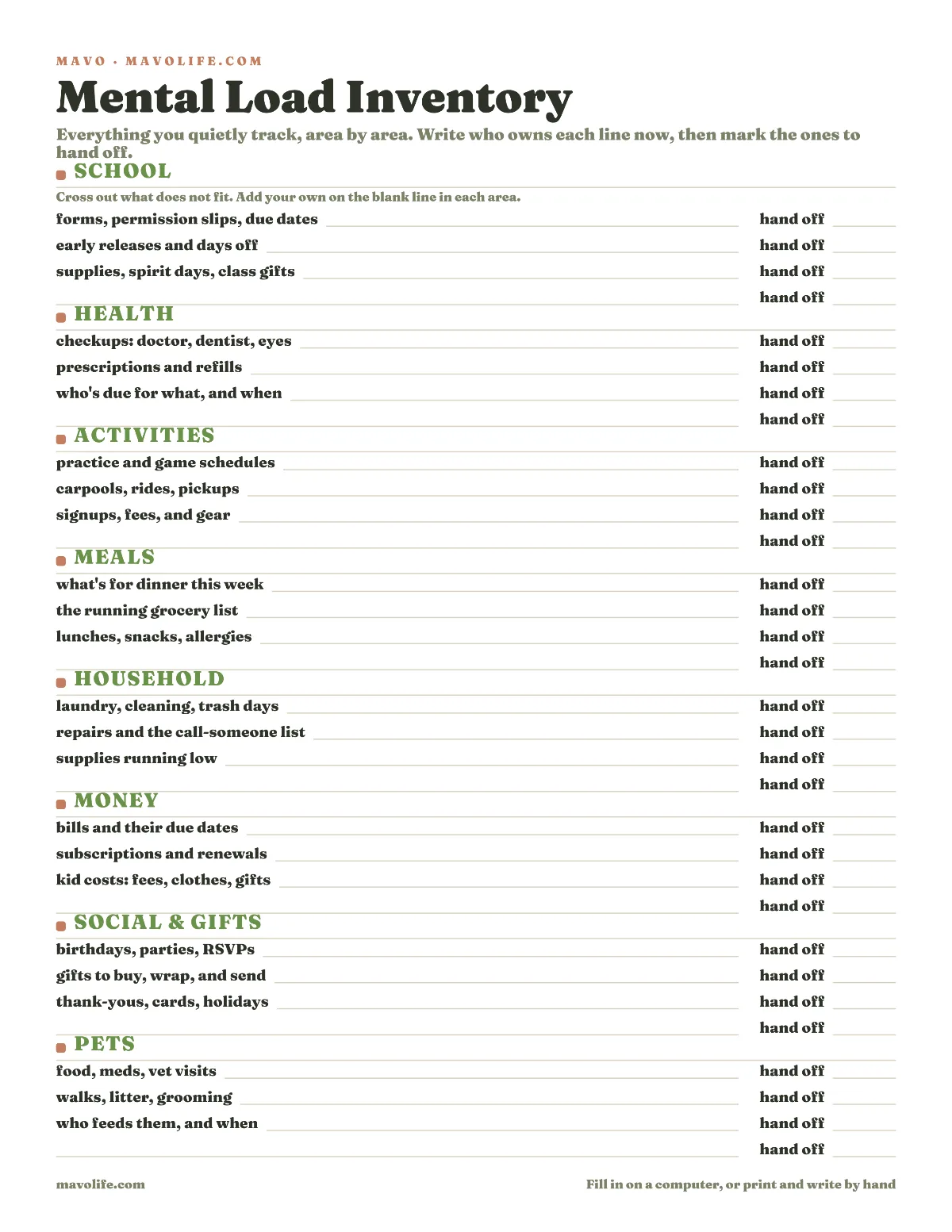
Download the printable mental load inventory (PDF)
Fill it in on a computer, or print it and write by hand, and keep adding as things surface over the next day. The list is never really done, and that's fine. You're not trying to be exhaustive tonight. You're trying to make the size of it visible for the first time.
It's worth running again whenever the load quietly spikes and re-piles onto one person: the back-to-school stretch, a new season of activities, a move, a new baby. Those are the moments the invisible list grows fastest and defaults hardest, and they're the easiest times to end up right back where you started.
The two names: who holds it now, who takes it next
A list by itself is just a longer version of the worry. The two name boxes beside each row are what turn it into something two people can split.
Start with holds it now, and fill it in honestly. For most families doing this the first time, the same name lands in row after row after row. That's the honest starting picture, and you can't divide a load until you can both see how lopsided it actually is.
Then takes it next. Write a name beside any area you'd like to move off your plate, and be a little greedy here: the handoffs that actually stick move a whole area at once, so the remembering travels with the task instead of staying on you. There's more on making a handoff hold in how to share the mental load with your partner.
You'll hit a few areas neither of you wants: the paperwork marathon, the gift-and-card list, the tracking of who's due for a checkup. Don't leave those blank and quietly let them stay yours. Give each one a name even if you have to trade for it ("you take health, I'll take social and gifts") or split an area down the middle. An unwanted area with a name on it is still handled; left blank, it just slides back to whoever notices things first.
Some of what's in those boxes can go to a kid. A child who is ready for pet feeding, trash night, or their own laundry takes that job off both parents at once. The free chore chart maker turns the handoff into a printed chart with age-appropriate suggestions, so the new owner is visible on the fridge.
For a static split that includes the adults too, the fillable family chore list keeps recurring jobs grouped by name and includes its own review date.
When the same laundry loads keep getting washed but not returned home, the family laundry schedule gives each load a day, finisher, and weekly reset.
You can feel the difference this makes. Before the page existed, when your partner asked what they could take off your plate, the honest answer was some version of "I don't even know where to start," because the plate was invisible even to you. Help meant handing over one errand while you silently kept the ninety-nine you were still tracking. With the filled-in page on the table, your partner can read down the holds-it-now column, see their name on almost nothing, and claim a whole area instead of waiting to be handed a task. The next time the dentist calls to move Thursday, it's already their line to catch.
Put a name on every line
A filled page on the kitchen table is a great start and a poor long-term home. Paper gets buried, and until the list moves, it's still sitting in your house, closest to you, the person it always defaults to. Getting it somewhere the whole family can see is what keeps it from sliding back.
So move the list into Mavo and put a name on each line. That name is the owner, so who's handling something is a shared fact everyone can see, instead of a thing only you remember. As pieces get done, covered status shows what's handled and what still needs attention, and nobody has to ask you for the update, because the plan already shows it.
Some lines will still have your name, and that's fine. A perfectly even split down the middle isn't the goal, and it never was. You've just gone from one person holding the whole board to a family that can all see it.
Keep it shared after tonight
One night's worksheet won't hold up on its own. Left alone, the list drifts back to one head, because that's the groove the family already runs in. Two things keep it from resetting.
The first is the bigger conversation. If tonight surfaced more than you expected, the default parent is the longer read on why this work stays invisible, and why "just ask me for help" quietly hands it all back.
The second is a standing check-in. A ten-minute weekly family meeting is how the holds-it-now column stays true, so the areas you handed off on Sunday don't creep back to your name by Wednesday. That's what the last line of the sheet is for: the date you look at it again, and who brings it up.
The worksheet isn't the win. The real one is quieter: tomorrow, when the form is due or the dentist calls to move Thursday, you won't be the only person in the house who saw it coming. Someone else's name is on the line, and they've got it.