The mental load · August 27, 2026 · 5 min read
Family Mission Statement Template With Examples
Use a free fillable family mission statement template to gather your family's own words, write a short draft, and choose when to revisit it.

A family mission statement is a short description of what your household wants to remember about itself. The useful version sounds like the people who wrote it. It doesn't need to read like a company motto. It also shouldn't promise perfect behavior or settle what every family should value.
Start by collecting a few words from the people involved. Then attach those words to ordinary examples from your own home before you try to write the final sentence. The free family mission statement template below gives that conversation one page without supplying the answers.
Collect words before writing sentences
Give each person a turn to suggest a word or short phrase. Someone might name curiosity or showing up. Another person may think of quiet mornings, while somebody else writes down humor or making things together. These show the size of answer that fits; they aren't a recommended list.
Write down the words that sound familiar to more than one person. If a word needs a speech to make it acceptable, leave it in the conversation for now. Four blank spaces on the worksheet are a limit, not a quota. Two honest phrases can give you more to work with than four polished ones nobody would say again.
This is also where a family can keep the exercise neutral. The page doesn't rank beliefs or tell a household which cultural traditions matter. It doesn't turn parenting or moral choices into a worksheet answer. It records the words your household supplies. If people don't agree on a word, the printable shouldn't turn one person's preference into a family rule.
If one adult is writing this alone, treat the first version as a draft and invite edits before calling it the family's statement. If people move between two households, write for this home instead of asking one page to speak for both.
Test each word against a real moment
Abstract words get slippery quickly. Before drafting, choose one or two ordinary moments that show one or more of the selected words. If someone chose “welcoming,” the recognizable example might be pulling out another chair when a neighbor stays for dinner. A jar of questions during long car rides could hold both curiosity and humor. Use scratch paper if the conversation produces more examples than the two lines on the worksheet can hold.
The example doesn't prove that your family always acts that way. It gives everyone a shared picture of what the word means here. That makes it easier to notice when two appealing words are really pointing at the same idea, or when a phrase came from somewhere else and doesn't fit your life.
Use the second line for something the household wants to remember more often. Keep it descriptive rather than corrective. “Leave room for an extra chair” gives the draft a scene. “Everyone must be more generous” turns the worksheet into a behavior judgment, which isn't its job.
Download the family mission statement template
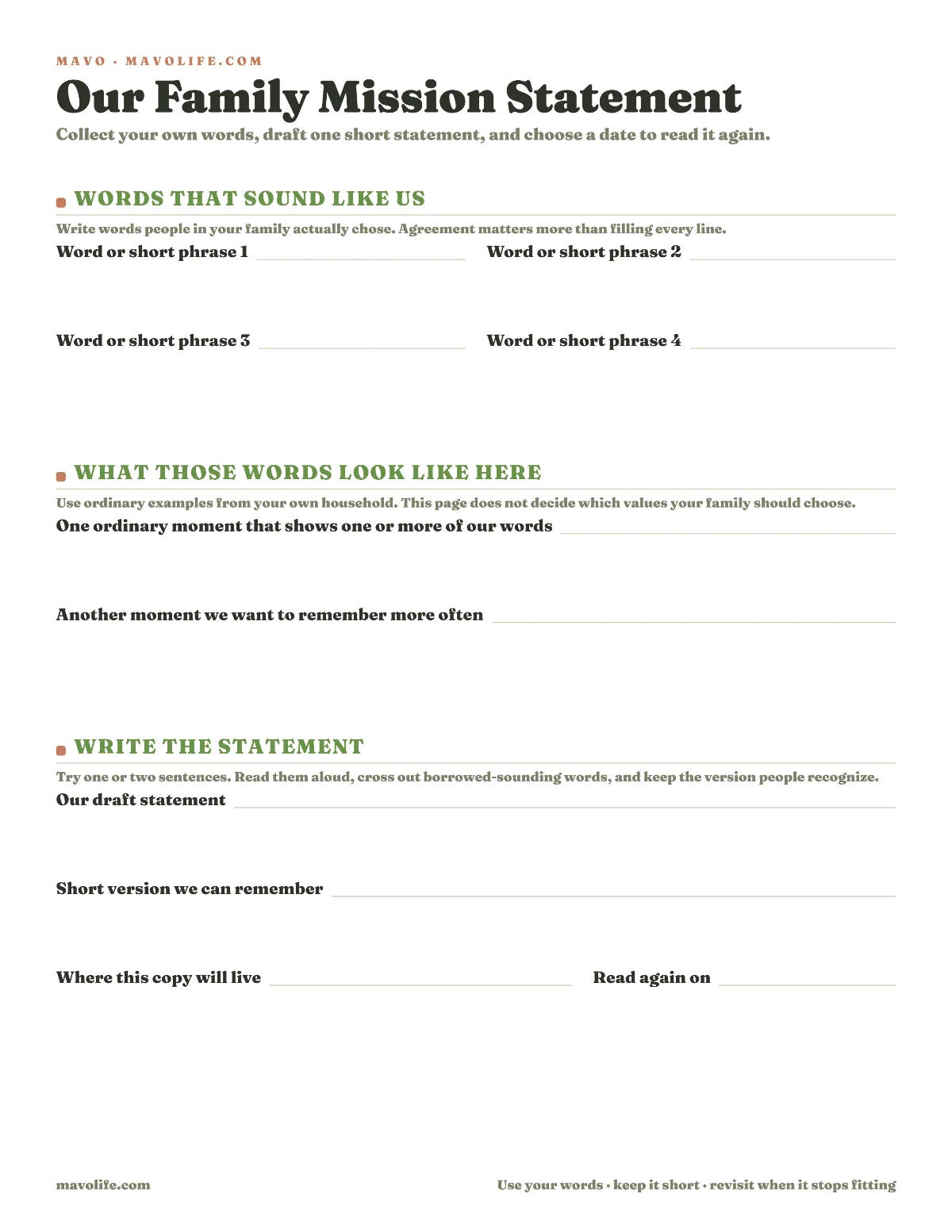
Download the fillable family mission statement worksheet (PDF)
You can type into the PDF or print it and write by hand. The first half holds up to four shared words and two examples. The second half holds the draft and a shorter version. It also records where the finished copy will live and when the family wants to read it again.
That is deliberately smaller than many mission statement workbooks. You don't need a multi-page values inventory to leave the table with a sentence. Keep scratch notes somewhere else, then use this sheet for the words that survived the conversation.
Turn the notes into one or two sentences
Read the selected words and examples aloud. Then try a plain opening such as “In our family, we...” or “We want our home to be a place where...” Complete it with the language already on the page. The opening is scaffolding; change or remove it if a different sentence sounds more natural.
Here are three made-up examples that show different shapes without prescribing the content:
- “In our family, we make room for questions, laughter, and one more chair.”
- “We show up for one another, make useful things, and keep learning.”
- “Our home is a place for calm mornings, honest repair, and generous welcomes.”
The examples are intentionally short. A statement can be a sentence or a compact pair of sentences. If the draft needs a glossary, it probably still contains words that work better in the scratch notes. Read it once without looking at the page. The phrase people can recall is often the best clue to what belongs in the shorter line.

Put the finished words somewhere they make sense
The “where this copy will live” field asks for a real location. A short statement might go inside a kitchen cabinet. It could also fit on a corkboard or in the front of a household binder. It doesn't have to become wall art. Choose a place where the people who wrote it are likely to encounter it. Taking it down later shouldn't feel like breaking a promise.
The review date has the same modest purpose. It does not set a deadline for becoming the family the sentence describes. It simply brings the words back into view. When that day comes, read the short version aloud and ask whether it still sounds recognizable. It can stay as written. If it no longer fits, rewrite the line or retire the page.
That review is different from tracking a shared goal. If your household wants to choose one time-bound change, name its first action, and decide later whether to keep going, use the family goal setting worksheet. The mission statement stays about the words your family wants to carry across more than one plan.
If you want a place to discuss the draft alongside the coming week's decisions, bring it to a weekly family meeting. The statement can be one small item in that conversation. It doesn't need to become a permanent agenda or a test anyone passes.