The mental load · August 22, 2026 · 5 min read
Family Goal Setting Worksheet: One Shared Goal
Download a free family goal setting worksheet to choose one shared goal, name the first action and adult, and set a review date.

Start a family goal conversation with one future moment, not a category. Pick a day or place your household already knows. Then ask a modest question: “What would make that moment feel easier next week?”
That question gives the conversation something to look at together. It may be the rush at the door before a Saturday activity. It may be the counter where the same loose papers keep collecting. You are not trying to solve the whole season. You are choosing one change the people in the room can picture.
Start with a moment you can picture
A good shared goal does not need to sound impressive. It needs a scene your household recognizes. “Make Saturday morning less scrambled” can be enough. “Be a better family” cannot, because each person may hear a different request in it.
Ask everyone who is part of the decision to name what they would want to notice in that moment. Keep the answers loose at first. One adult may say the bags should be ready before Friday night. Another may want to stop looking for shoes at the door. Those are observations to compare, not instructions that the worksheet hands down.
When two answers are really about the same moment, choose the version you can say without adding a second goal. A list that needs a daily log is probably asking for a calendar or another tool. A goal that points to one familiar moment can stay on a single page without turning into a new household system.
Pick one thing to try before the next conversation
Now ask what could happen before you talk about the goal again. The answer should be a small action that belongs to the coming week. It doesn't need to repair the whole problem.
For the Saturday example, one action could be putting the packing list by the door on Friday. A different household may choose something else. The point is to name the move that begins the trial, not to borrow somebody else's routine.
One adult can take that first move. That name is a starting point, not a permanent assignment. If the household cannot name a person yet, the conversation has found the useful unfinished part. Do not fill the line with a guess just to make the page look complete.
Keep the rough ideas off the final page
The first conversation can wander a little. It might need a phone note, the back of an envelope, or just a few minutes of talking. That's fine. You don't have to make every useful thought fit on the worksheet.
Use the page only after you know which words belong to the household's next try:
| During the conversation | On the worksheet |
|---|---|
| The different things people notice in the future moment | The one goal the household chooses to try |
| Suggestions that don't yet have an owner | The first action one adult has agreed to take |
| Details that still need another conversation | The date that brings the page back into view |
This separation keeps the PDF from becoming a record of debate. It also means the person who opens the page later won't have to guess which idea was the actual choice. A page with fewer words can do more for a handoff when each of those words has already been decided.
Write down the conversation after it happens
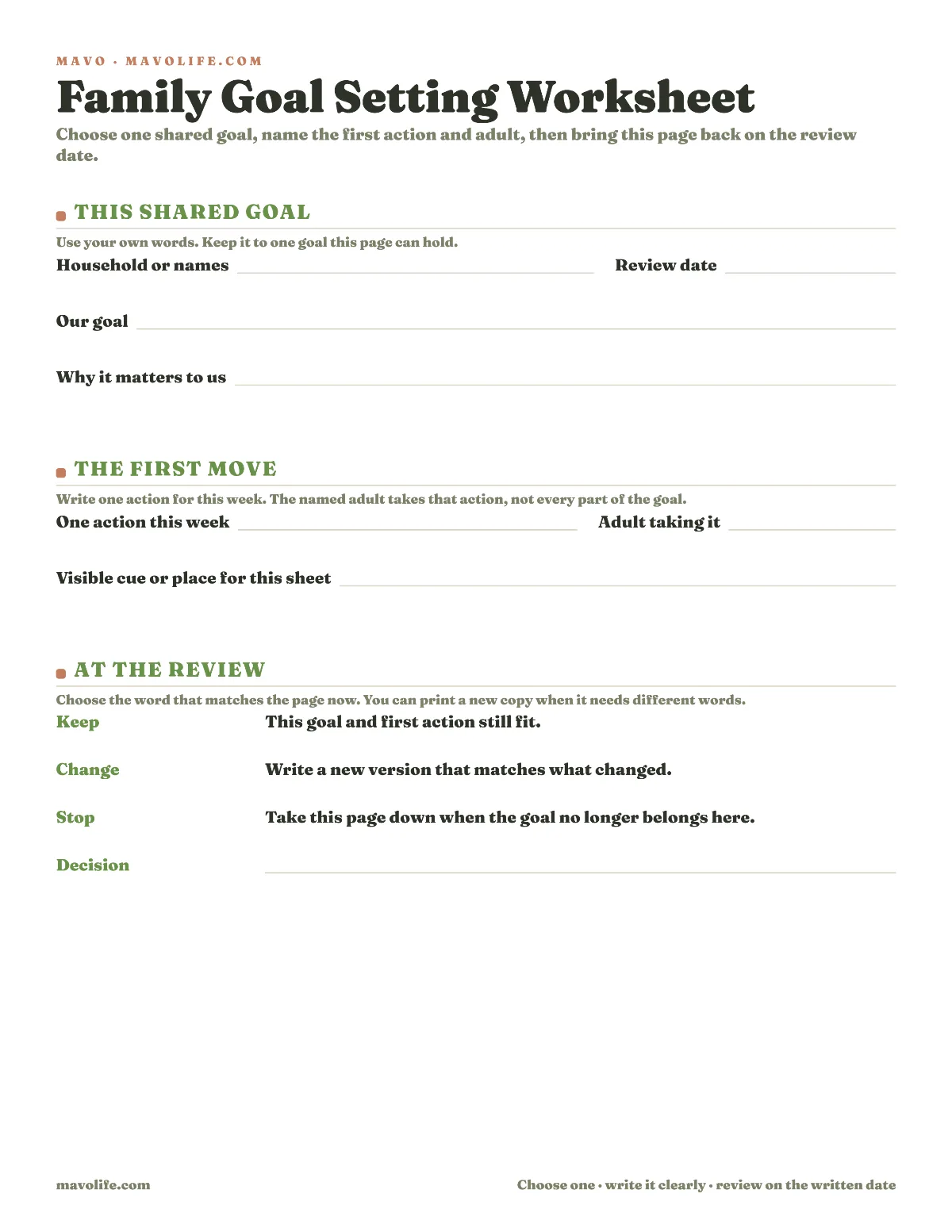
Download the fillable family goal setting worksheet (PDF)
The free family goal setting worksheet comes after the conversation, not before it. Type into the PDF if you want a clean copy, or print it blank and write the words together. The page records what the household chose and when it wants to return to that conversation.


Give the page a job outside the conversation
The PDF has eight independent fields: household or names, review date, goal, why it matters, first action, adult, visible cue, and decision. Fill in the first six while the discussion is still fresh. The last two tell the page where it belongs and what the next conversation needs to decide.
Do not use the worksheet as meeting notes. If the discussion needs a list of options, keep that list elsewhere. This page is the short version a person can glance at later without guessing which idea survived the conversation.
Choose a place that fits the moment you named. A page about the door can live near the door. A page about Sunday evening may fit beside the calendar. You aren't building a wall of goals. You are putting one sentence near the place where it becomes useful.
Make the visible cue concrete enough to find with your hands. If you write “by the door,” name the hook, bowl, or shelf. You don't need a new command center, and it won't help if no one looks there. If that spot already disappears beneath coats or papers, that's useful information: move the page until the sentence points to a place people can actually notice on the ordinary day you chose.
Let the next conversation start with the page
The review date is not there to turn the goal into a permanent agreement. It gives the household a way to begin the next conversation without starting from zero. Read the sentence, then use the decision field as a prompt: keep the goal, change the words, or stop because the moment has passed.
If the larger question is about the coming week's commitments, use the weekly family meeting agenda for that work. The worksheet can arrive at that meeting as one small piece of context, rather than trying to become the agenda.
For a deeper look at the remembering that often sits behind a vague “we should,” read the default parent. The next useful step is a future moment your household can name, followed by one thing to try before you talk again.