The mental load · July 10, 2026 · 7 min read
Weekly family meeting agenda that shares the load
A weekly family meeting agenda that keeps the mental load shared: review the week, assign an owner to each commitment, and offload what lives in one head.

Before a weekly family meeting starts, write down the four ways an agenda item is allowed to end: understood, owned, given a decision date, or parked where everyone can find it. If an item finishes in none of those states, the family discussed it but didn't move it.
That is the real job of the meeting. It turns scattered calendar entries, open questions, meal decisions, and half-made handoffs into a week the family can act on. The agenda below is built around those outcomes, so the meeting doesn't depend on one person remembering everything or translating every vague agreement afterward.
Fifteen minutes, not a corporate standup
Fifteen minutes is a useful starting limit, not a test you have to pass. A family with a complicated week may need longer, while a household with a stable routine may finish in ten. The limit works because it forces the meeting to handle the week ahead instead of absorbing every household disagreement.
Three patterns make the meeting less useful:
- The agenda expands. A review of next week's logistics becomes a long argument about an unrelated household problem.
- One person supplies all the information. Everyone attends, but the person who already carries the schedule also prepares it, reads it, and records every decision.
- Discussion substitutes for an outcome. The family notices Thursday's conflict and leaves it as “we'll figure it out.”
A fixed agenda contains those problems. Keep unrelated issues in the parking lot, rotate the person who runs the page, and don't close an item until its next state is clear. Sunday works for many families because the week is still ahead, but the best slot is the one your household can repeat.
The need for a shared review isn't evenly felt. In a Pew Research Center survey, 64% of mothers in two-parent households said they did more than their partner to manage children's schedules and activities. Fathers were more likely to describe that work as equal: 41% did, compared with 31% of mothers. A meeting cannot settle every question about fairness, but it can make the coming week's commitments and assignments visible enough to discuss.
The agenda, section by section
This meeting maintains a shared view of the week; it cannot reveal work that never reaches the agenda. If much of the household load is still invisible, use a mental load checklist once to inventory it, then bring the time-sensitive pieces into the weekly meeting.
Fill in this agenda on a computer, or print a stack and keep it nearby. Reusing the sections saves setup, while the contents change with the week.
If the current week also lives on a physical wall, the family command center ideas guide includes a layout map and a separate reset sheet for that space.
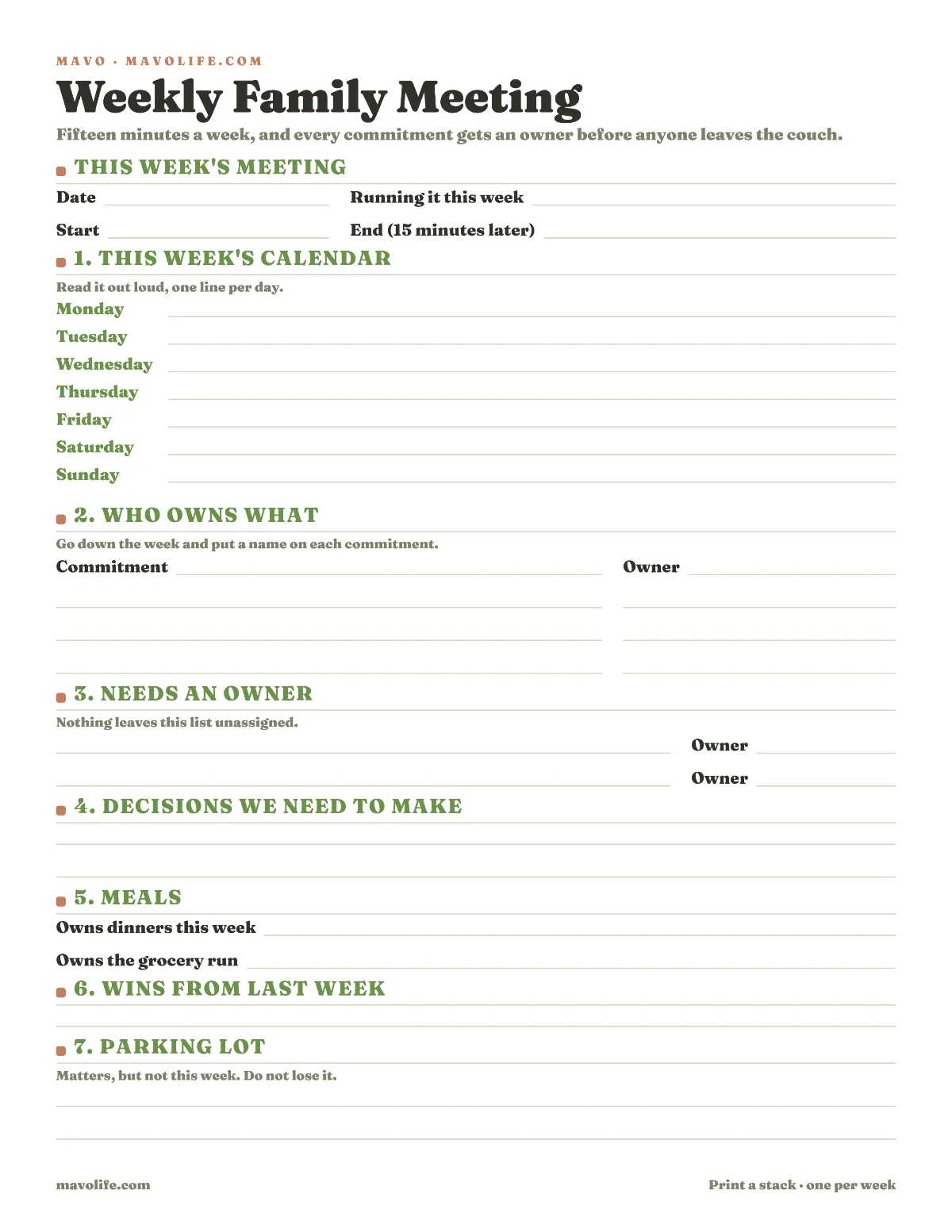
Download the printable meeting agenda (PDF)
A few notes on the sections that do the real work:
- Who owns what. Read the week out loud off the calendar you already keep, one day at a time. Every commitment it turns up gets a line and a name, and each person should be able to ask what an entry means, what it requires, and whether a collision is hiding beside it. A line still holding a blank owner at the end needs a name, a decision date, or an explicit choice to cancel. “We'll see” is not coverage.
- Decisions we need to make. The camp deposit, whether to say yes to the birthday party that collides with the game, who's booking the sitter. Small standing decisions pile up when there's no regular place to make them, so each one gets a decide-by date before the meeting moves on.
- Meals. Decide who is handling the meal plan and who is handling the grocery run. If the week needs a night-by-night plan, use weeknight meal planning around activities outside the meeting rather than building it from scratch here.
- Wins from last week. Keep this brief and specific. It gives children and adults a place to notice what worked, not only what still needs attention.
- Parking lot. Write down an important issue that does not need to consume this meeting, along with when it will be revisited. Parking is useful only if the item has a return route.
Put a name on every commitment
Reviewing a commitment tells the family it exists. Naming an owner tells everyone who is taking the next action.
Go line by line. “Thursday pickup” needs a person, not “we'll work it out.” So does the team snack, the permission slip, and the sitter call. Some weeks will be uneven because capacity is uneven. The meeting's contribution is not proof of fairness; it is a visible assignment that the family can question and change before the week begins.
An owner also needs enough context to act. If Alex owns the game, does that include pickup, uniform, water bottle, and arrival time, or only the drive there? Clarify the handoff while everyone is present. Otherwise the name can hide a second layer of unassigned preparation.
This is also where handing off a whole domain beats handing off one errand. "You own weeknight dinners this month" moves more load than "can you cook Tuesday," because the remembering moves with it. If you want to go deeper there, handing your partner whole domains is its own piece.
In Mavo, an event or task can carry an owner. The shared calendar shows what is covered and what still needs one, so the assignments remain visible after the meeting. That status shows who is responsible for the item; it does not judge whether the week's total split is fair.
Let the weekly digest tee up the meeting
A meeting cannot work from information nobody gathered. Keep a shared note through the week, mark open items on the printed agenda, or use the family calendar as the source list. The purpose of preparation is to bring the same facts into the room, not to make one person produce a polished agenda.
With Plus, Mavo's weekly family digest includes the events that still need an owner. That list can fill in the owner column, but it is not a complete meeting agenda. Decisions, meals, wins, and parked topics still come from the family.
If a covered event later loses its owner, Mavo can alert the family. For eligible events happening today or tomorrow, one follow-up can also go to an owner who has not confirmed after the grace period. Those safeguards help surface a changed assignment; they do not replace a conversation about capacity or resolve every open task.
When to meet, who runs it, and keeping kids in it
How long, and when?
Start with fifteen minutes, once a week. Sunday evening puts the review close to the week ahead; Friday afternoon lets a family close one week and prepare for the next. Choose based on when the people and the calendar can be in the same place. If the meeting repeatedly runs long, move non-urgent discussion to the parking lot instead of treating the time limit as the problem.
Who runs it?
Rotate the role deliberately. The facilitator reads the sections, watches the time, and records outcomes; they do not become the owner of every item raised. An older child can run the calendar readout while an adult handles decisions that need adult judgment.
How do we keep kids involved without it becoming a lecture?
Give them information to contribute and decisions they can actually influence. They can read their activities, name something they need, choose between two workable options, and add a win. If a topic does not involve them and will turn into a long adult negotiation, park it for later rather than making them sit through it.
If chores are part of their week, assign them here too. A printed chart from the free chore chart maker at kid height keeps those assignments available after the meeting.
If the family wants one seasonal plan to choose together, the fall family bucket list keeps the ideas, dates, and weather backups on one printable page.
When one shared intention needs a place between meetings, the family goal setting worksheet holds the goal, one first action, and the date to return to it.
When the conversation is about the words your household wants to carry across many plans, the family mission statement template keeps those words, a short draft, and one date to read it again.
Before you finish, scan every line once. It should now be understood, owned, dated for a decision, or parked with a return date. That final pass is what turns a completed agenda into a usable week.