The mental load · August 20, 2026 · 6 min read
Chore and Allowance Chart: Free Fillable PDF
Download a free chore and allowance chart to write your family's own task, amount or points, timing, completion meaning, and review date.

A checkmark can carry a surprising amount of guesswork. Does it mean the task is done, or does it mean the row needs a conversation later? Add an amount or point value beside that mark and the unspoken part of the agreement becomes harder to see.
Start with one arrangement that needs a shared note. Keep the wording your household already uses. A short page gives the agreement room to stay visible instead of turning into a list of everything a household has to do.
Write the agreement before the marks begin
A chore and allowance chart is useful when it carries the agreement along with the marks. It won't choose chores, rates, rewards, or rules. That's for your family to decide.
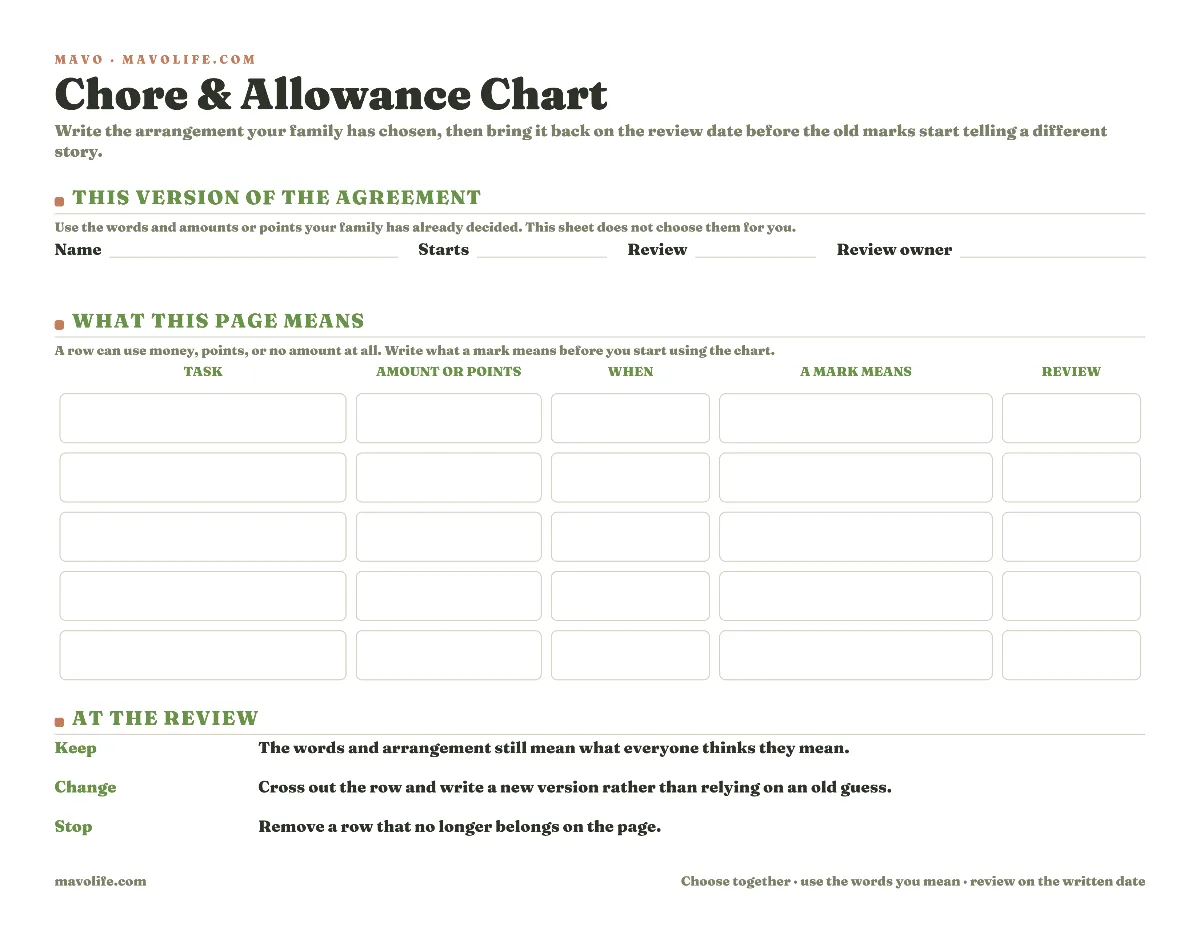
For each row, settle four small things:
- Task: Use the words your household already uses for the work or agreement.
- Amount or points: Write an amount, a point value, or leave the field empty when money and points are not part of that row.
- When: Name the time or condition that applies to this version of the page.
- A mark means: Write the shared meaning, such as finished or ready to discuss. Use the words that are true in your house.
That last field is why this printable is different from a blank grid. A mark can be satisfying, but it is only useful when the people looking at it read it the same way.
Download the free chore and allowance chart
Download the fillable chore and allowance chart (PDF)
The landscape PDF has five open rows. Type into it before printing, or print a blank copy and use a pen. It is free and doesn't require an account. You don't need to fill every row for the page to be useful.

Fill in the terms during a short conversation
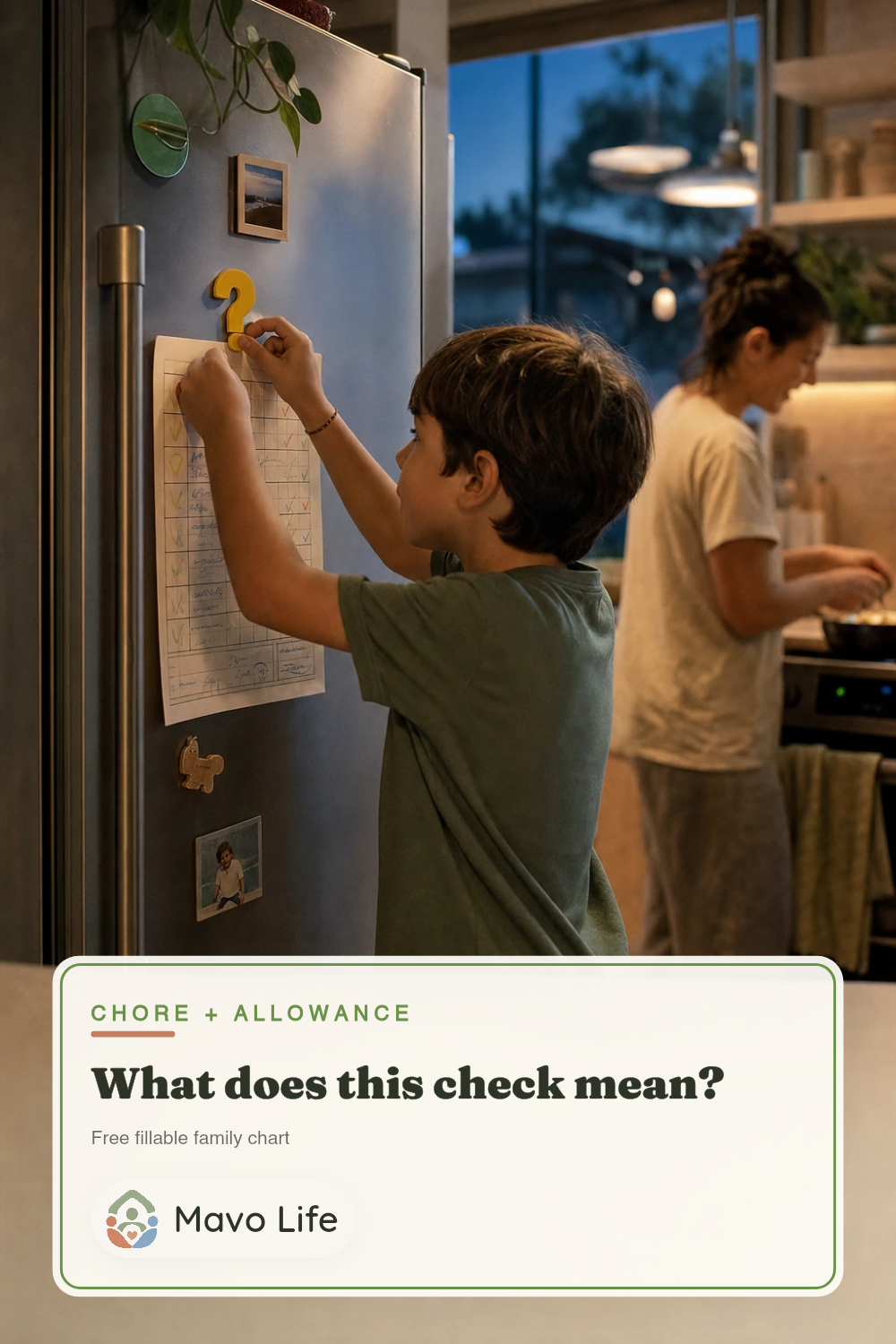
This page works best when the household fills it in during one short conversation, then puts it where the agreement belongs. A kitchen counter before the week starts can be enough. The refrigerator works when that's where the page will be used.
Write the household or person's name, a start date, a review date, and the person who will bring the page back. That person isn't responsible for every row. They only need to say, "Let's look at this version again" when the written date arrives.
Keep the five rows for the agreements that need a shared reminder. You don't need to list every small contribution around the house. If the page needs a new line every day, it's already asking more of the paper than paper can do well.
Start with one real row
The chart is intentionally blank because a family shouldn't have to erase somebody else's idea of what belongs there. But begin with one complete row before adding the rest. Here is a clearly illustrative shape, not a recommended task or allowance rule:
| Part of the row | An example of specific wording |
|---|---|
| Task | Put shoes on the rack |
| Amount or points | The value this family already chose, or leave it empty |
| When | School mornings |
| A mark means | Shoes are on the rack before leaving |
| Review | Keep or change the row on Sunday |
The point is not the particular shoe row. A reader can see what the mark means without guessing. Leave the amount field blank when your agreement has no amount or points. The page should match the arrangement you made, rather than squeeze every row into a money rule.
Use the same ordinary language you use at home. A person reading the chart shouldn't need to decode a polished label or remember a conversation that happened somewhere else. If the explanation needs a long note, keep the note with the person teaching the task and let the chart hold the short shared meaning.
Make each check mean one thing
A check beside a task can feel complete even when nobody has agreed on what it records. On this
chart, the field after When is the part that gives the mark its job. Write the outcome that makes
the row count for your household. Shoes on the rack before leaving is clearer than shoes done,
because the paper no longer has to carry the missing explanation.
If the arrangement has a condition that matters, put that condition in the same row. A task that must happen before school reads differently from the same task that happens sometime that day. The smallest useful agreement is the one a household can say aloud without adding a second rule from memory.
Let the amount or points field stay honest
The amount-or-points space is there for a term your household has already chosen. You can leave it empty when the agreement has no amount or points. A blank cell isn't unfinished; it can be the most accurate version of the row.
Don't add a number merely to make the chart look complete. The sheet won't suggest a rate, a reward, or what a completed task should be worth. It gives an existing choice a place beside the words that explain it. That distinction matters when a checkmark and a number would otherwise look like a rule without anyone having written the rule down.
Choose the size that fits the situation
For one child or one agreement
Use a single complete row and leave the rest blank. A smaller page is useful when the household is trying one arrangement and wants to revisit the language later. It doesn't need to become a list of every recurring job, and it doesn't need a point value just because the field is available.
For several children or several agreements
Give each agreement its own row, especially when the wording or completion meaning differs. If the page starts to need every person's weekly tasks, it has moved into the job of a household chore list or a day-by-day chart. Keeping the agreement sheet narrow helps the actual point of discussion stay in view.
Let the review change the terms
The review date is a chance to read one row and decide whether its words still match the agreement. It doesn't require a household meeting about every chore. The page can be unchanged after that conversation, or one line can get a more useful phrase.
Give each row one of these outcomes:
- Keep it when the wording still matches what the household means.
- Change it when the task, amount-or-points term, timing, or checkmark meaning has shifted.
- Stop it when the arrangement no longer belongs on the page.
If several lines change, print another copy. A fresh sheet lets the new words do their job without forcing anyone to interpret arrows, squeezed notes, or a crossed-out amount.
Choose a different page when the shape is different
Use the Chore Chart Maker when a weekly, day-by-day grid is the useful part. It is built for a changing schedule. Don't keep this agreement sheet and a separate weekly chart current unless each page has a distinct job.
For a household-wide list of standing work, including adult jobs, the family chore list template groups recurring tasks by person and gives that list its own review date. This chart stays narrower: it holds the terms around one family-defined chore and allowance arrangement.
The mental load guides can help when the disagreement is bigger than a small chart and the household needs to name who notices or follows up on a whole area of work.
Print the sheet and write one row. Circle the review date. When the date arrives, take the page down and replace any line that no longer matches the agreement.