Hosting & celebrations · July 26, 2026 · 7 min read
A Sleepover Scavenger Hunt That Fits Your House
Plan a six-stop sleepover scavenger hunt with free printable clue cards and a host route map you can customize for your home.
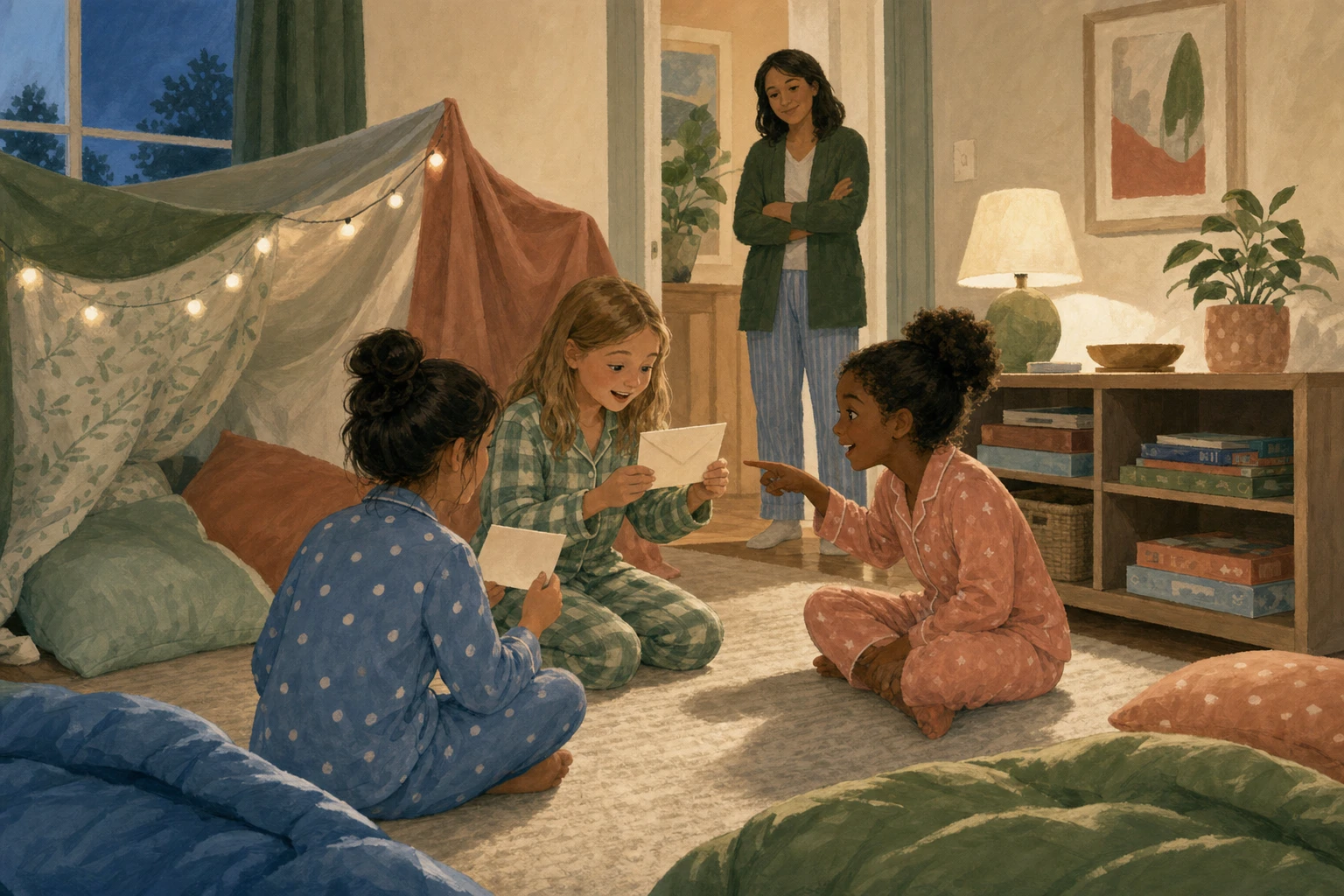
Print the six clue cards, then choose where they will lead inside your home. The private host map keeps the answers and hiding places together while the group gets only the clue in front of them.
That makes this sleepover scavenger hunt cooperative and easy to adapt. Everyone follows one route, and you don't have to depend on a fixed riddle about a printer or room your house doesn't have.
Choose the finish before the first clue
Start with the last place you want the group to reach. That final location doesn't need a prize or a dramatic reveal. You can simply announce that the hunt is complete there. If you add a completion note at the finish, treat it as an extra note rather than one of the six clue cards.
Now work backward. If the final answer is the bookshelf, clue 6 should point to the bookshelf. Hide clue 6 at the answer to clue 5. Then decide where clue 5 is hidden by choosing the answer to clue 4. Continue until every card has both an answer and a hiding place.
The backward method prevents the classic setup mistake: hiding a card in the same place its clue describes. If clue 6 says, “Find the place where stories stand shoulder to shoulder,” clue 6 belongs at stop 5. The bookshelf is the final answer, not the place where that card waits.
Six stops are enough to feel like a real hunt without asking the host to spend the evening writing riddles. Use fewer when the available part of the home is small. A short route that works beats a long route with two weak clues and a mysterious missing card.
Pick places the host is happy to use
Walk the route once before you write. Choose ordinary indoor locations that are easy for the group to recognize and that the adult host wants included in the activity.
Good answers are specific enough to point toward one place:
- the bookshelf in the living room
- the basket holding extra blankets
- the table where games are stacked
- the coat hooks by the door
- the couch with the striped pillow
- the shelf holding family photos
“Something soft” could mean half the house at a sleepover. “The basket where the extra blankets wait” gives the group a fair destination.
The hunt stays indoors. An adult chooses every stop before play and keeps anything outside the planned route out of the game. The host map is private, so it can hold the exact answer path while the clue cards show only what the players should solve.
Write clues that sound like your home
You don't need to rhyme. A clean clue that points to one familiar detail is more satisfying than a rhyme that could describe three rooms.
Try one of these shapes:
- Describe what the place does. “I hold stories, but I never tell them out loud.”
- Name a detail without naming the object. “Look for four wooden legs beside the window.”
- Use a gentle comparison. “Your next clue is where coats wait for their next trip.”
- Point to a shared memory without inventing a secret. “Find the place where we chose tonight's first game.”
- Give a two-part filter. “Find something soft that holds the blanket nobody picked.”
Read every clue as if you hadn't written it. If two answers seem possible, add one detail. If the answer appears in the clue, swap it for what the place does or what sits nearby.
A laundry basket is unusually cooperative in this kind of game. Its shape is recognizable, and it has no ambition to become a poetic metaphor. Let a few clues be that easy. The group should spend more time moving and laughing than debating the author's intent.
One group usually works better than a race
For a small sleepover, let everyone solve the same chain together. One person reads the first clue. Someone else can carry the found card, and the reader role moves around as the hunt continues.
If several children want a turn, write the team name on the route map and put all the names on the starting card. You can also number the cards so the group can tell when one was skipped.
For two groups, make two copies and use different routes. Start them in different parts of the planned indoor space. A duplicate route sends both groups toward the same hiding place, which turns a clue game into a sprint for paper.
Mixed ages don't need separate hunts. Give the younger player the card and let an older player read it. A clue that depends on spelling tricks or private knowledge can leave one child standing beside the action, so favor details everyone can see.

Download the host map and clue cards
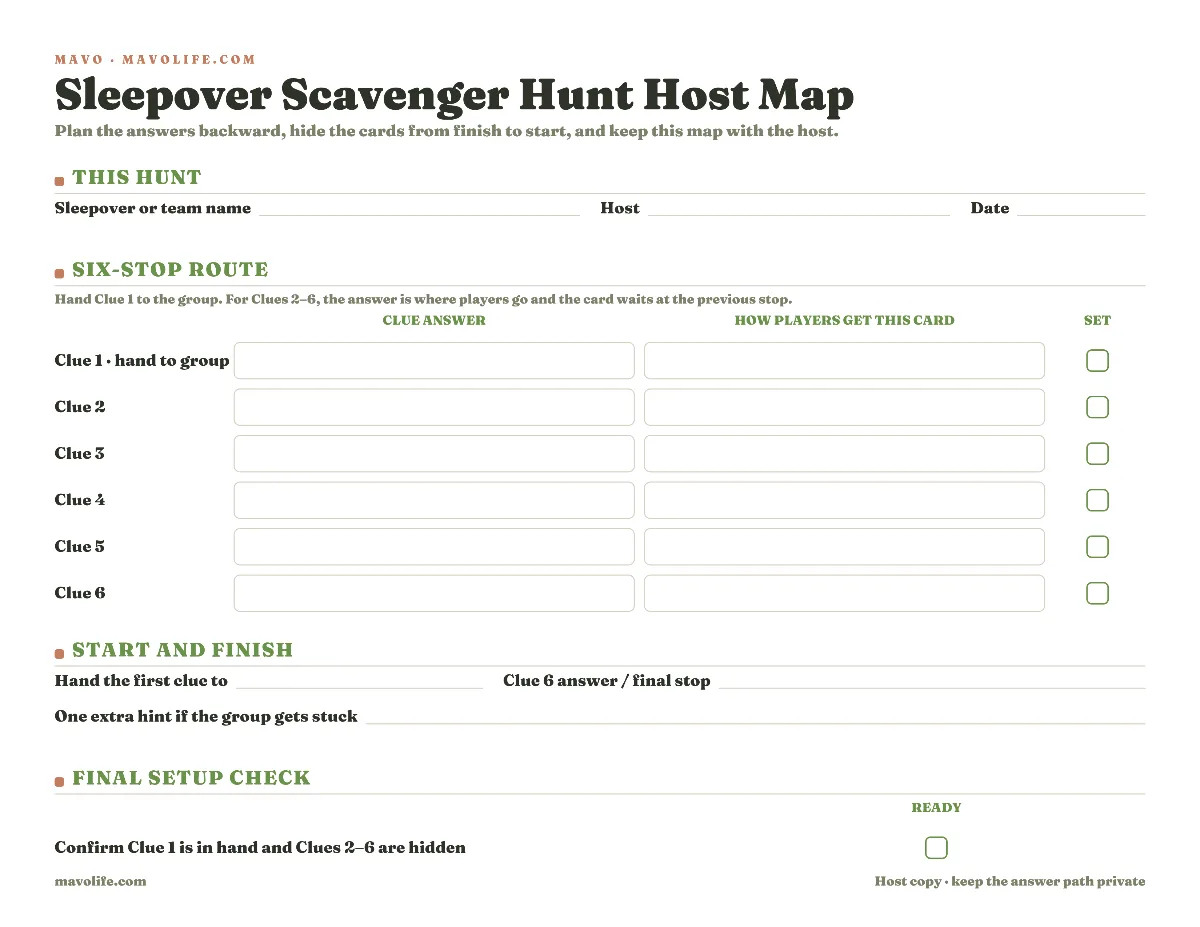
Download the fillable sleepover scavenger hunt host route map (PDF)
Keep this page with the adult setting up the hunt. Write the answer for each clue first. Mark Clue 1 as the card you will hand to the group, then record where Clues 2 through 6 will be hidden. The checkbox is for setup, not for the players.
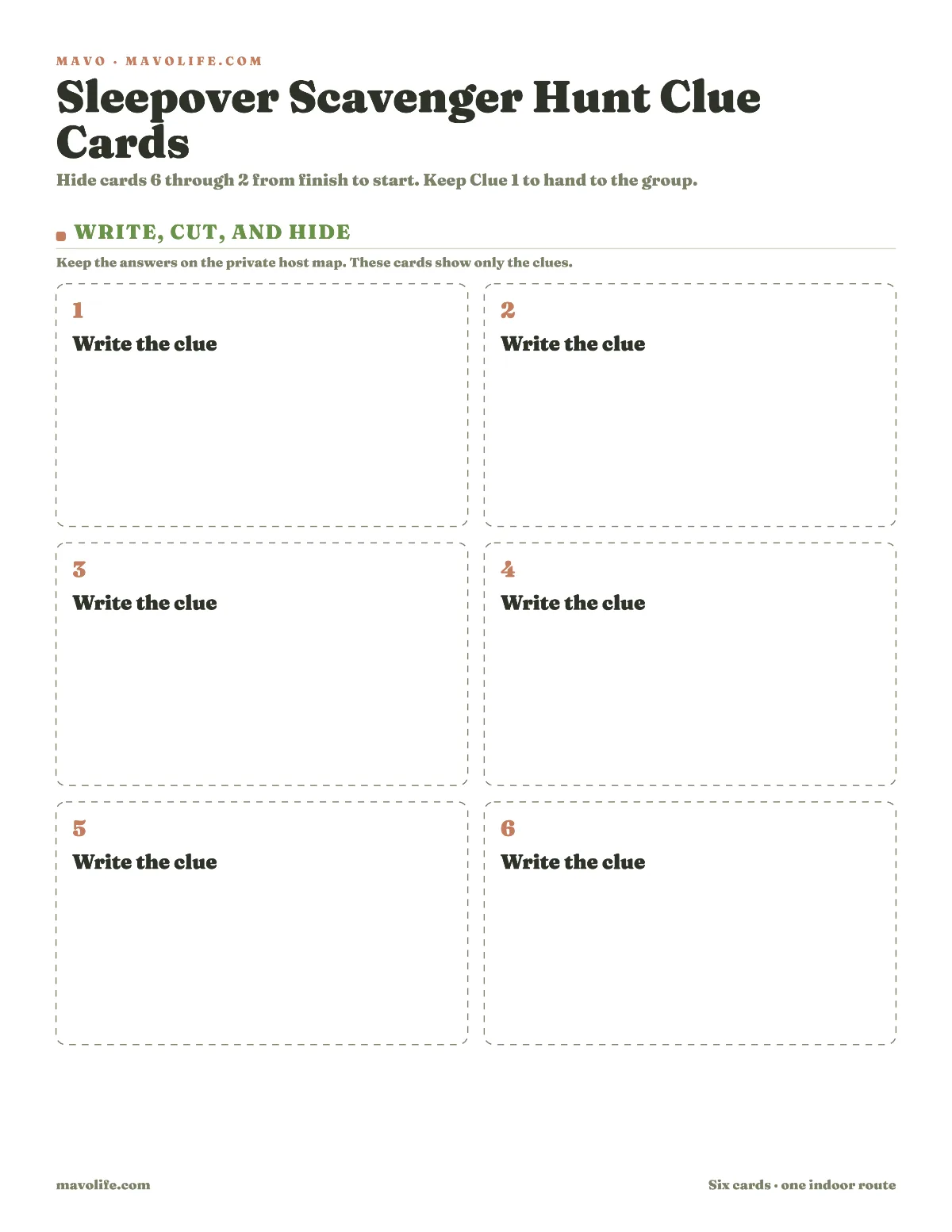
Download the printable sleepover scavenger hunt clue cards (PDF)
Print the clue-card page and cut along the dashed borders. Write one clue on each card. The cards deliberately don't print a hiding-location field. That answer belongs on the private host map, where it can't give the route away.
Both downloads work without an account. You can type into the route map before printing or write on paper. The clue cards leave their main writing area blank for a pen or marker.
Set up from the finish back to the start
Lay the six cards in order on the table. Take clue 6 to the hiding place written on its row and check it off. Then hide clues 5, 4, 3, and 2 in that order. Clue 1 stays in your hand because you give it directly to the group.
Working backward matters here too. When you reach the starting card, every later clue is already waiting. You won't have to remember whether card four is under the blanket basket or whether the basket is card four's answer.
Keep the host map with you while the group plays. If a clue stalls, you can offer one extra detail without announcing the answer. If a card moved during setup, the map shows where it was supposed to be.
Before handing over the first clue, confirm that Clue 1 is in your hand and Clues 2 through 6 are hidden. The tiny stack on the table should be empty. An abandoned clue card beside the scissors has ended many imaginary adventures before they began.
Adjust the hunt to the home and the group
In a small home
Use four stops and make the clues more specific. The same room can appear twice when the answers are different objects, but don't use the same exact hiding place. A couch cushion and a nearby game shelf can feel like separate discoveries even when they're only a few steps apart.
With several children
Rotate jobs instead of adding more clues. One child reads while another carries the card. A third can give the group's final answer before anyone moves. Switch roles at the next stop.
With a wide age range
Use visible household details instead of wordplay. A younger child can spot the striped pillow while an older child works out why the clue mentions “the seat with one bright stripe.”
When the group is stuck
Give a location category first: “It's in the living room.” If that isn't enough, add one physical detail. The goal isn't to protect the riddle at all costs. It's to get the group moving together again.
Fix the clue that doesn't work
Most weak clues fail in one of three ways.
Too broad: “Find something that holds things.” Add the object type or room: “Find the woven thing in the living room that holds extra blankets.”
Too revealing: “Look under the striped pillow.” Keep the useful detail but hide the noun: “Your next card is under the soft square with one bright stripe.”
Too dependent on one child: “Go where Ava left her book.” Replace private knowledge with a detail everyone can verify: “Go where the green book is standing beside the lamp.”
Do one final walk with the cards in place. Read each clue from the previous location and make sure it points forward. Then put the host map out of sight and hand the group card one.
If you're also working out the information and packing side of the night, the first sleepover checklist handles the host-and-guest handoff. This page can stay focused on the game.
The family hosting collection has more plans and printables for the parts around the activity.
Choose the final location first. The rest of the route gets much easier once you know where everyone is going.