Hosting & celebrations · September 20, 2026 · 20 min read
Party Games for Teens: 6 Tabletop Games to Print
Find six tabletop party games for teens with original drawing prompts, caption challenges, fictional word games, and free printable rules and player materials.
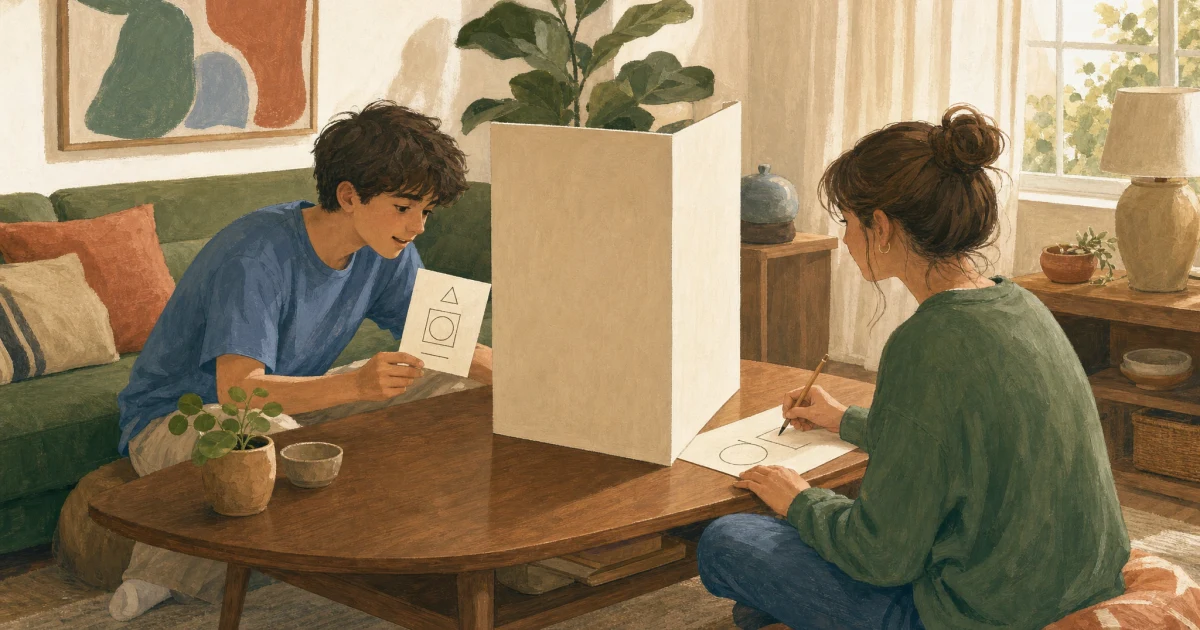
Eight-Line Draw limits a whole scene to eight straight lines. Make-Believe Dictionary asks you to invent a convincing meaning for an imaginary word. These six tabletop party games for teens give everyone something to draw, describe, write or guess.
Each game has a free PDF with rules and the prompts or player sheets included. You'll need pencils, ordinary paper and, for several games, scissors or a timer. Print the pages for the game you choose and write by hand; these aren't fillable PDFs.
Pick the kind of round you want
- Eight-Line Draw: Draw a scene under a strict line limit while the rest of the table guesses.
- Screen Sketch: Describe a hidden picture and compare the drawings made from those directions.
- Caption Match: Invent captions for abstract pictures, then match other captions to their pictures.
- Make-Believe Dictionary: Invent a meaning for a made-up word and try to recognize the supplied meaning.
- Find the Sorting Rule: Test a few shape cards, then predict which others fit a hidden rule.
- One-of-a-Kind Answers: Write category answers at the same time and see which ones nobody else chose.
Play with 3–12 people using the grouping described in each game. Anyone can watch or pass a turn. When seven people need teams, make two pairs and one trio.
Print single-sided on US Letter paper at actual size. A4 users can choose their printer's fit setting. Keep hidden cards and answer keys with the person running the round. The closed previews below show the actual pages, including any secret material; check their labels before opening them.
1. Eight-Line Draw
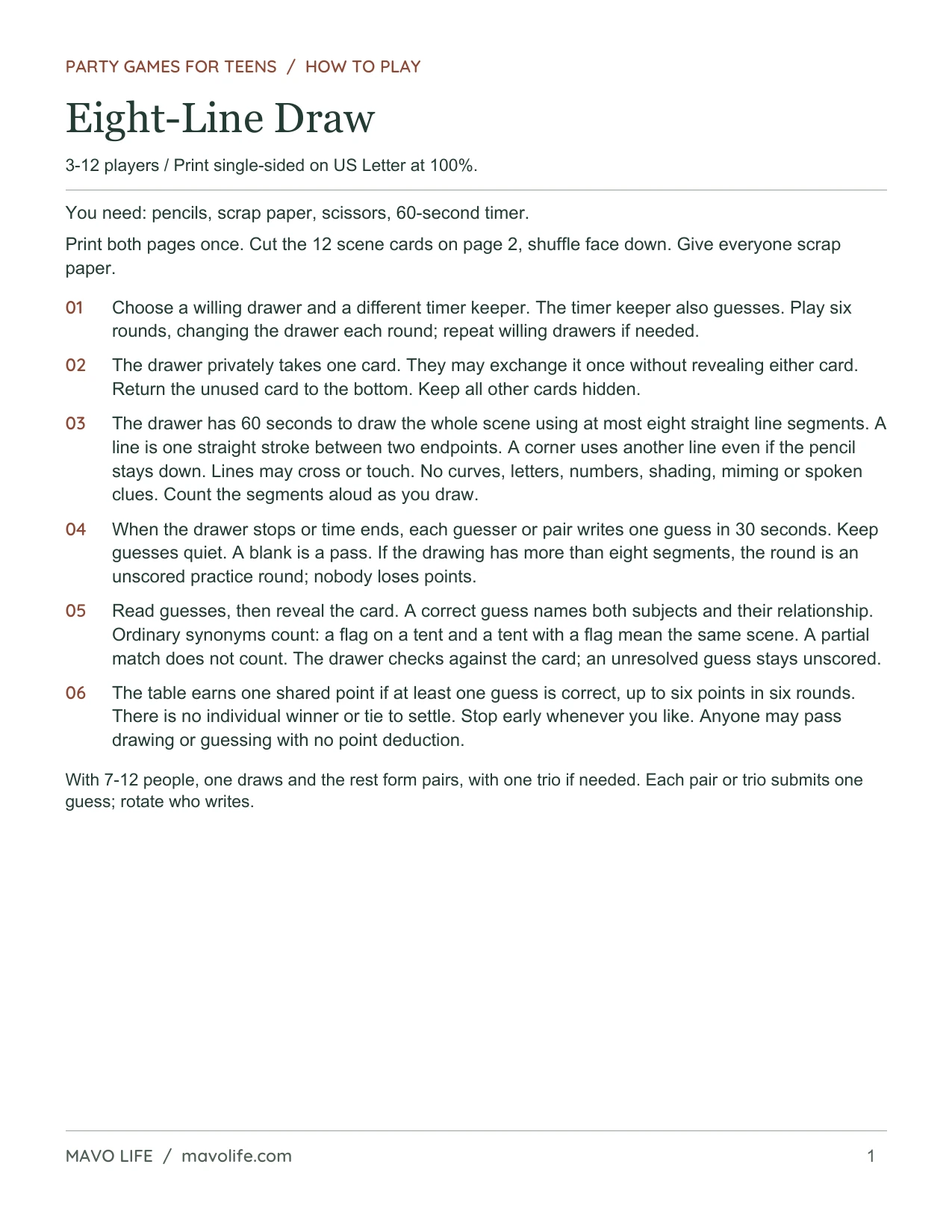
Draw the scene on a secret card with at most eight straight lines. Everyone else writes one guess.
Download Eight-Line Draw: rules and game material (PDF)
Print: both pages once. Cut the 12 scene cards on page 2, shuffle face down. Give everyone scrap paper.
Bring: pencils, scrap paper, scissors, 60-second timer.
- Choose a willing drawer and a different timer keeper. The timer keeper also guesses. Play six rounds, changing the drawer each round; repeat willing drawers if needed.
- The drawer privately takes one card. They may exchange it once without revealing either card. Return the unused card to the bottom. Keep all other cards hidden.
- The drawer has 60 seconds to draw the whole scene using at most eight straight line segments. A line is one straight stroke between two endpoints. A corner uses another line even if the pencil stays down. Lines may cross or touch. No curves, letters, numbers, shading, miming or spoken clues. Count the segments aloud as you draw.
- When the drawer stops or time ends, each guesser or pair writes one guess in 30 seconds. Keep guesses quiet. A blank is a pass. If the drawing has more than eight segments, the round is an unscored practice round; nobody loses points.
- Read guesses, then reveal the card. A correct guess names both subjects and their relationship. Ordinary synonyms count: a flag on a tent and a tent with a flag mean the same scene. A partial match does not count. The drawer checks against the card; an unresolved guess stays unscored.
- The table earns one shared point if at least one guess is correct, up to six points in six rounds. There is no individual winner or tie to settle. Stop early whenever you like. Anyone may pass drawing or guessing with no point deduction.
Practice round: Ana draws an arrow in three straight segments, then a separate triangle in three. Bo guesses "an arrow pointing at a triangle"; Cy writes "a tree." Six lines communicate both shapes and the relationship. Use this practice scene before shuffling the twelve different cards.
For a larger group: With 7-12 people, one draws and the rest form pairs, with one trio if needed. Each pair or trio submits one guess; rotate who writes.
Reveal the 12 secret scene prompts
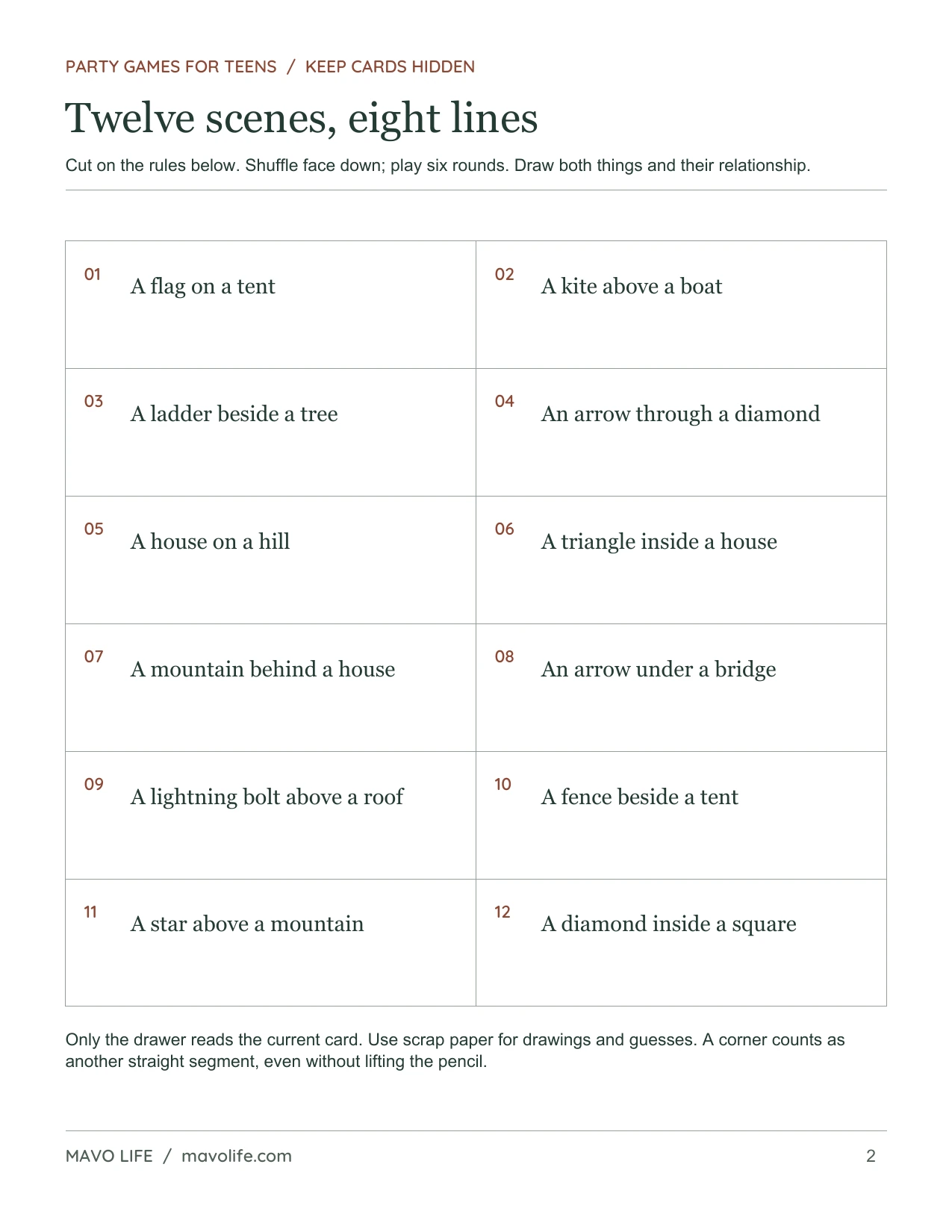
- A flag on a tent
- A kite above a boat
- A ladder beside a tree
- An arrow through a diamond
- A house on a hill
- A triangle inside a house
- A mountain behind a house
- An arrow under a bridge
- A lightning bolt above a roof
- A fence beside a tent
- A star above a mountain
- A diamond inside a square
Preview both pages, including secret scene cards
2. Screen Sketch
One person describes a hidden diagram while the others draw what they hear.
Download Screen Sketch: rules and game material (PDF)
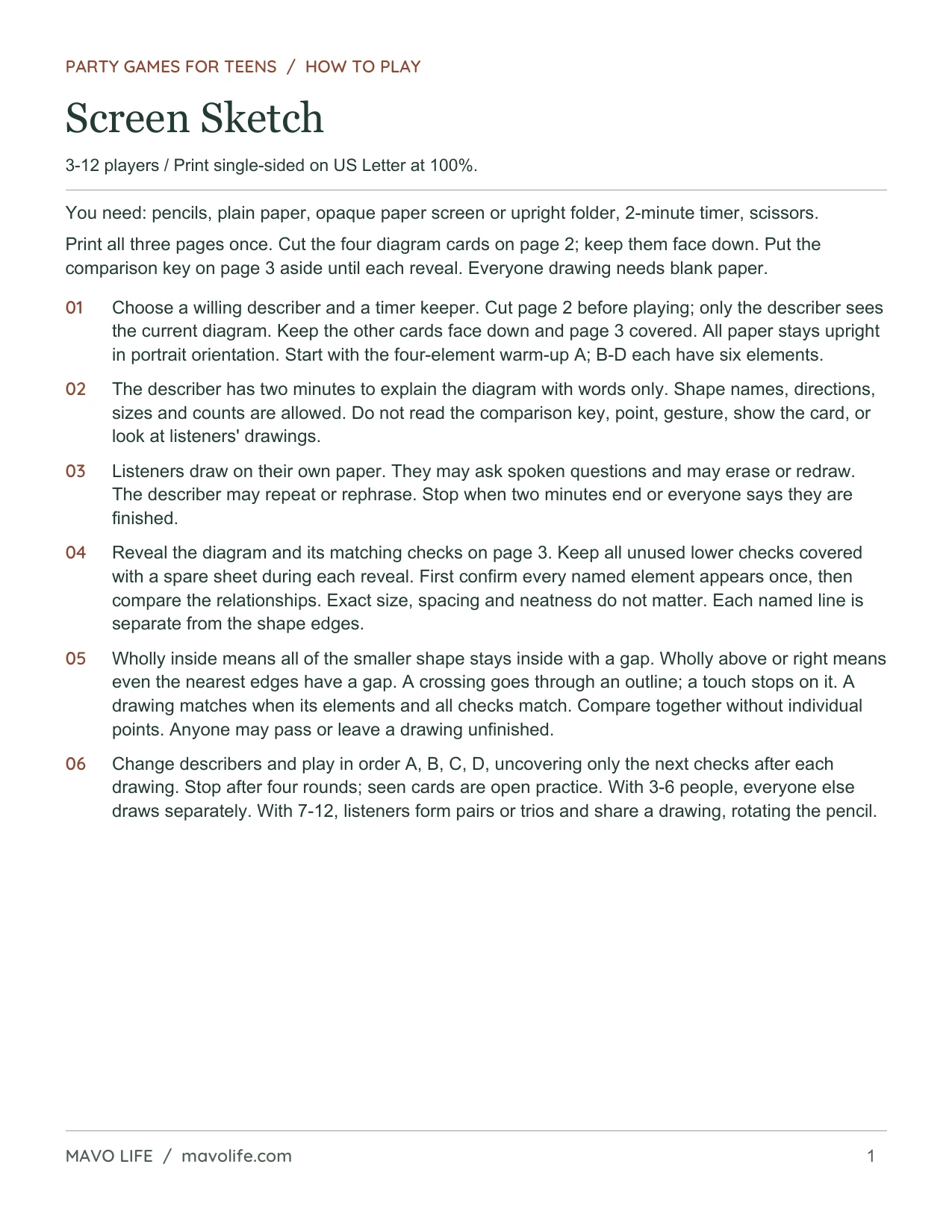
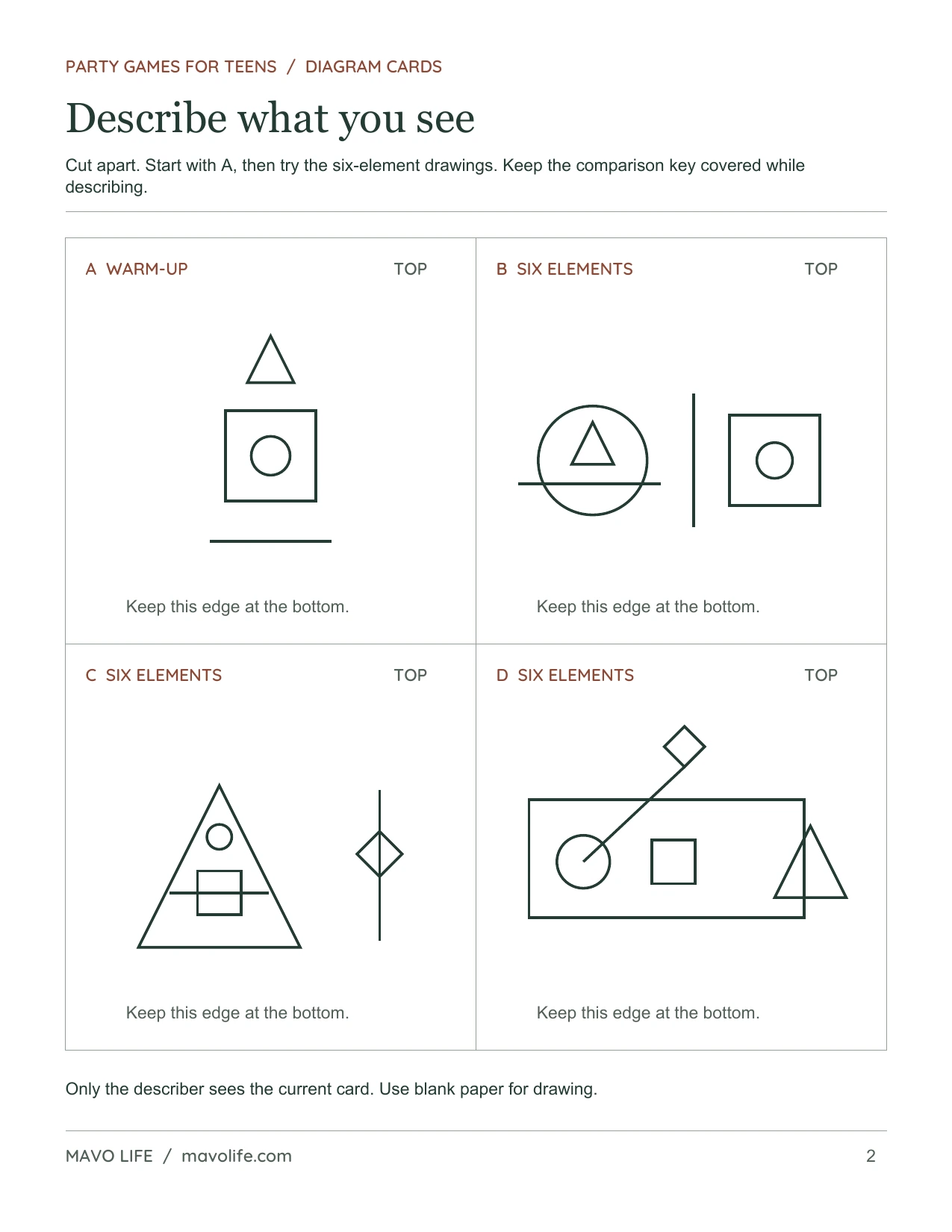
Print: all three pages once. Cut the four diagram cards on page 2; keep them face down. Put the comparison key on page 3 aside until each reveal. Everyone drawing needs blank paper.
Bring: pencils, plain paper, opaque paper screen or upright folder, 2-minute timer, scissors.
- Choose a willing describer and a timer keeper. Cut page 2 before playing; only the describer sees the current diagram. Keep the other cards face down and page 3 covered. All paper stays upright in portrait orientation. Start with the four-element warm-up A; B-D each have six elements.
- The describer has two minutes to explain the diagram with words only. Shape names, directions, sizes and counts are allowed. Do not read the comparison key, point, gesture, show the card, or look at listeners' drawings.
- Listeners draw on their own paper. They may ask spoken questions and may erase or redraw. The describer may repeat or rephrase. Stop when two minutes end or everyone says they are finished.
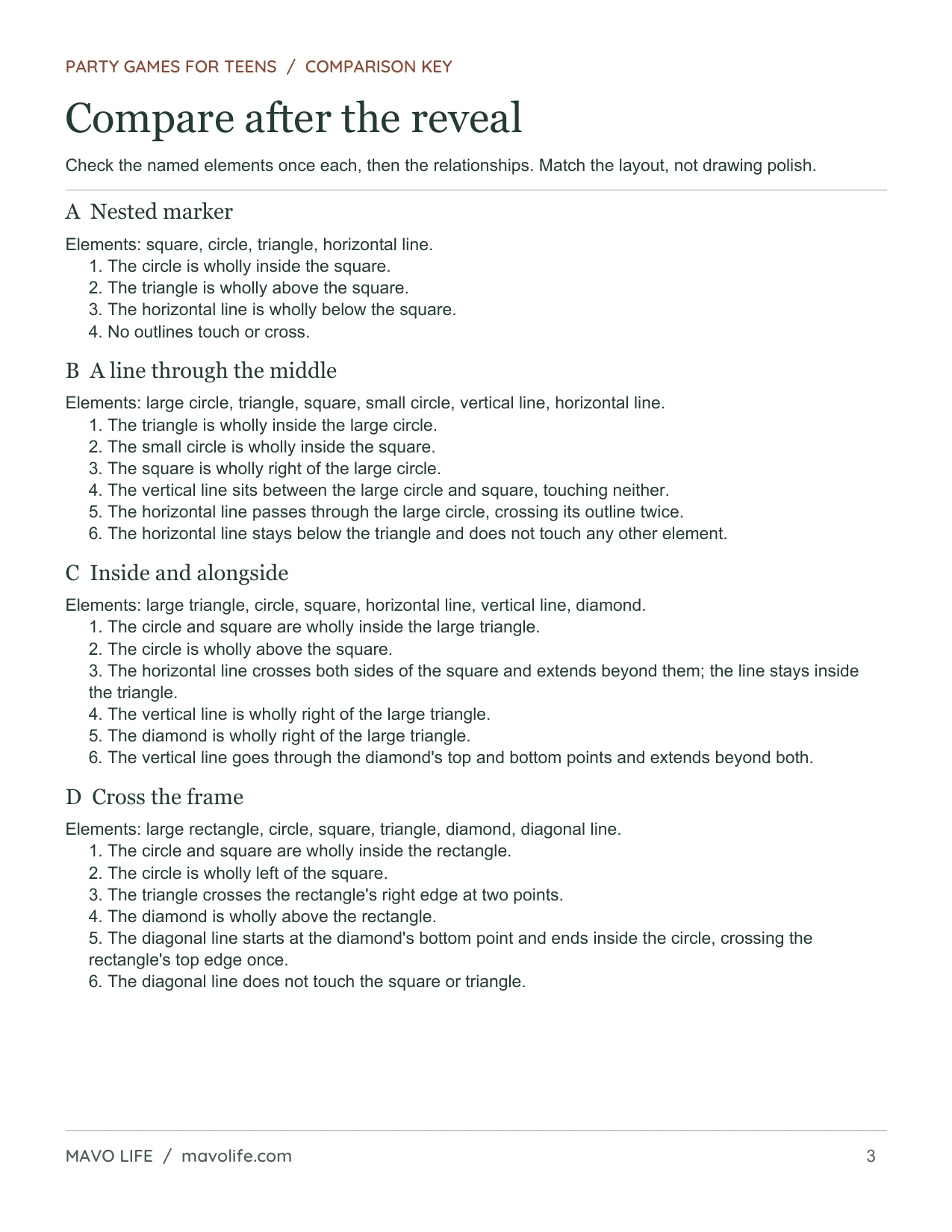
- Reveal the diagram and its matching checks on page 3. Keep all unused lower checks covered with a spare sheet during each reveal. First confirm every named element appears once, then compare the relationships. Exact size, spacing and neatness do not matter. Each named line is separate from the shape edges.
- Wholly inside means all of the smaller shape stays inside with a gap. Wholly above or right means even the nearest edges have a gap. A crossing goes through an outline; a touch stops on it. A drawing matches when its elements and all checks match. Compare together without individual points. Anyone may pass or leave a drawing unfinished.
- Change describers and play in order A, B, C, D, uncovering only the next checks after each drawing. Stop after four rounds; seen cards are open practice. With 3-6 people, everyone else draws separately. With 7-12, listeners form pairs or trios and share a drawing, rotating the pencil.
Warm-up example: For diagram A, Dev says "Draw a square. Put a circle fully inside it. Put a triangle above it with a gap. Draw a horizontal line below the square, also with a gap." Three listeners compare the four relationships after reveal.
Reveal all four diagram checks, including unused answers
A. Nested marker: The circle is wholly inside the square. The triangle is wholly above the square. The horizontal line is wholly below the square. No outlines touch or cross.
B. A line through the middle: The triangle is wholly inside the large circle. The small circle is wholly inside the square. The square is wholly right of the large circle. The vertical line sits between the large circle and square, touching neither. The horizontal line passes through the large circle, crossing its outline twice. The horizontal line stays below the triangle and does not touch any other element.
C. Inside and alongside: The circle and square are wholly inside the large triangle. The circle is wholly above the square. The horizontal line crosses both sides of the square and extends beyond them; the line stays inside the triangle. The vertical line is wholly right of the large triangle. The diamond is wholly right of the large triangle. The vertical line goes through the diamond's top and bottom points and extends beyond both.
D. Cross the frame: The circle and square are wholly inside the rectangle. The circle is wholly left of the square. The triangle crosses the rectangle's right edge at two points. The diamond is wholly above the rectangle. The diagonal line starts at the diamond's bottom point and ends inside the circle, crossing the rectangle's top edge once. The diagonal line does not touch the square or triangle.
Preview all three pages: hidden diagrams and comparison key included
3. Caption Match
Writers invent titles for secretly assigned abstract doodles; the table matches the titles back to the drawings.
Download Caption Match: rules and game material (PDF)
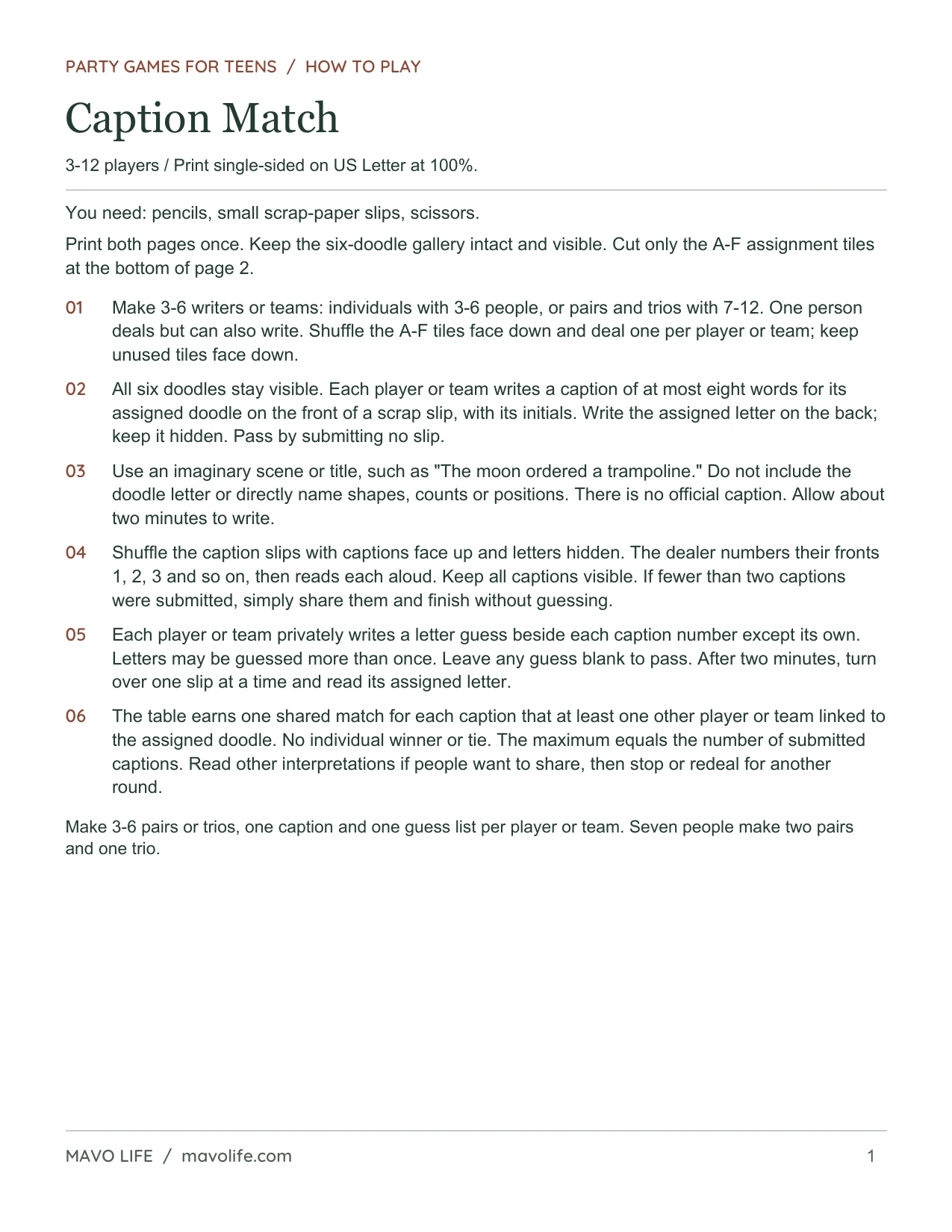
Print: both pages once. Keep the six-doodle gallery intact and visible. Cut only the A-F assignment tiles at the bottom of page 2.
Bring: pencils, small scrap-paper slips, scissors.
- Make 3-6 writers or teams: individuals with 3-6 people, or pairs and trios with 7-12. One person deals but can also write. Shuffle the A-F tiles face down and deal one per player or team; keep unused tiles face down.
- All six doodles stay visible. Each player or team writes a caption of at most eight words for its assigned doodle on the front of a scrap slip, with its initials. Write the assigned letter on the back; keep it hidden. Pass by submitting no slip.
- Use an imaginary scene or title, such as "The moon ordered a trampoline." Do not include the doodle letter or directly name shapes, counts or positions. There is no official caption. Allow about two minutes to write.
- Shuffle the caption slips with captions face up and letters hidden. The dealer numbers their fronts 1, 2, 3 and so on, then reads each aloud. Keep all captions visible. If fewer than two captions were submitted, simply share them and finish without guessing.
- Each player or team privately writes a letter guess beside each caption number except its own. Letters may be guessed more than once. Leave any guess blank to pass. After two minutes, turn over one slip at a time and read its assigned letter.
- The table earns one shared match for each caption that at least one other player or team linked to the assigned doodle. No individual winner or tie. The maximum equals the number of submitted captions. Read other interpretations if people want to share, then stop or redeal for another round.
Example: Eli receives A and writes "A small boat applying for flight school." Farah guesses A; Gia guesses C. Turning over Eli's slip reveals A, so the table earns one shared match for that caption.
Read descriptions of the six doodles
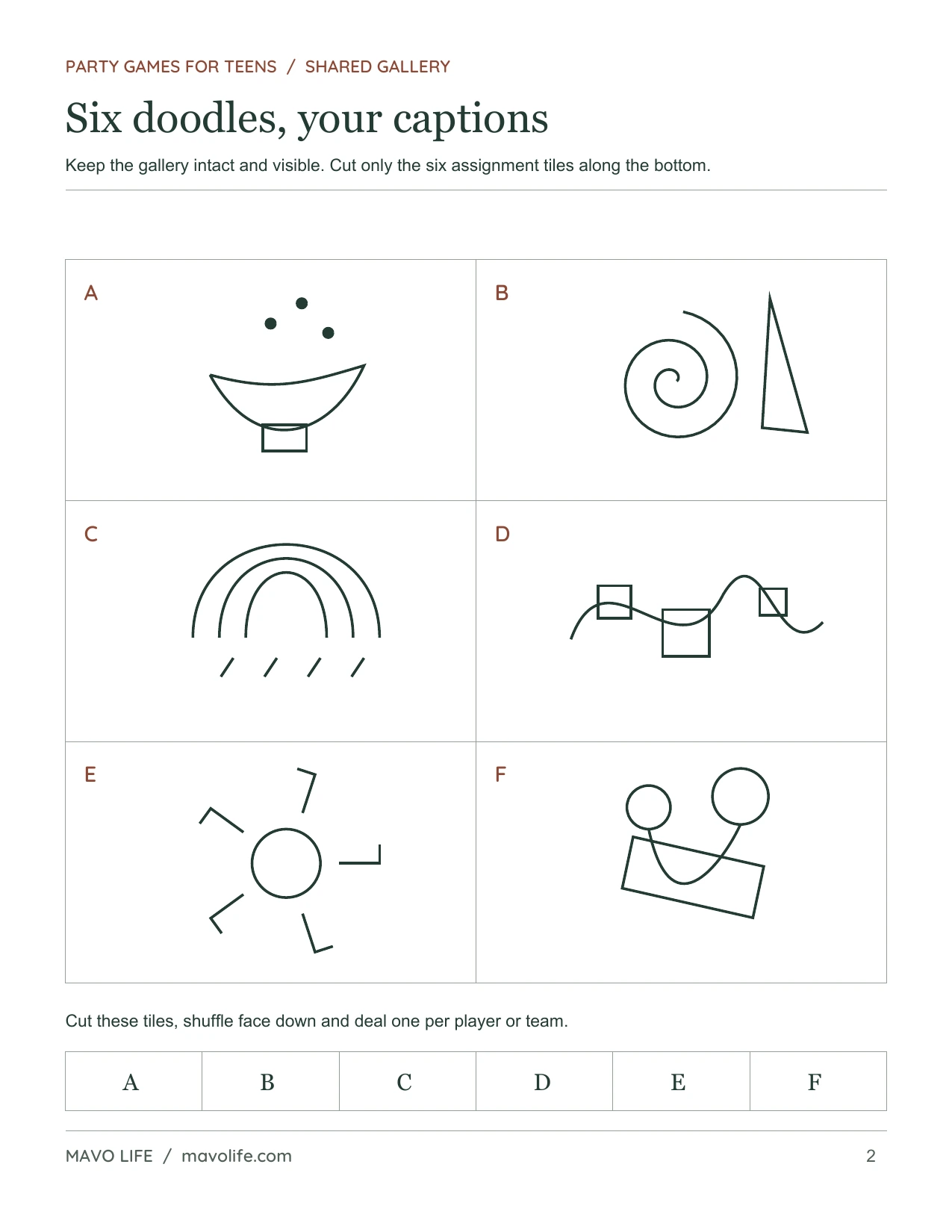
The actual six doodles appear in the PDF preview below. Their printed letters identify these drawings:
- A: A shallow crescent rests on a small rectangle, with three dots rising above it.
- B: An open spiral curls beside a narrow leaning triangle.
- C: Three nested arches stand above four short diagonal dashes.
- D: Three uneven squares sit along a loose winding line.
- E: Five bent spokes surround an open ring without touching it.
- F: Two circles float above a tilted open rectangle, joined by a loose curved thread.
Preview the rules, doodle gallery and assignment tiles
4. Make-Believe Dictionary
Players write decoy meanings for invented words, then vote for the supplied fictional meaning.
Download Make-Believe Dictionary: rules and game material (PDF)
Print: both pages once. Cut the six word cards on page 2 and keep them face down. Use scrap paper for decoys and votes.
Bring: pencils, small paper slips, scissors, 2-minute timer.
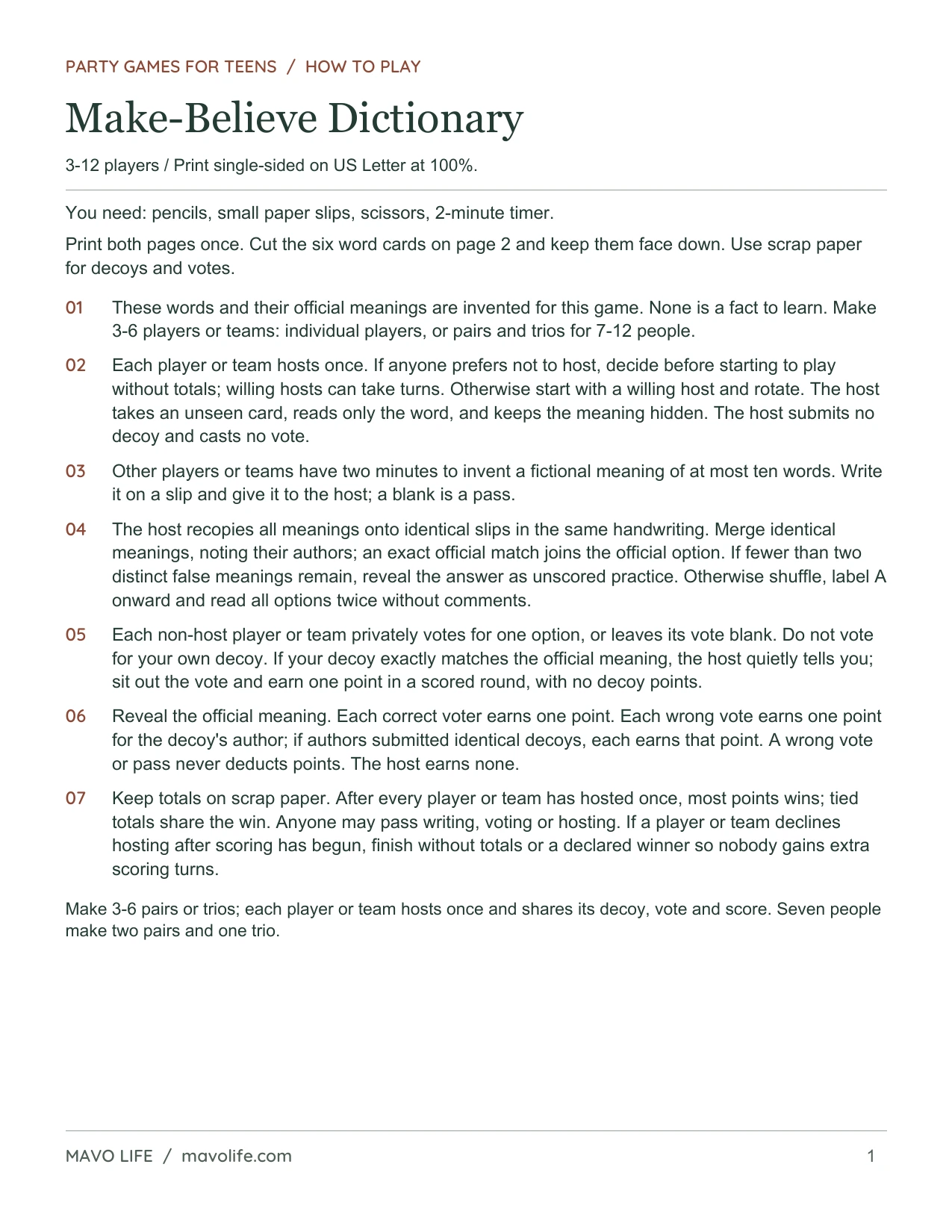
- These words and their official meanings are invented for this game. None is a fact to learn. Make 3-6 players or teams: individual players, or pairs and trios for 7-12 people.
- Each player or team hosts once. If anyone prefers not to host, decide before starting to play without totals; willing hosts can take turns. Otherwise start with a willing host and rotate. The host takes an unseen card, reads only the word, and keeps the meaning hidden. The host submits no decoy and casts no vote.
- Other players or teams have two minutes to invent a fictional meaning of at most ten words. Write it on a slip and give it to the host; a blank is a pass.
- The host recopies all meanings onto identical slips in the same handwriting. Merge identical meanings, noting their authors; an exact official match joins the official option. If fewer than two distinct false meanings remain, reveal the answer as unscored practice. Otherwise shuffle, label A onward and read all options twice without comments.
- Each non-host player or team privately votes for one option, or leaves its vote blank. Do not vote for your own decoy. If your decoy exactly matches the official meaning, the host quietly tells you; sit out the vote and earn one point in a scored round, with no decoy points.
- Reveal the official meaning. Each correct voter earns one point. Each wrong vote earns one point for the decoy's author; if authors submitted identical decoys, each earns that point. A wrong vote or pass never deducts points. The host earns none.
- Keep totals on scrap paper. After every player or team has hosted once, most points wins; tied totals share the win. Anyone may pass writing, voting or hosting. If a player or team declines hosting after scoring has begun, finish without totals or a declared winner so nobody gains extra scoring turns.
Practice round: Extra practice word, not in the six-card deck: wimbrelune. Its fictional official meaning is "A map drawn by a cloud to find its rain." Host Hana shuffles that with Iv's "A cloud's spare pocket" and Jo's "A sleepy paper dragon." Iv votes for Jo's decoy; Jo chooses the official meaning. Jo earns two points, Iv zero, Hana none.
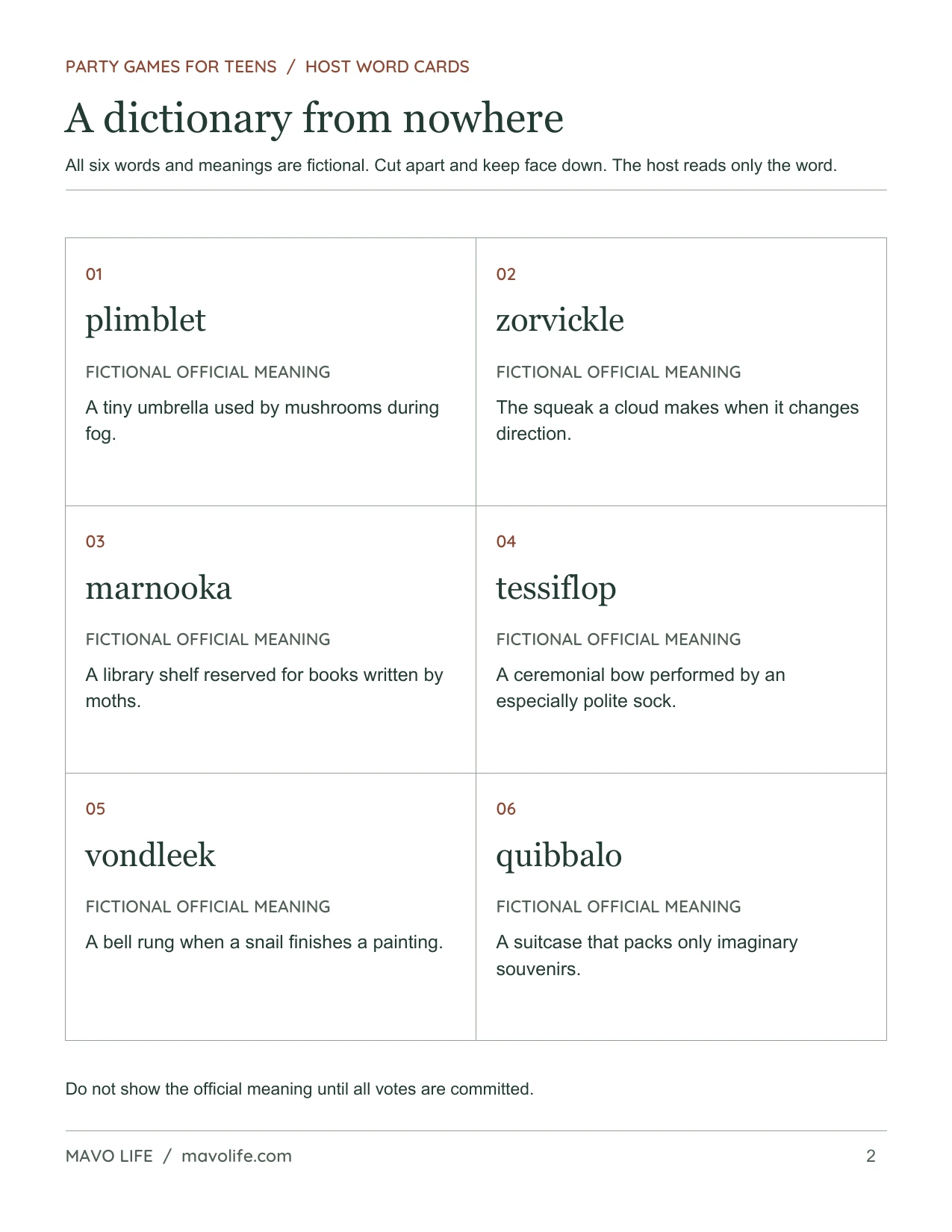
Hosts only: reveal the six fictional meanings
These are invented game meanings, not dictionary definitions. Keep them hidden from anyone guessing.
- plimblet: A tiny umbrella used by mushrooms during fog.
- zorvickle: The squeak a cloud makes when it changes direction.
- marnooka: A library shelf reserved for books written by moths.
- tessiflop: A ceremonial bow performed by an especially polite sock.
- vondleek: A bell rung when a snail finishes a painting.
- quibbalo: A suitcase that packs only imaginary souvenirs.
Hosts only: preview both pages, including secret meanings
5. Find the Sorting Rule
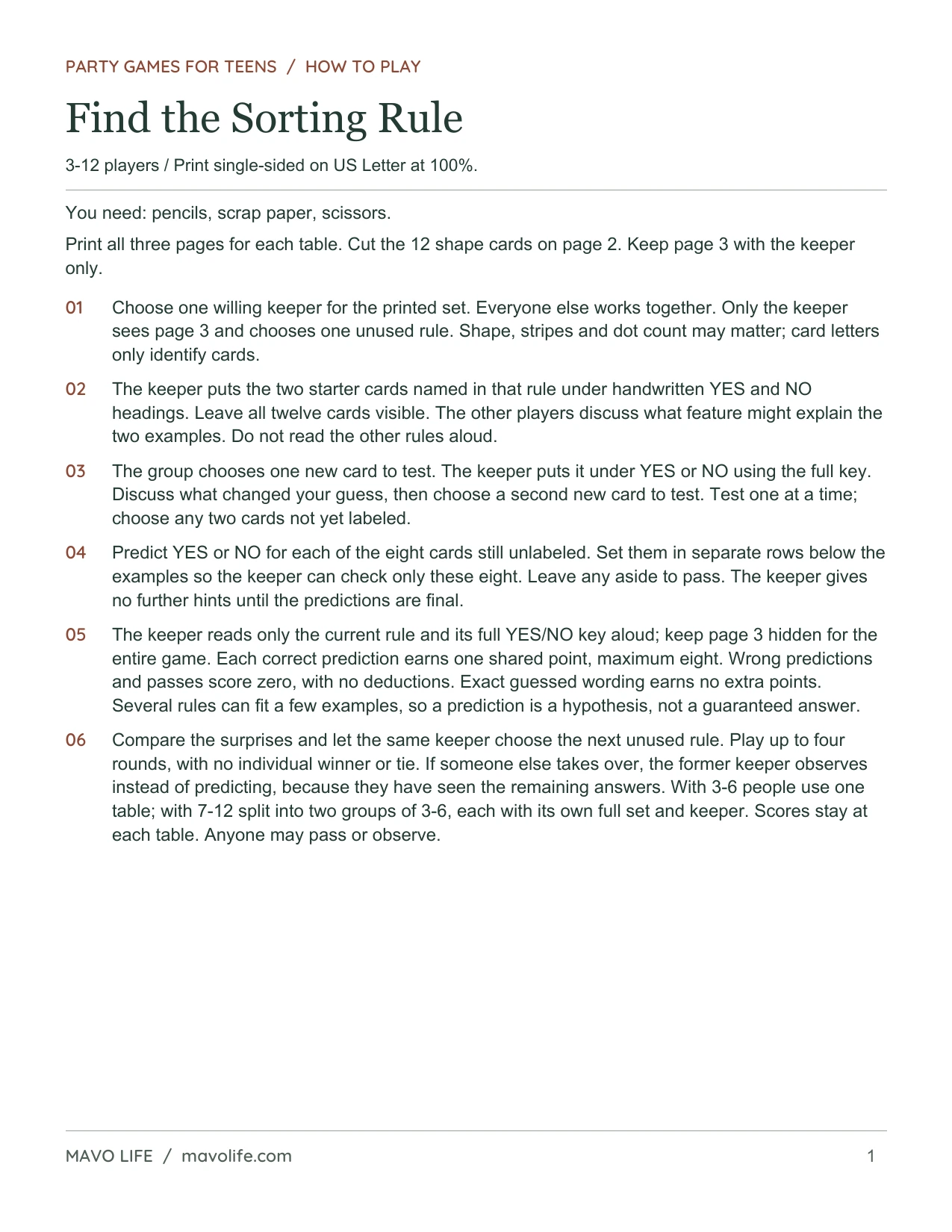
A keeper labels examples under a hidden rule. Players choose two tests, then predict how the remaining cards will be classified.
Download Find the Sorting Rule: rules and game material (PDF)
Print: all three pages for each table. Cut the 12 shape cards on page 2. Keep page 3 with the keeper only.
Bring: pencils, scrap paper, scissors.
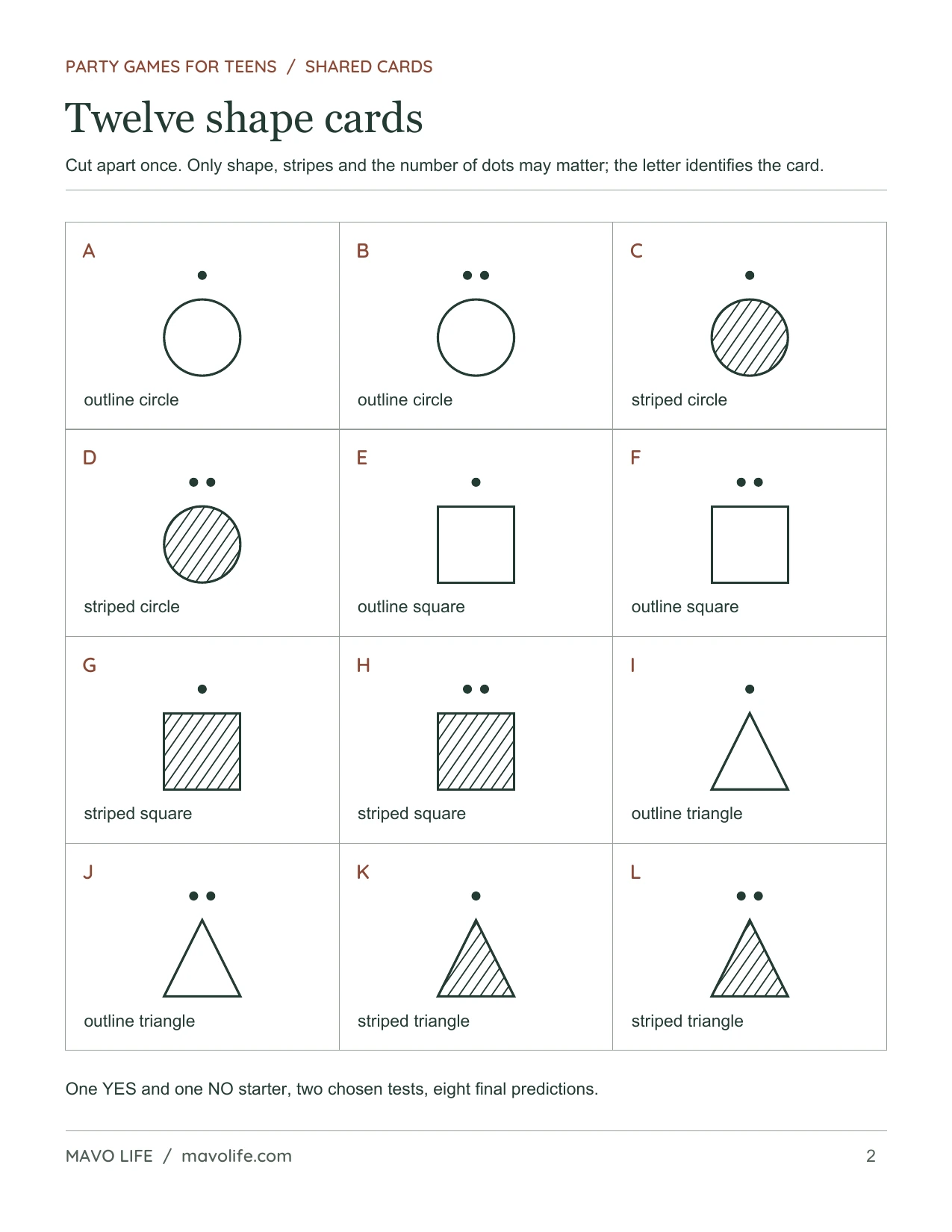
- Choose one willing keeper for the printed set. Everyone else works together. Only the keeper sees page 3 and chooses one unused rule. Shape, stripes and dot count may matter; card letters only identify cards.
- The keeper puts the two starter cards named in that rule under handwritten YES and NO headings. Leave all twelve cards visible. The other players discuss what feature might explain the two examples. Do not read the other rules aloud.
- The group chooses one new card to test. The keeper puts it under YES or NO using the full key. Discuss what changed your guess, then choose a second new card to test. Test one at a time; choose any two cards not yet labeled.
- Predict YES or NO for each of the eight cards still unlabeled. Set them in separate rows below the examples so the keeper can check only these eight. Leave any aside to pass. The keeper gives no further hints until the predictions are final.
- The keeper reads only the current rule and its full YES/NO key aloud; keep page 3 hidden for the entire game. Each correct prediction earns one shared point, maximum eight. Wrong predictions and passes score zero, with no deductions. Exact guessed wording earns no extra points. Several rules can fit a few examples, so a prediction is a hypothesis, not a guaranteed answer.
- Compare the surprises and let the same keeper choose the next unused rule. Play up to four rounds, with no individual winner or tie. If someone else takes over, the former keeper observes instead of predicting, because they have seen the remaining answers. With 3-6 people use one table; with 7-12 split into two groups of 3-6, each with its own full set and keeper. Scores stay at each table. Anyone may pass or observe.
Practice round: Extra practice rule, not on the keeper page: YES means a shape with corners. A begins in NO and E in YES. Players test B (NO), then I (YES), before predicting the other eight. Under this practice rule C and D are NO; F, G, H, J, K and L are YES. In a real round the keeper's rule remains hidden until final predictions.
Keepers only: reveal the four rules and answer lists
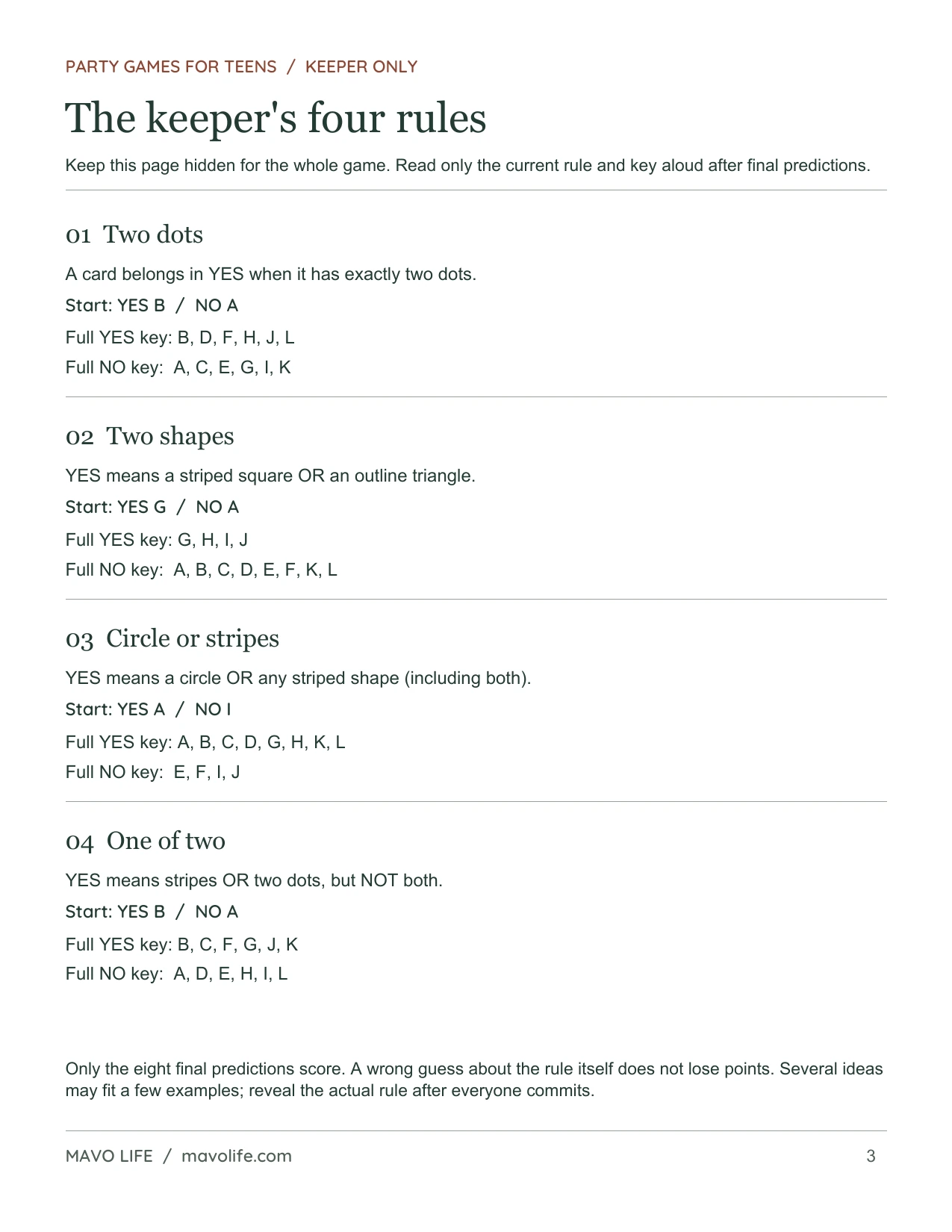
The keeper keeps the rules and answer lists hidden during play.
- Two dots: A card belongs in YES when it has exactly two dots. YES: B, D, F, H, J, L. NO: A, C, E, G, I, K.
- Two shapes: YES means a striped square OR an outline triangle. YES: G, H, I, J. NO: A, B, C, D, E, F, K, L.
- Circle or stripes: YES means a circle OR any striped shape (including both). YES: A, B, C, D, G, H, K, L. NO: E, F, I, J.
- One of two: YES means stripes OR two dots, but NOT both. YES: B, C, F, G, J, K. NO: A, D, E, H, I, L.
Keepers only: preview all three pages, including hidden rules
6. One-of-a-Kind Answers
Everyone writes category answers at the same time; matching objects cancel and unique valid answers score.
Download One-of-a-Kind Answers: rules and game material (PDF)
Print: page 1 once for the table and page 2 for each individual or team.
Bring: pencils, 2-minute timer.
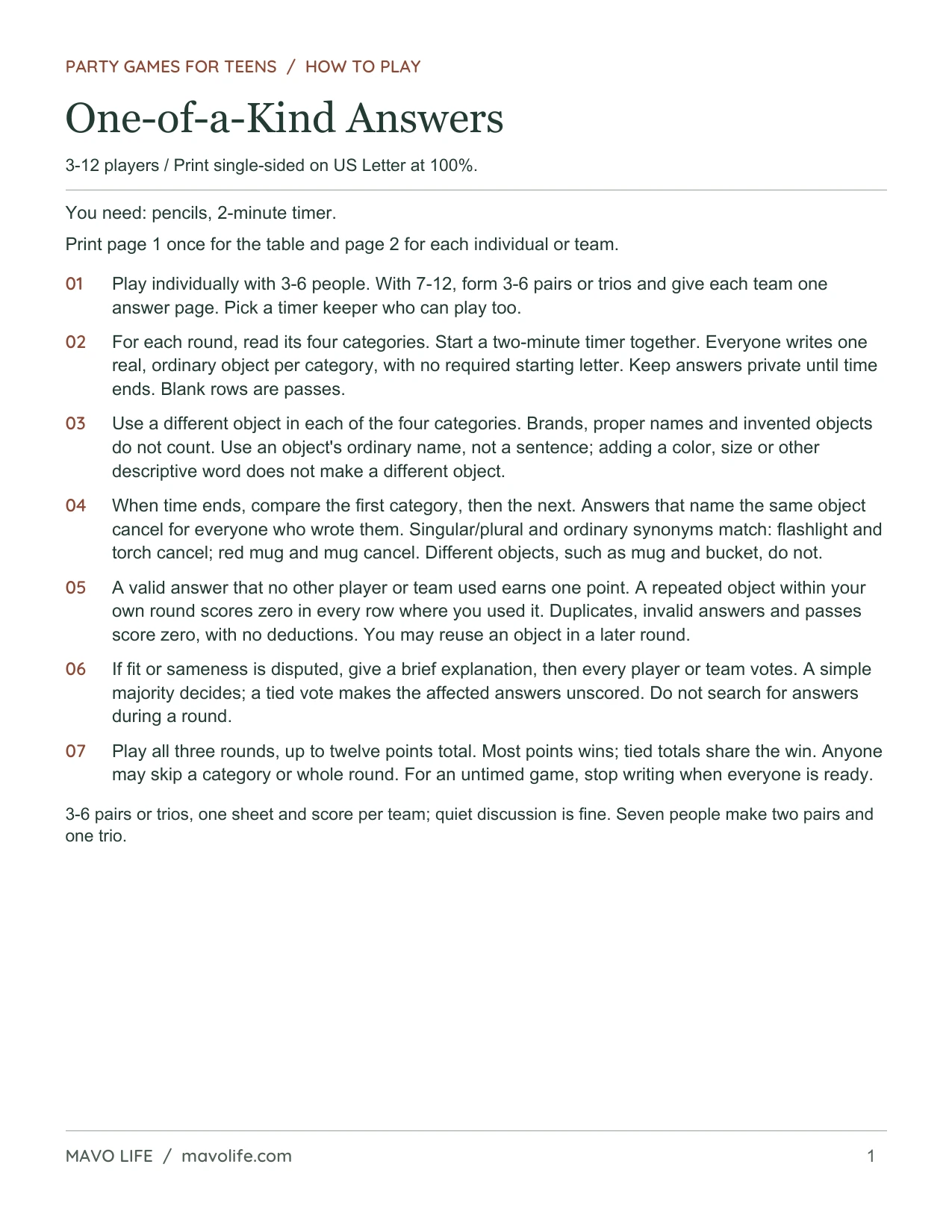
- Play individually with 3-6 people. With 7-12, form 3-6 pairs or trios and give each team one answer page. Pick a timer keeper who can play too.
- For each round, read its four categories. Start a two-minute timer together. Everyone writes one real, ordinary object per category, with no required starting letter. Keep answers private until time ends. Blank rows are passes.
- Use a different object in each of the four categories. Brands, proper names and invented objects do not count. Use an object's ordinary name, not a sentence; adding a color, size or other descriptive word does not make a different object.
- When time ends, compare the first category, then the next. Answers that name the same object cancel for everyone who wrote them. Singular/plural and ordinary synonyms match: flashlight and torch cancel; red mug and mug cancel. Different objects, such as mug and bucket, do not.
- A valid answer that no other player or team used earns one point. A repeated object within your own round scores zero in every row where you used it. Duplicates, invalid answers and passes score zero, with no deductions. You may reuse an object in a later round.
- If fit or sameness is disputed, give a brief explanation, then every player or team votes. A simple majority decides; a tied vote makes the affected answers unscored. Do not search for answers during a round.
- Play all three rounds, up to twelve points total. Most points wins; tied totals share the win. Anyone may skip a category or whole round. For an untimed game, stop writing when everyone is ready.
Example: For the category "An object with a handle." Lee writes mug; Mo writes red mug; Nia writes bucket. Lee and Mo both score zero because they named the same object. Nia scores one if no other answer is bucket.
Read the categories for all three rounds
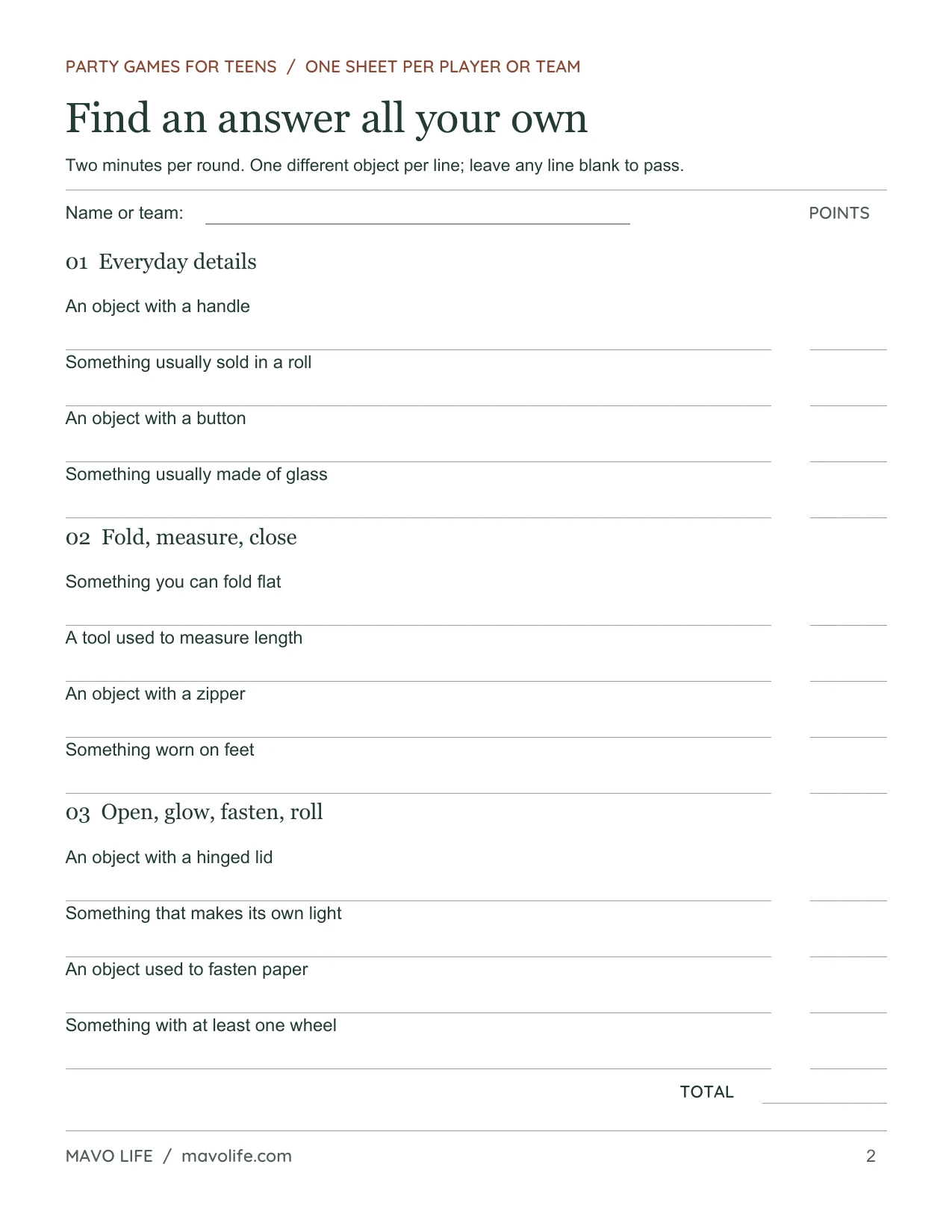
Everyday details
- An object with a handle
- Something usually sold in a roll
- An object with a button
- Something usually made of glass
Fold, measure, close
- Something you can fold flat
- A tool used to measure length
- An object with a zipper
- Something worn on feet
Open, glow, fasten, roll
- An object with a hinged lid
- Something that makes its own light
- An object used to fasten paper
- Something with at least one wheel
Preview the rules and three-round answer sheet
Before the first round
Run the practice example without points if someone wants to see a turn before joining. For Screen Sketch, use the warm-up diagram before the three more detailed cards.
Use an unseen prompt for each scored round. Keep scores within their own game; a point in drawing isn't equivalent to a point in guessing definitions.
For a wider menu of activities around the games, see what to do at a sleepover. More resources for having people over are in the family hosting collection, and the printable library lists the individual downloads.