Hosting & celebrations · October 1, 2026 · 8 min read
Family Night Ideas: Four Ways to Play at Home
Choose family night ideas for a short evening or a longer session: complete drawing, sound, storytelling, and table games using paper, pencils, or voices.
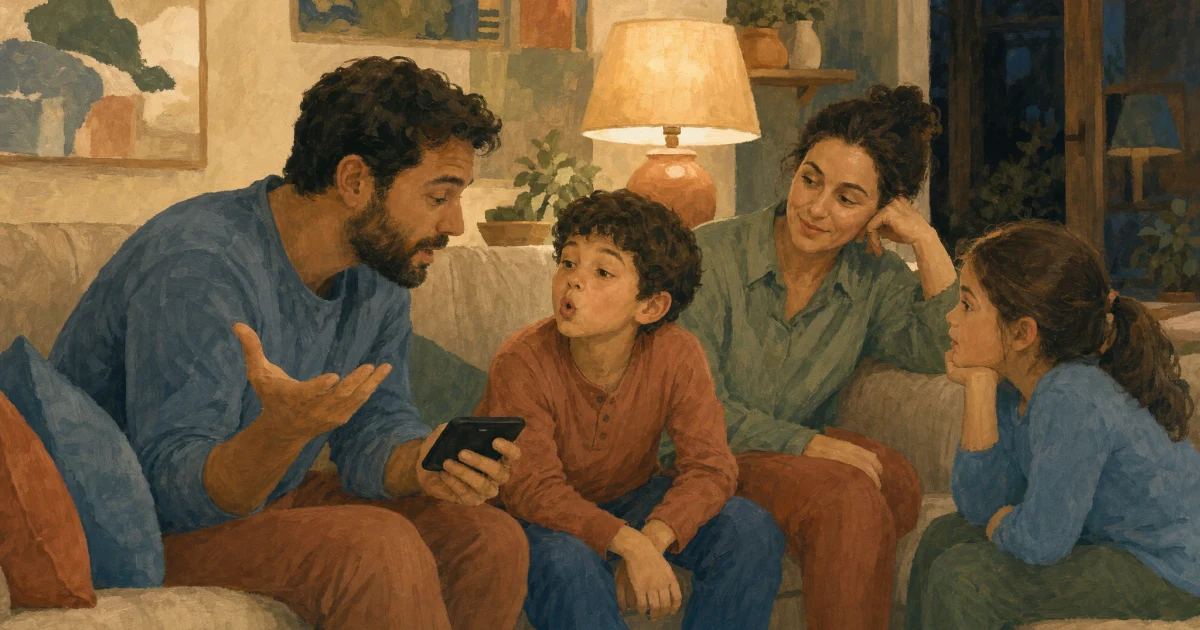
For a short evening, turn the same pencil mark into different pictures or perform the sounds for a tiny story. With more time, interview visitors from made-up places or draw a town together on one sheet. These family night ideas include the words to start with, the turns to take, and a finish for each activity.
Pick by the time and materials you have. The times below are rough estimates; a larger group or a detailed drawing can take longer. Each activity also has a clear stopping point, so you can finish without watching a clock.
- Same start, different picture, about 10–15 minutes. Give each person a sheet and pencil. You'll make different pictures from one starting mark.
- A tiny sound studio, about 10–15 minutes. Use voices and one person reading this page to perform a short story with a live soundtrack.
- Interview an imaginary visitor, about 20–30 minutes. Use voices, with optional paper and pencils for a postcard. You'll invent a visitor and the place they came from.
- Build a town on the table, about 20–30 minutes. Share one sheet and pencils to draw a connected map with two additions per person.
You can join any of these by describing instead of drawing, or listen for a turn before joining in. A pass simply moves the turn along; nobody has to keep score.
Same start, different picture
Everyone begins with the same mark, then makes something different from it. Give each person a sheet of paper and a pencil.
Read to start: “Draw a small hill shape in the middle of your paper, like an upside-down U. Add a short straight line pointing down from each end. Everyone starts with that same shape. What can you turn it into?”
Keep the original mark visible somewhere in the finished picture. You can turn the paper around, add lines, or make the picture as large as you want. Don't show it yet; wait until everyone says they're finished or ready to share.
Two possible pictures: Add a handle under the hill and raindrops above it to make an umbrella. Or turn the paper sideways, add an eye and a tail, and make a fish with an unusually square mouth. Neither is the answer to copy; the starting shape can become anything you can explain.
Go around once. Each person shows the picture and gives it a title, or says what happened in it. With two people, that's one reveal each. With a larger group, keep everyone's picture turned away until its owner's turn. Someone who prefers to describe a picture can ask another person to draw it, with that person's agreement.
Finish after the reveals. If everyone wants another round, start with a small circle and one straight line sticking out from it. That could become a magnifying glass, a flower leaning toward the window, or something none of the examples suggests.
A tiny sound studio
One person reads the scene below. Everyone else supplies its sounds, listening for the three cue words. You don't need music, props, or a recording.
Choose who will make each sound:
- Rain: a soft “shhhh.”
- Train: “chug-chug.”
- Bell: “ding-ding.”
The reader says each cue once before starting, so the sound makers can try their parts. During the scene, pause after a cue word for its sound, then continue. Keep each sound short enough for the reader to resume.
Scene to read:
The rain began just as a small station opened for the evening.
A train arrived with one passenger: a penguin carrying an empty flowerpot.
The penguin rang the bell at the ticket window.
“One ticket to the garden, please,” it said, while the rain watered its pot.
The train left with the penguin aboard, and the station keeper rang the bell to say goodbye.
Use the sound when the exact cue word is spoken, including its second appearance. The other words don't need effects.
With two people, one reads and the other makes all three sounds. With three people, one reader has two sound makers; one can take rain and train, and the other bell. In a larger group, share the three parts, with several people making the same sound if needed. The reader can also take a sound if someone passes their part.
Finish when the penguin leaves. If you'd like a second performance, change the reader and swap the sounds: rain can become “pitter-patter,” train “whoosh,” and bell “ting.” Read the same scene again, then stop after its goodbye. The change is in the performance, so nobody has to invent a new story to take another turn.

Interview a visitor from an imaginary place
Take turns being a visitor from somewhere that doesn't exist. The rest of the table asks about the place, and the visitor invents the answers. You can draw a little postcard before your turn if making the place visible helps you describe it.
Opening to read: “Tonight we're meeting travelers from invented places. Think of a place name and one unusual thing about it. When it's your turn, introduce yourself as someone who lives there.”
A place can start with a familiar object: Button Island, a town inside a teacup, or a station built on a cloud. You don't need a whole world before you begin. One detail is enough to answer the first question.
Each visitor gets these three questions, in this order:
- “What would we notice first if we arrived where you live?”
- “What's an ordinary job there that would seem strange here?”
- “What would you bring us as a souvenir?”
An example interview:
Visitor: “I'm the evening post carrier from Button Island.”
Interviewer: “What would we notice first if we arrived where you live?”
Visitor: “Every door has four holes, and the doorbells are made of thread.”
Interviewer: “What's an ordinary job there that would seem strange here?”
Visitor: “I deliver letters by sliding them through the buttonholes.”
Interviewer: “What would you bring us as a souvenir?”
Visitor: “A coat with a tiny map sewn into every button.”
The visitor can answer in an ordinary voice. Acting, accents, and a costume aren't needed. If an answer stalls, borrow a detail from the example or point to something in your drawing. You can also pass a question and move to the next one.
With two people, one asks all three questions, then you swap roles. In a group, begin with the person next to the visitor and pass the question turn around, skipping the visitor. A small group can come around to the same interviewer again; a larger group may have people listening for that interview. After question three, the next willing person becomes the visitor.
Finish once everyone who wants a visitor turn has had one. Lay out any postcards and let each traveler point to one detail they'd like the others to notice. Someone who prefers not to be interviewed can show a drawing or remain an interviewer.
Build a town on the table
Place one sheet in the middle of the table. Draw a line across it and another from top to bottom, crossing near the center. Those are the town's first two streets. Leave space around them for places people will add.
Read to start: “We're drawing a town together. Every new place needs a door, gate, or arrival spot with a path to a street already on the page. We'll each add one place in the first round and one in the second.”
In round one, each person adds somewhere a visitor could go: a library, shop, museum, station, garden, or bench. Draw it anywhere there's room, then connect its entrance to one of the streets with a short path. Say what it is before handing the sheet or pencil to the next person. Words, simple shapes, and spoken descriptions all count.
In round two, each person adds a new place with an unusual detail. A shop might sell umbrellas shaped like leaves. A bench could be moon-shaped. A library could have a shelf for books that haven't been written yet. Keep the first places on the map; add to the town rather than drawing over someone else's contribution.
A four-place example: Two people start with a library and a hat museum, one on each side of the crossing. On their second turns, they add a moon-shaped bench and an umbrella shop. The library's front door, the museum gate, the bench's arrival path, and the shop door each connect to an existing street. A visitor can trace a route between all four.
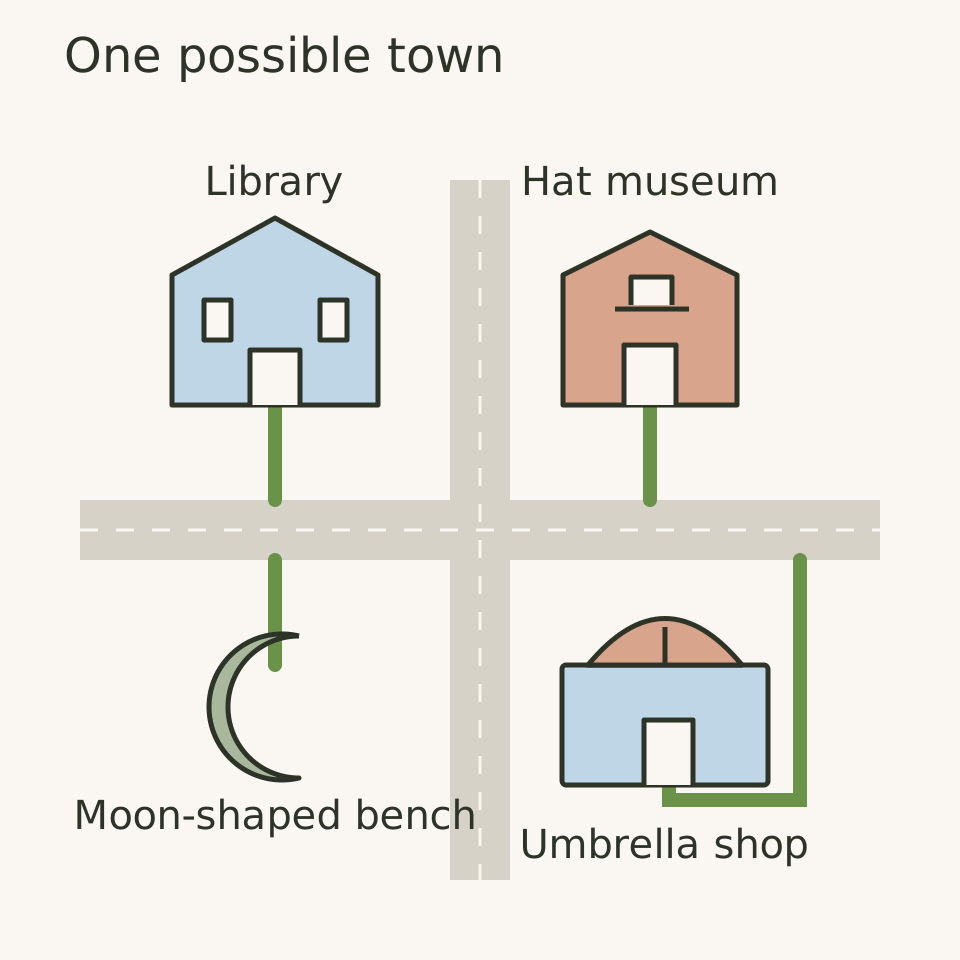
With two people, alternate turns twice each. In a larger group, go around the table twice, with one new place per person in each round. Anyone can pass, or tell another willing person what to draw. If the sheet fills up, finish the current round with spoken additions instead of squeezing unreadable places into the margins.
Finish after the second round. Give the town a name, then let each person describe a route between two places: “From the hat museum, follow the street past the crossing and take the short path to the moon bench.” Trace it with a finger as you speak. If a place has no connection yet, draw its missing path before taking the next tour.
Keep the evening's result, if you want it
The drawings and map can go on the fridge, in a folder, or straight into recycling. The sound scene can end when the last bell does. Nothing needs to become a recurring project for the evening to be finished.
For possibilities to come back to across weekends and seasons, browse the family bucket list ideas. If you're having a larger group over and want separate printable rounds, the party games for teens include drawing, captions, and word games. More gathering resources are in the family hosting collection.