Hosting & celebrations · August 6, 2026 · 5 min read
How to Plan a Family Reunion: A Shared Kit
Plan a family reunion with a free editable coordination kit for household replies, beds, shared costs, and contributions.

A family reunion has two separate plans: how each household arrives, and when the group is actually together. Don't build an itinerary until you can see their overlap. The useful first document is a response map, with one household per row and one clear place for the answer that changes beds, shared commitments, or the next follow-up.
This guide gives you an order for building that map, plus a free family reunion coordination kit for the live answers. The goal is simply to make the next unanswered question easy to spot.
Find the reunion's anchor
A reunion needs one answer that the other answers can attach to. Pick the person or small group who can confirm the basic frame: the date range, the main place, and the group that is being invited. They are the anchor, not the person who has to carry every task. They don't need to be the oldest relative, and they don't need to be the person with the biggest house.
Write the anchor in a plain sentence before you ask for details. For example: “The Johnson cousins are meeting near Lake Ada from Friday evening through Sunday lunch, with Saturday at the lodge.” That sentence tells distant relatives what kind of answer is useful, separates the main gathering from optional arrival time, and gives the host group something specific to correct if it changes.
If the reunion is a simple local lunch and everybody already knows the place, a shared message may be enough. You won't need a fuller planning file unless overnight space, shared money, or several households' contributions would otherwise be guessed from old messages. You'll know when the same question starts coming back through more than one conversation.
Ask every household for one reply
Do not ask the whole family a stream of disconnected questions. Send each household one compact request and record its answer beside that household. The four fields below are usually enough to expose the next decision without asking anyone to fill out a survey.
| Ask for | Why it changes the plan |
|---|---|
| Who is coming, and on which days? | It separates attendance from a hopeful headcount. |
| Does anyone need or offer overnight space? | It reveals the bed question before an itinerary assumes an answer. |
| What is one contribution that household can confirm? | It turns “we can help” into a useful promise. |
| Is there one question they need answered first? | It stops a missing detail from looking like silence. |
One reply per household also makes follow-up kinder. You can ask for the missing field instead of sending a general “any updates?” note to everyone. A blank cell isn't a no. It's a reason to ask directly.
Settle beds before building an itinerary
The overnight plan and the daytime gathering are related, but they are not the same decision. A person can need a bed without joining every activity, and a day guest can make the Saturday meal bigger without using a room. Keep those answers in separate columns from the start.
First list the available sleeping spaces and the households that might use them. Then mark what is confirmed, what is offered but not yet assigned, and what still needs a conversation. You don't need to publish every detail to the whole group. The people coordinating space need the complete picture; everyone else needs the answer that affects their arrival.
Once the bed picture is stable enough, choose only the gathering moments that depend on it. A shared dinner, a photo, or a park reservation can wait until you know which days the group overlaps. That is why an activity schedule belongs after the response map, not before it.
Draw a line between shared and local plans
Some reunion decisions belong to the group. Others belong to the household making the trip. Put shared costs, the main meal, the central gathering place, and any common rental on one side. Put personal travel, individual meals, and optional stops on the other unless the family has explicitly chosen to share them.
That line protects the plan from quiet assumptions. A cousin can book their own hotel without making the whole group responsible for it. A person can offer drinks for the Saturday meal without becoming the owner of every meal all weekend. When an item crosses the line, name the next action and the person who will report back.
You're looking for a small set of shared commitments that a new arrival can understand in one read. A long list of private choices usually makes the reunion look more organized than it really is.
Use the free family reunion coordination kit for the live answers
The free editable workbook gives the response map a home after the first replies arrive. It has five tabs: Start Here for the reunion anchor, Planning Timeline for follow-ups, Guests & Lodging for each household's response and sleeping answer, Budget for truly shared costs, and Food & Assignments for confirmed contributions.
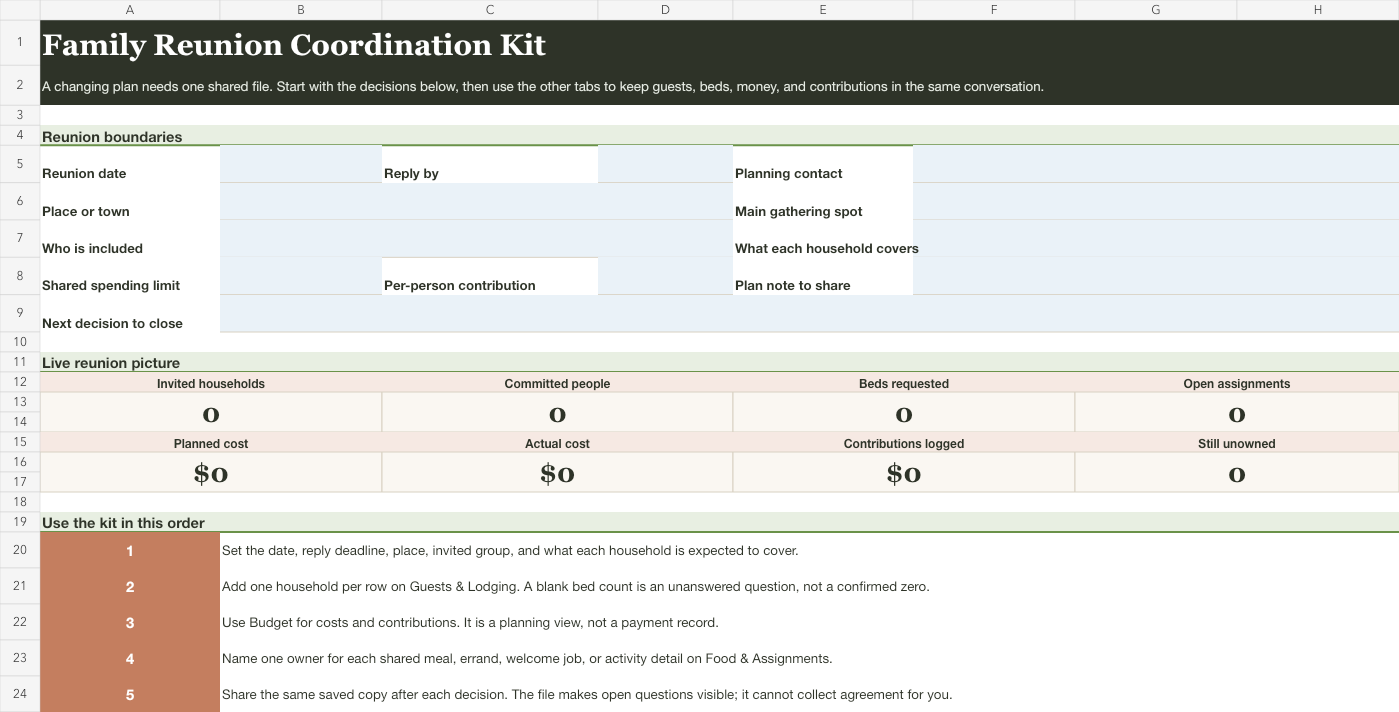
Download the Family Reunion Coordination Kit (Excel workbook)
Open it in the spreadsheet app your family uses. Start by entering the anchor and the first household responses. The summary is there to show what is still missing. It doesn't decide how rooms should be assigned, how money should be divided, or whether a plan is right for your family.

Make one final pass with the anchor group
Before you send the group update, have the anchor group read the unresolved items together. Ask: Which households still need a direct reply? Which beds or costs are genuinely shared? Which contribution is only an offer, not a confirmation? Then share the short list of settled commitments and the one place where the current answers live.
Treat that last pass as a short decision check. It tells the group what is settled and shows the anchor group which detail still needs a private follow-up. A clear arrival answer and lodging answer will prevent most crossed wires.
For a smaller gathering with one meal to coordinate, use the Thanksgiving menu planner. For games and activities after the logistics are settled, visit the family hosting collection.