Hosting & celebrations · September 8, 2026 · 8 min read
24 Potluck Themes, With Invitation Wording for Each
Choose from 24 potluck themes with a ready-to-copy invitation line for each, dish examples, and a free worksheet to plan your contribution categories.

A potluck theme can be as loose as “bring something you love” or as specific as a table of pies. The useful part is being able to explain it in one sentence, so guests can picture what belongs before they choose a dish.
Below are 24 potluck themes grouped by the kind of invitation you want to send. Each has a copyable line and a few examples. The examples suggest directions, not a menu you have to fill. After choosing a theme, use the one-page worksheet to work out which course categories you want.
Familiar food, with room to choose
1. The dish you get asked to bring. Invite each person to bring something people already associate with them. One guest might choose a pasta salad; another might bring a favorite cake.
Invitation line: “Bring the dish someone always asks you to make, or a favorite you’d like to share.”
2. Breakfast at any hour. Build the theme around breakfast favorites without tying it to a morning gathering. Muffins, a chosen egg dish, and fruit are possible directions; name the course categories in the invitation if you want more than pastries.
Invitation line: “We’re having breakfast for dinner. Bring a breakfast favorite and tell us what you’ve chosen.”
3. Soup and something alongside. Give soup a supporting cast of bread, a side, or a sweet finish. Guests can choose one of those roles instead of everyone arriving with a separate main.
Invitation line: “The theme is soup and its sidekicks. Choose a soup, bread, side, or dessert.”
4. A table of pies. Include savory pies as well as sweet ones. A vegetable pie and an apple pie fit the same idea but serve different parts of the meal.
Invitation line: “Bring a pie, sweet or savory. Tell us which kind so we can see the table taking shape.”
5. The favorite sandwich table. Ask for sandwich ideas and the accompaniments people like with them. The theme can include rolls, a selected filling, a side, or dessert; specify which of those people should choose from.
Invitation line: “Let’s build a sandwich-table potluck. Choose a sandwich contribution, a side, or something sweet.”
6. Sunday-lunch favorites. Let each household interpret what that meal means to them. Someone may choose a casserole; someone else may think of salad and bread. The title supplies a mood without prescribing a particular tradition.
Invitation line: “Bring something you’d enjoy at a long Sunday lunch, whatever that looks like in your home.”
Themes that start a conversation
7. A dish with a place attached. The place might be a former home, a trip, or a favorite local café. Guests choose their own connection; no one has to represent a country or explain an entire cuisine.
Invitation line: “Bring a dish that reminds you of a place. You can share the connection if you’d like.”
8. Cookbook bookmark. Pick something from a cookbook you already own or have borrowed. Ask guests to bring the title or a photo of the cover if they want to compare books over the meal.
Invitation line: “Bring a dish from a cookbook you’ve been meaning to open. We’ll swap book titles over dinner.”
9. The recipe you kept. Center the evening on food people have chosen to make again. This can be a recent discovery, a clipped recipe, or something written on a much-used card.
Invitation line: “Bring a recipe you kept coming back to, whether you found it last month or years ago.”
10. A meal from a movie. Choose one movie everyone knows, or let guests choose their own. A named dish, a setting, or a character’s favorite food can be the connection.
Invitation line: “Bring something inspired by a movie. A loose connection is welcome; no costume required.”
11. Book-club table. Let the current book inspire dish names or choices. A food mentioned in the story is one option; the title, setting, or cover colors can suggest another.
Invitation line: “Our book is the potluck theme. Bring a dish connected to the story, title, setting, or cover.”
12. First apartment favorites. Ask adults to revisit something they liked making or buying when they first lived away from home. The result might be dressed-up toast, a pasta dish, or a bakery favorite.
Invitation line: “Bring something you loved in your first place. Homemade and bought favorites both belong.”
Playful prompts with a clear rule
13. One chosen color. Pick a color and ask guests to choose a dish that naturally fits it. For green, possibilities include a green salad or a pea dish. Keep the color optional if it makes someone's choice awkward.
Invitation line: “Our color is green. Bring something that fits, or a favorite you’d rather share.”
14. Round things. Use shape as the connection: a round loaf, a pie, or a round cake. Guests can use the shape of a whole dish or one of its ingredients.
Invitation line: “Bring something round, or something with round pieces. That’s the whole theme.”
15. A letter of the alphabet. Choose one letter for the group. With P, guests could consider pasta, potatoes, pears, or pie. Dish names can supply the letter too.
Invitation line: “The potluck letter is P. Choose an ingredient or dish name that starts with it.”
16. A song on the menu. Let guests connect a dish to a song title or lyric. The food doesn't have to appear in the song; a playful name can make the link.
Invitation line: “Bring a dish with a song connection, and send the song title if you’d like it on the playlist.”
17. Same ingredient, different ideas. Choose one ingredient the group wants to use, such as apples or lemon. Let it appear in a main, a side, or dessert instead of requiring everyone to make a variation of one dish.
Invitation line: “Apples are our starting point. Choose any dish you’d like that includes them.”
18. Opposites on the table. Pair two broad prompts, such as crunchy and soft, or sweet and savory. Guests pick a side of the pair when they reply.
Invitation line: “Choose sweet or savory for your contribution. We’re putting both on the table.”
Let the occasion choose the theme
19. Welcome-to-the-neighborhood favorites. Invite established neighbors to share a personal favorite and newcomers to do the same. A nearby bakery purchase can sit beside a home recipe; no local knowledge is required.
Invitation line: “Bring a favorite to our neighborhood table. It can be homemade or something you love buying.”
20. A birthday person's picks. Ask the person being celebrated for a few foods or flavors they enjoy, then offer those as directions. Let guests choose a contribution instead of assigning them a full recipe.
Invitation line: “We’re celebrating with some of Sam’s favorites: pasta, strawberries, and chocolate. Choose a direction you like.”
21. The reunion table. Use dishes people remember from earlier gatherings, with room for new favorites. Guests who weren't at those events can bring something they would like to see again next time.
Invitation line: “Bring an old gathering favorite or a new dish you’d like to add to the reunion table.”
22. Garden-color table. Take inspiration from the colors people associate with a garden. Tomatoes, carrots, greens, or berries might suggest a direction without requiring anyone to grow the ingredients.
Invitation line: “Bring something inspired by garden colors. Your dish can be homemade or bought.”
23. End-of-season favorites. Let guests choose a dish they enjoyed during the season that is ending.
Invitation line: “Bring something you enjoyed this season. We’ll make a table of everyone’s favorites.”
24. Choose your own favorite. A potluck doesn't need a stricter theme. This is a useful choice when the group already has dishes in mind or nobody wants another constraint.
Invitation line: “Bring something you’re looking forward to sharing. Tell us what you’ve chosen so we can plan around it.”
Turn one theme into a clear invitation
Choose a theme your guests can understand without a second message. If the idea needs a long explanation, use one of the invitation lines as a starting point and add examples. “Soup and its sidekicks: soup, bread, sides, or dessert” gives more direction than a clever title by itself.
Then say what kind of gathering you're planning. A dessert potluck and a meal with dessert ask different things of guests. For a full meal, name the course categories you want people to choose from; for a dessert gathering, make that part of the invitation. The theme alone doesn't settle the menu.
For example, the cookbook theme could use four contribution categories: main dishes, sides, bread, and dessert. The invitation might read: “Bring a dish from a cookbook you’ve been meaning to open. Choose a main, side, bread, or dessert and reply with your dish idea.”
Sketch your theme before making a sign-up sheet
The optional worksheet gives you a place to write the chosen theme, the sentence you'll send, and four course categories with possible dishes. It is a host's planning sheet, not a guest list or a place to claim contributions.
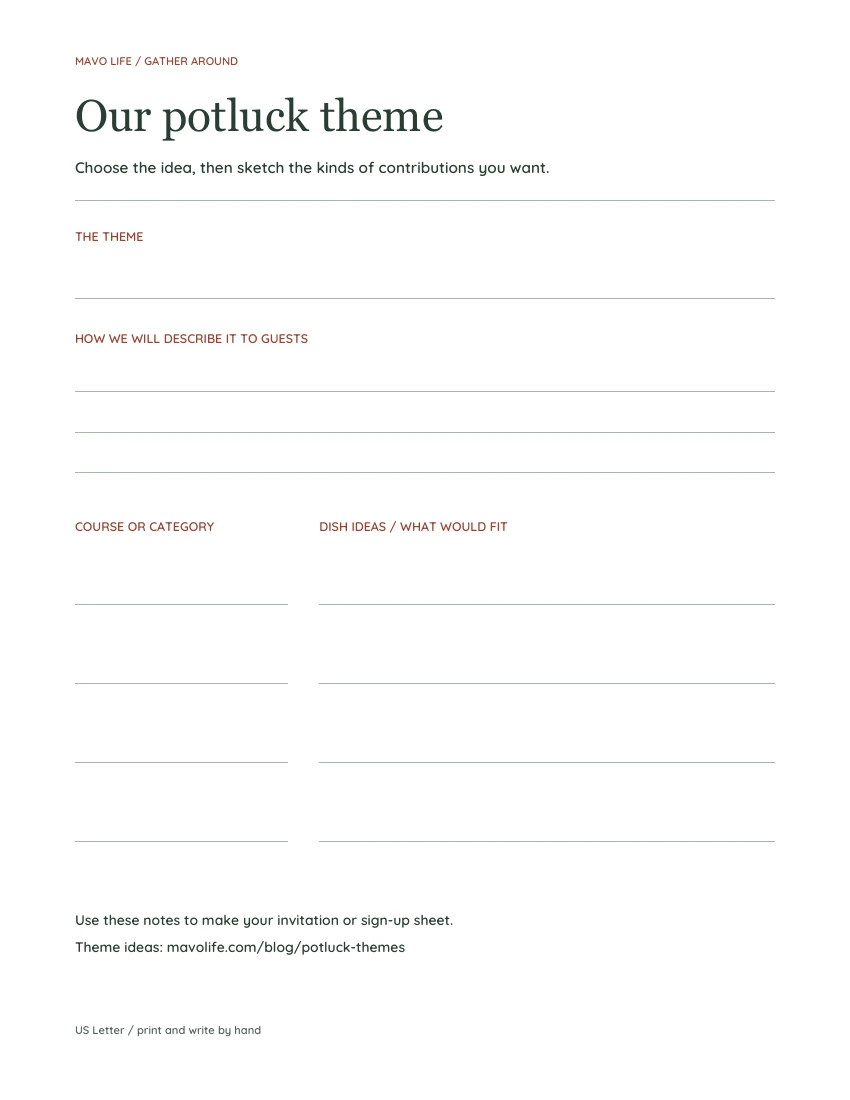
Download the potluck theme worksheet (PDF)
Print on US Letter paper at Actual size and fill it in by hand. This is a blank, non-fillable PDF; it has no typed form fields. If you already know the invitation and categories, you can skip the worksheet.
When you're ready to collect names and contributions, the free sign-up sheet generator can turn your chosen categories into a printable sheet. It handles the list after the theme is settled. The party guest list template gives invitations and replies their own place. For a different kind of family gathering, browse the family hosting articles.