Hosting & celebrations · August 25, 2026 · 7 min read
Family bucket list ideas: choose twelve that fit
Browse family bucket list ideas for home, nearby days, seasons, and someday, then download a free fillable choose-12 worksheet.

The best family bucket list ideas are the ones your family would still choose without the word “bucket.” A blanket on the living-room floor, a library you have never visited, the first cold-weather breakfast, and a trip you may take someday can all belong on the same list.
Start wide, then choose twelve. A short list leaves room for ordinary weekends, changing interests, and the possibility that nobody wants to finish every square.
Start with ideas that already fit your days
Before you search for a hundred activities, look at the free time your family already has. A weeknight hour won't hold the same idea as an open Saturday. A family that likes returning to familiar places may want fewer first-time adventures and more variations on things it already enjoys.
Use the categories below as prompts, not recommendations. Each idea stays deliberately loose, so you can decide whether it fits your people and current circumstances.
At-home family bucket list ideas
- Make breakfast for dinner and let each person choose one part.
- Build one blanket room for reading, games, or a movie.
- Cook a family recipe and write down the version you actually made.
- Hold a living-room dance night with a short shared playlist.
- Trade favorite books, songs, or photos and explain one choice.
- Create a tiny museum from objects already in the house.
- Eat a meal outside, on the floor, or in an unusual room.
- Make a family time capsule from copies and ordinary notes.
- Learn one card game well enough to teach another person.
- Pick a color and photograph where it appears around home.
- Re-create a favorite snack or meal together.
- Turn an ordinary evening into a themed double feature.
For something to start this evening, the family night ideas give you complete drawing, sound, storytelling, and table-play instructions. Choose a short activity or a longer one and read its opening directly from the page.
Nearby ideas for an ordinary free day
- Visit a branch of the library you have not used before.
- When it suits everyone involved, take an accessible transit route to one stop nobody usually chooses.
- Try a playground, park, trail, or public garden new to you.
- Visit a local market and let each person notice one thing.
- Walk a familiar route slowly enough to notice three things you usually pass.
- Pack a picnic for a place close enough to leave whenever you want.
- Find a free community exhibit, concert, or open house.
- Choose a nearby landmark and learn why it is there.
- Visit a local bakery or food shop and share one new choice.
- Bring sketchbooks or a camera on a neighborhood noticing walk.
- Return to a favorite place at a different time of day.
- Invite another household to join one simple local plan.
Current hours, access, costs, and conditions can change. Check the place's own source before you make a plan, and choose the version that fits your household.
Seasonal ideas without a giant calendar
- Make the first meal that signals a season in your home.
- Watch one familiar place change over several weeks.
- Choose a seasonal fruit or vegetable and use it your own way.
- Make a window, table, or shelf display from things you already have.
- Take one photo from the same spot in each season.
- Repeat a favorite walk when the weather changes.
- Write a short list of sounds, colors, or smells you notice now.
- Choose one annual local event worth returning to.
- Make a playlist for the season and revise it together.
- Trade one decoration or tradition for something the family prefers now.
- Mark the season's last or first ordinary day in a small way.
- Make a one-page season album from three photos or drawings.
For an autumn-only list with dates, owners, and weather backups, use the fall family bucket list. It helps fit a few seasonal activities into a short calendar window; the list here can stay useful all year.
Someday ideas that do not become promises
- Visit a place connected to a family story.
- Take a train, ferry, or long drive chosen for the journey itself.
- Learn enough of one shared skill to make or perform something.
- Attend a live event everyone has helped choose.
- Return to a meaningful place after several years.
- Plan a reunion around one activity people can share.
- Make a book, recording, or collection from family stories.
- Spend a day following one person's curiosity.
- See a landscape, building, artwork, or performance in person.
- Volunteer together when an organization offers an appropriate role.
- Host a gathering built around something the family enjoys making.
- Leave one line blank for an idea nobody has named yet.
Someday can stay someday. The list can't prove an experience is affordable, available, suitable, or safe for a particular person. It holds possibilities until your family decides whether any one of them belongs in a real plan.
Download the choose-12 family bucket list
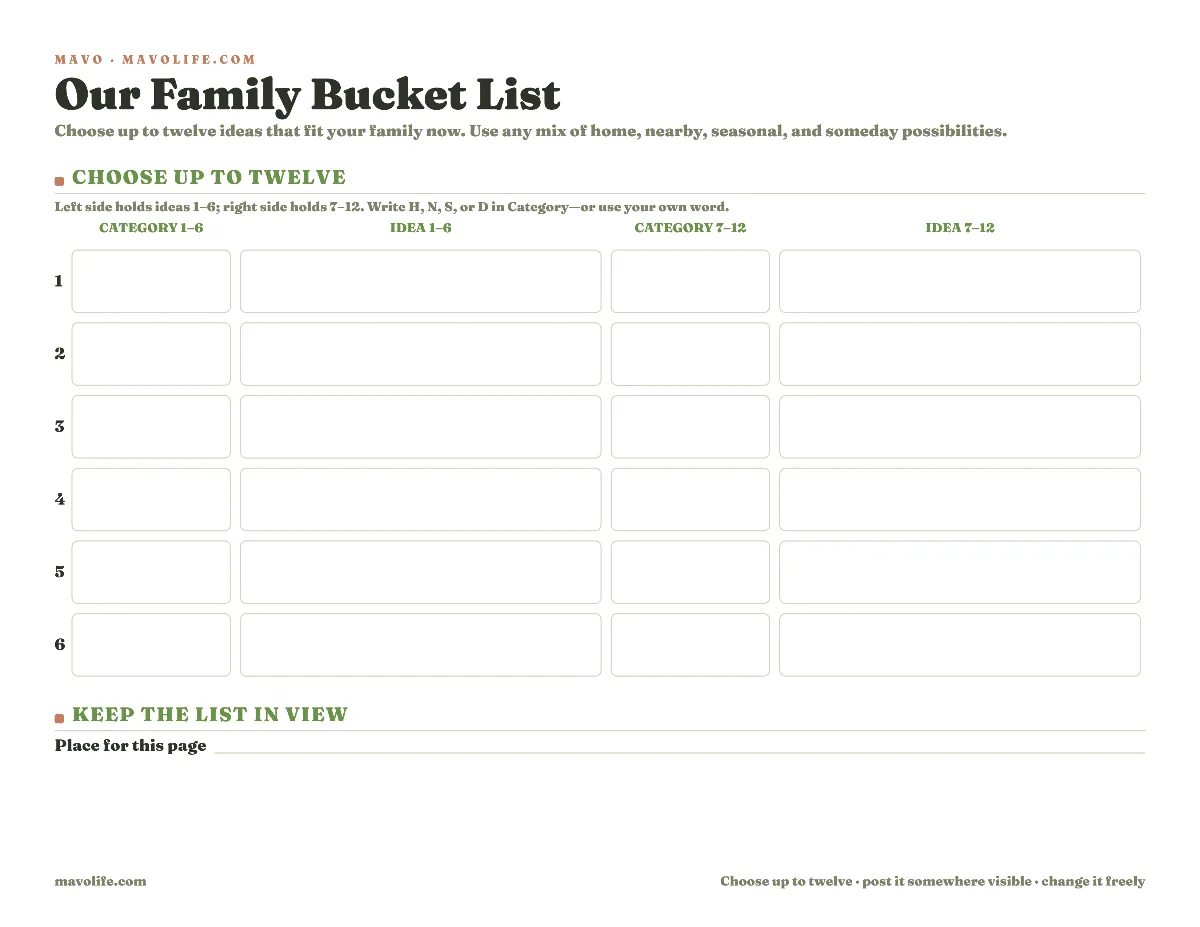
Download the fillable family bucket list (PDF)
The free worksheet has twelve flexible rows. Each row has a small category field and a wide space for the idea, so your list can hold six at-home choices and no someday choices, or any other mix. Type into the PDF or print it blank. Twelve rows are enough to make the choices visible without asking a family to adopt a hundred-item project.
Fill what you can during one conversation, then put the page somewhere a second person will see it. Blank rows can stay blank. Add, replace, or cross out an idea whenever the page stops sounding like the people who use it.

Let each person bring possibilities, not assignments
Ask each person to bring one or two ideas before the group chooses the final twelve. Someone can point to an example from this page. They might name a variation or suggest something entirely different. Nobody has to defend an idea as the most memorable choice.
Make each idea small enough to picture. “Have a picnic” might mean lunch on the porch. It could also mean a nearby park or a day trip. Write the version people actually mean. “Learn to cook together” can become one chosen dish instead of an open-ended family improvement project.
If two ideas are close, combine them only when the smaller wording stays clear. A library visit and a picnic could happen on one day, but they don't have to share a row. Either one can then survive a changed schedule.
Keep the list from becoming another obligation
Post the page where it can prompt a light question: “Does one of these fit the time we have?” The list helps when people remember possibilities. It isn't helping when empty boxes begin to look like overdue work.
You don't have to replace an idea as soon as you cross it out. A someday choice can come back when new information makes it realistic. An ordinary at-home idea can stay even after the family has done it before, because repetition may be the point.
If your household uses Mavo, a chosen idea can become a shared calendar event once it has a real date. Give that event an owner when someone has agreed to carry the next step. The worksheet doesn't sync automatically with Mavo, and Mavo won't choose activities or decide who should participate; the page remains the family's own short list.
Change the page when real life changes it
When someone suggests an idea from the page, read that row as it stands. If it no longer fits, change the scale or cross it out. You aren't preserving the original list for a score.
Keep the written page if the handwriting is worth saving, or recycle it and print a clean copy. A useful family bucket list isn't a contract with an earlier version of the household. It's a small, visible set of possibilities that can change with the people who chose it.
For more free pages built for real family use, browse the family printables collection.