Hosting & celebrations · September 30, 2026 · 6 min read
Snow Day Activities for Kids: 3 Indoor Games to Start Now
Try three indoor snow day activities for kids: draw a missing-mitten comic, tell a suitcase story, or play a listening game with ready-to-read prompts.
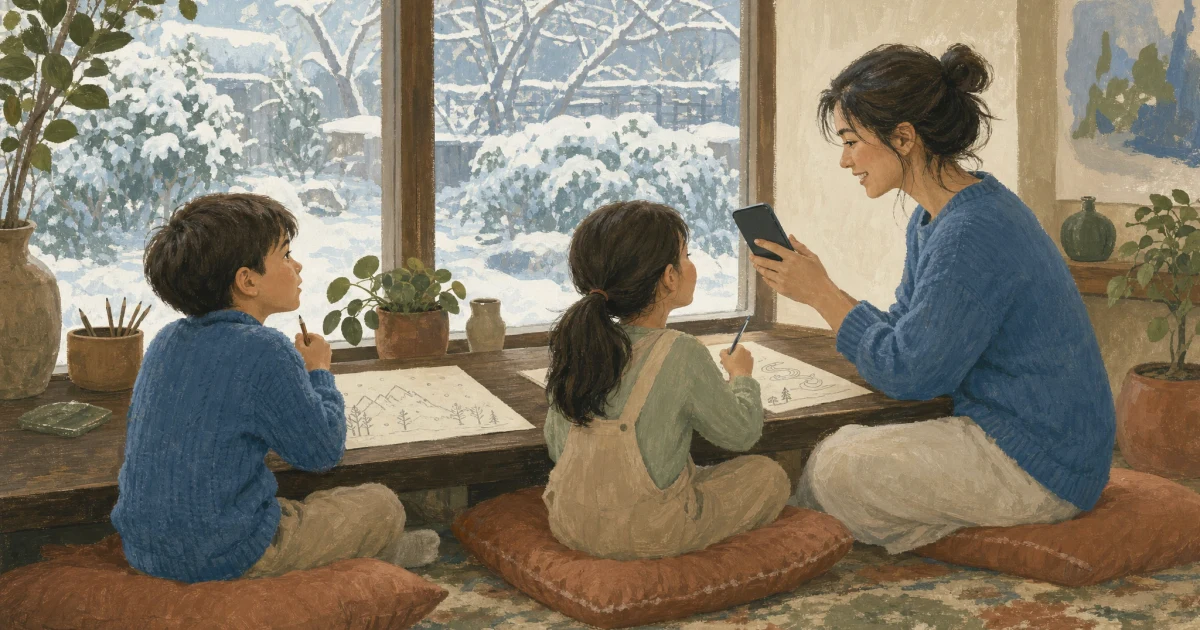
A missing mitten can take a toy-train ride. A suitcase at the front door can hold a map of a house that doesn't quite exist. These three snow day activities for kids begin with words you can read aloud, then give everyone a turn to draw, tell a story, or guess what changed.
The comic needs a sheet of paper and a pencil for each person. The other two games use voices only. Choose one from the table and go straight to its opening prompt.
| Start with | What you need | Finish after |
|---|---|---|
| The missing mitten comic | Paper and pencils | Three pictures and an ending sentence |
| The suitcase at the door | Voices only | Three scenes, with one turn per person in each |
| What changed? | One person reading from this page | Three short listening rounds |
The missing mitten comic
Turn a sheet sideways and draw two lines to divide it into three boxes. Each person makes their own comic from the same prompts. Stick figures, arrows and spoken explanations all work; the pictures don't need captions.
Read one prompt at a time. Wait until everyone is ready before moving to the next box:
- Box one: “One mitten has disappeared. Draw the last place anyone saw it.”
- Box two: “Something carries the mitten away without anyone noticing. Draw its unlikely ride.”
- Box three: “Someone finds the mitten in a surprising place. Draw where it turns up.”
Once the third box is finished, each artist says one sentence that joins their pictures. The round ends after those sentences. Show the drawings at the end so everyone can choose their own route instead of copying the first person's.
A finished example: The mitten starts on a chair by the door. A toy train carries it across the living room. Someone finds it perched on the cactus's tallest arm like a hat. The ending sentence is, “The cactus wore the mitten until the train came back.”

One possible ending. Your mitten can go somewhere completely different.
With two people, each draws all three boxes, then takes a turn telling the ending. For a larger group, go around once so each person can show their comic and say their sentence. Someone who'd rather describe a picture can do that while another person draws it. If you want another round, use the same three prompts with a striped sock or a paper hat in place of the mitten.
The suitcase at the door: a story to tell aloud
Choose a speaking order. In each of the three scenes below, go around once, with each person adding one sentence to the same story. Start the next scene after everyone has had a turn. Keep the suitcase in the story and build on what the previous speaker said.
Opening to read aloud: “On a snow day, a small blue suitcase appeared just inside the front door. A note on its handle said, ‘Please return me before dinner.’”
Scene one: open the suitcase
Ask, “What's inside, and why might it be there?” The first speaker names something in the suitcase. The next speaker adds a detail about it. Any remaining speakers continue from there.
Two-person example:
First voice: “Inside is a tiny map of our house.”
Second voice: “The kitchen has a star on it, but it's drawn where our cupboard should be.”
Scene two: follow the clue
Ask, “Where does the clue take us inside this imaginary house?” Each person adds a sentence about the journey. The whole adventure happens in the story; you can stay where you're sitting.
Two-person example:
First voice: “We open that cupboard and find a little doorbell.”
Second voice: “When we ring it, a paper bird appears and asks whether we've found its suitcase.”
Scene three: return it
Ask, “What does the owner need from the suitcase?” Go around once more. The final speaker returns the suitcase to its owner and ends the story in that last sentence.
Two-person example:
First voice: “The bird needs the map to find its nest behind the kitchen clock.”
Second voice: “We give the suitcase and map to the bird, and it flies home before dinner.”
With two people, that's two sentences per scene. A larger group gives each person one sentence in each scene, including the last one; wait until the final turn to end the story. Anyone can pass. If the final person passes, the reader adds the closing sentence. If a speaker is stuck, read an example line above and let them continue from it.
For another story, keep the three-scene rules and read this opening: “A purple umbrella is leaning against the sofa. A label says, ‘Lost by someone who has never seen rain.’” Open it to find the clue, follow that clue through an imaginary house, then return it to its owner. Stop after the third scene.
What changed? A listening game
Pick one reader for the three prepared rounds. Everyone else listens without looking at this page, because it shows both versions and the answers. The reader says the first sentence, pauses, then says the second. The listeners name the one changed detail.
Round one
Read first: “A red scarf is hanging by the door.”
Read second: “A blue scarf is hanging by the door.”
Answer: The scarf changed from red to blue.
Round two
Read first: “Three paper birds sit on the windowsill.”
Read second: “Three paper birds sit on the bookshelf.”
Answer: The birds moved from the windowsill to the bookshelf.
Round three
Read first: “The toy train brought a mitten to the cactus.”
Read second: “The toy train brought a hat to the cactus.”
Answer: The train brought a hat instead of a mitten.
Read at an ordinary speaking pace, and repeat both sentences if someone asks. In a two-person game, the listener guesses or passes, then the reader says the answer. With a larger group, invite an answer from each listener before revealing it. Nobody needs to keep score. Finish after the third round.
If you want to switch readers, make new sentences so the next guesser hasn't already seen the answers. Use an object in the room: “A pencil is on the table” becomes “A pencil is under the table.” Change one detail, such as its color, number, object or location. For two people, swap reader and guesser after each new round; in a larger group, let a different person read and everyone else guess.
When the day also needs a care plan
These are activities to do together indoors. If the school closure also leaves work hours without a caregiver, use the separate no-school-day childcare plan to work out which parts of the day need a person. For more games to play at the table, the holiday party games include complete printable rounds. More gathering ideas are in the family hosting collection.