Moving binder printables: find the box you need
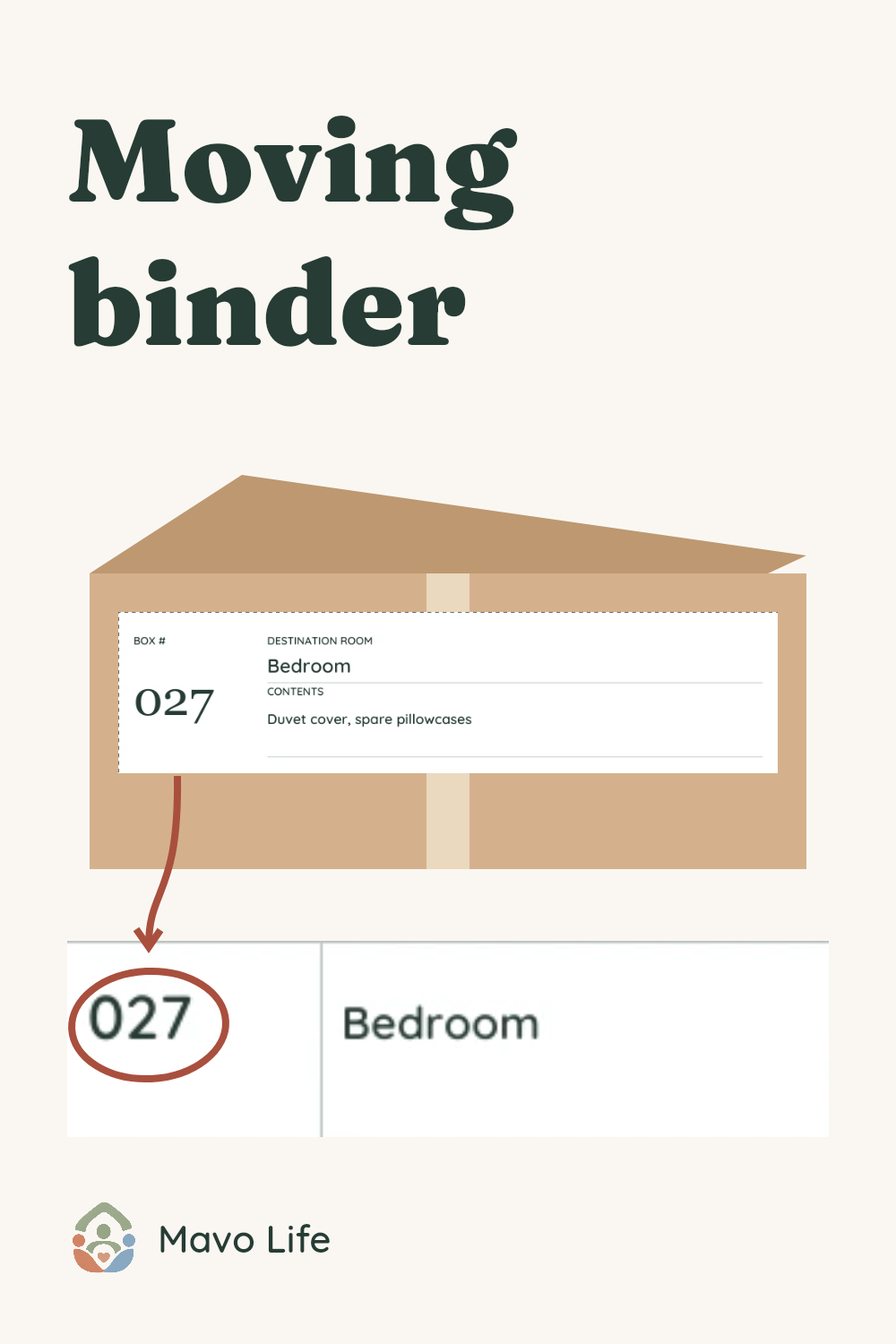
Give each packed box a number, then write that number beside its contents in the binder. This free kit gives you a box index, matching labels, a short first-open list and a timeline for your own moving tasks. When you want the duvet cover, the example shows you where to look: box 027, Bedroom.
Four reusable pages, free without email or an account. Type into the 90 fields or print and write by hand. Entries on different pages do not update one another; copy each change to the matching index row, label and first-open entry.
The four pages in the blank kit
Start with the index and labels. Add the first-open list when you know which packed items you want to find sooner; use the timeline for tasks that need a date. You can print only the pages you need from the four-page PDF.
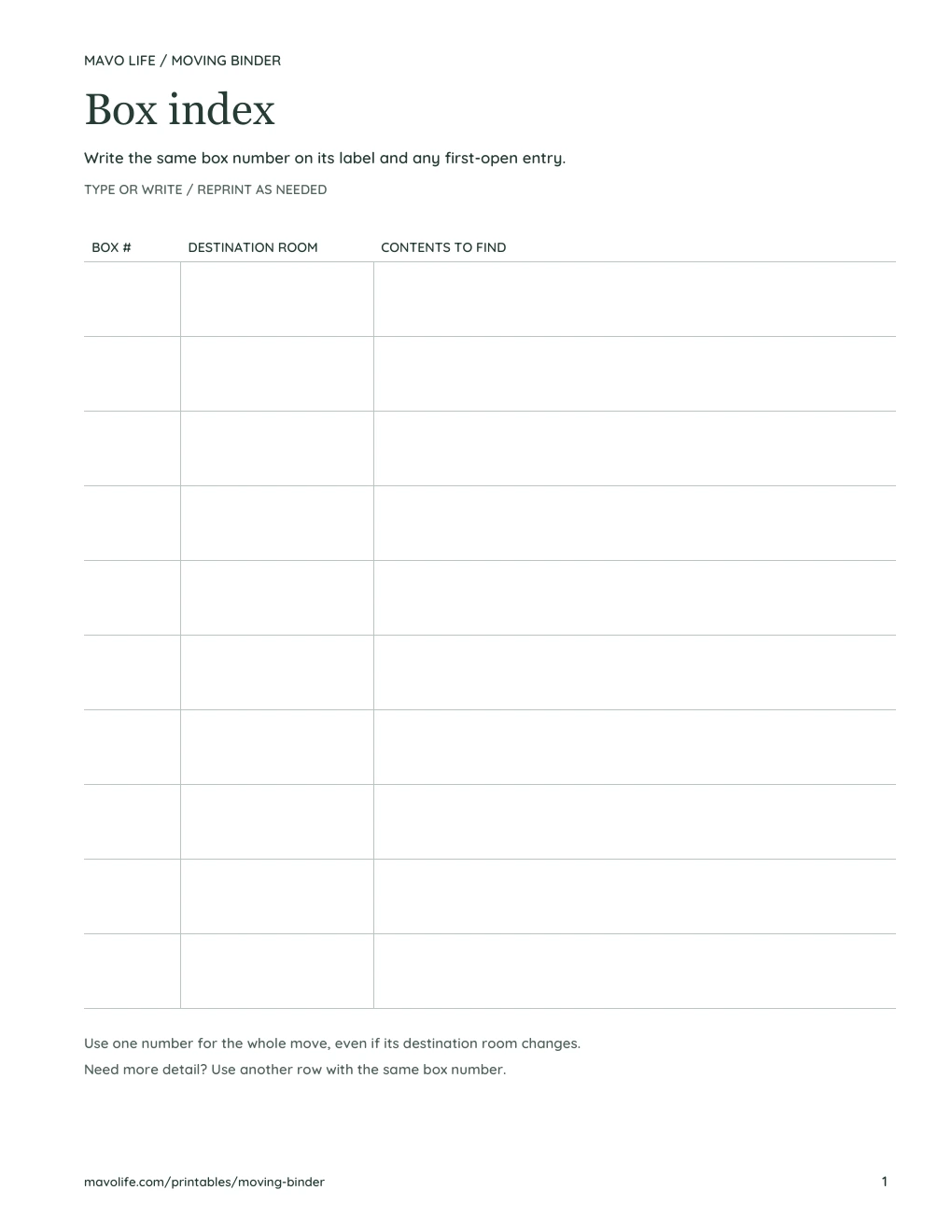
Box index
Ten roomy rows for the box number, destination room and contents. Print extra copies as you pack more boxes. If one box needs two rows, repeat its number on both.
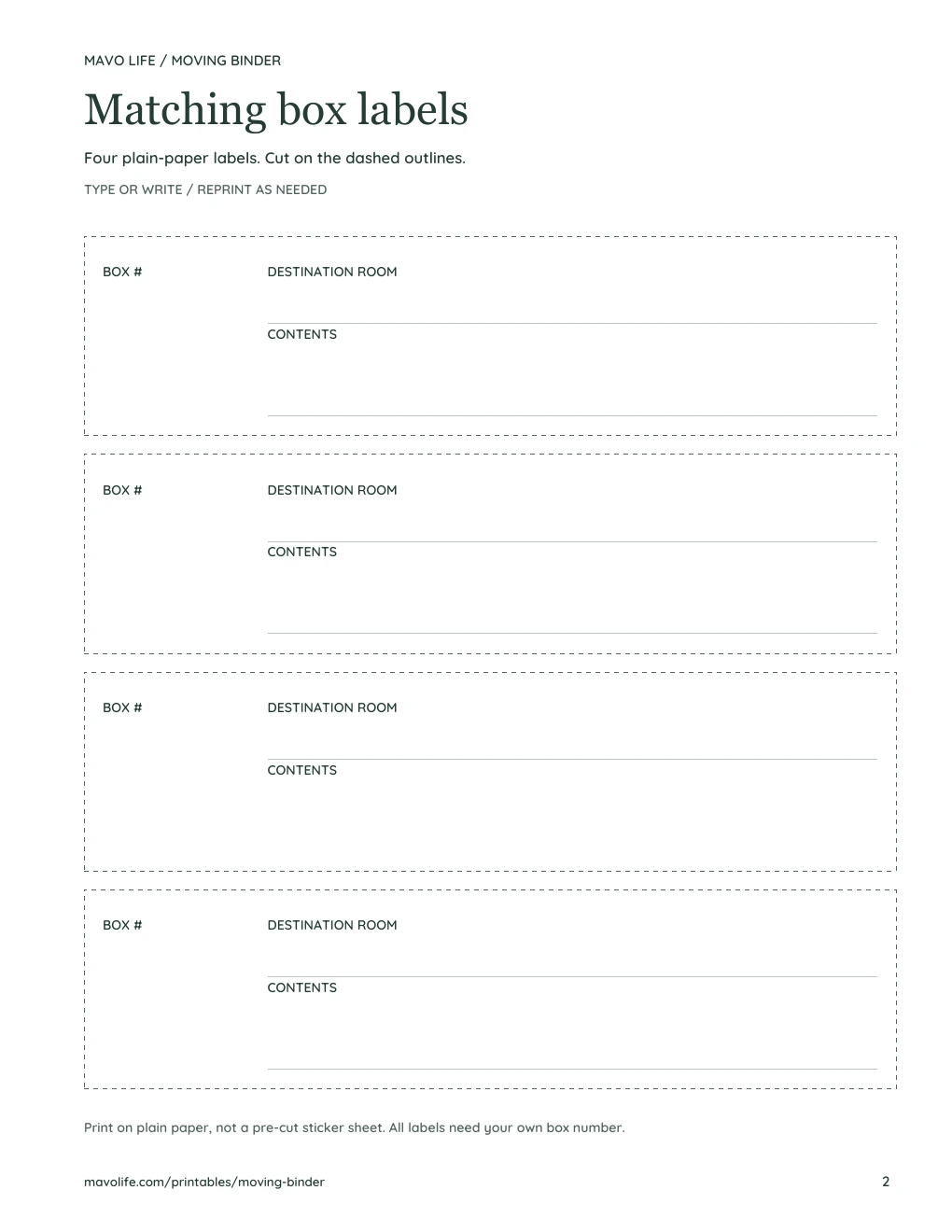
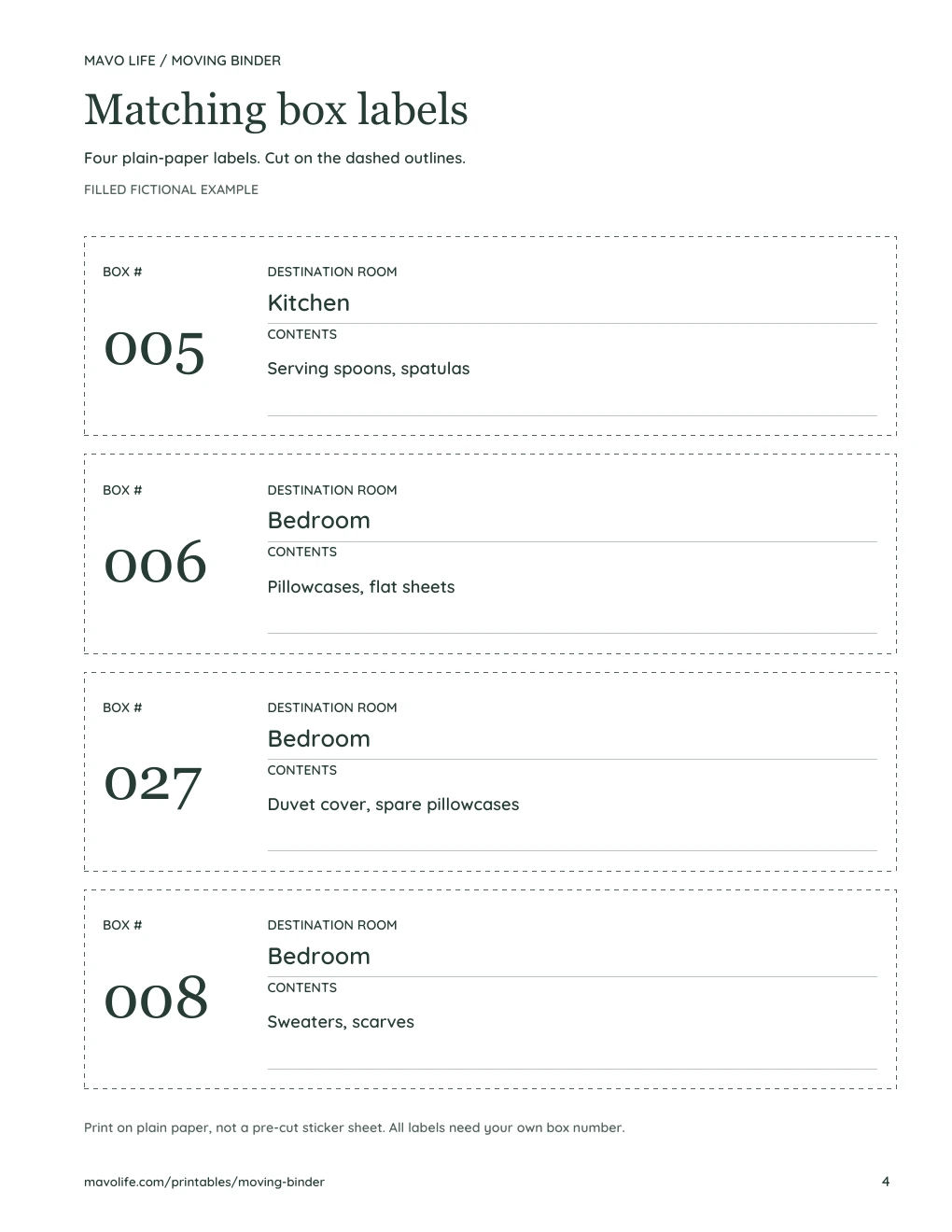
Matching box labels
Four large labels per page, each with a prominent number and room for the destination and contents. These are for plain paper that you cut apart and attach to a box, rather than a pre-cut sticker sheet.
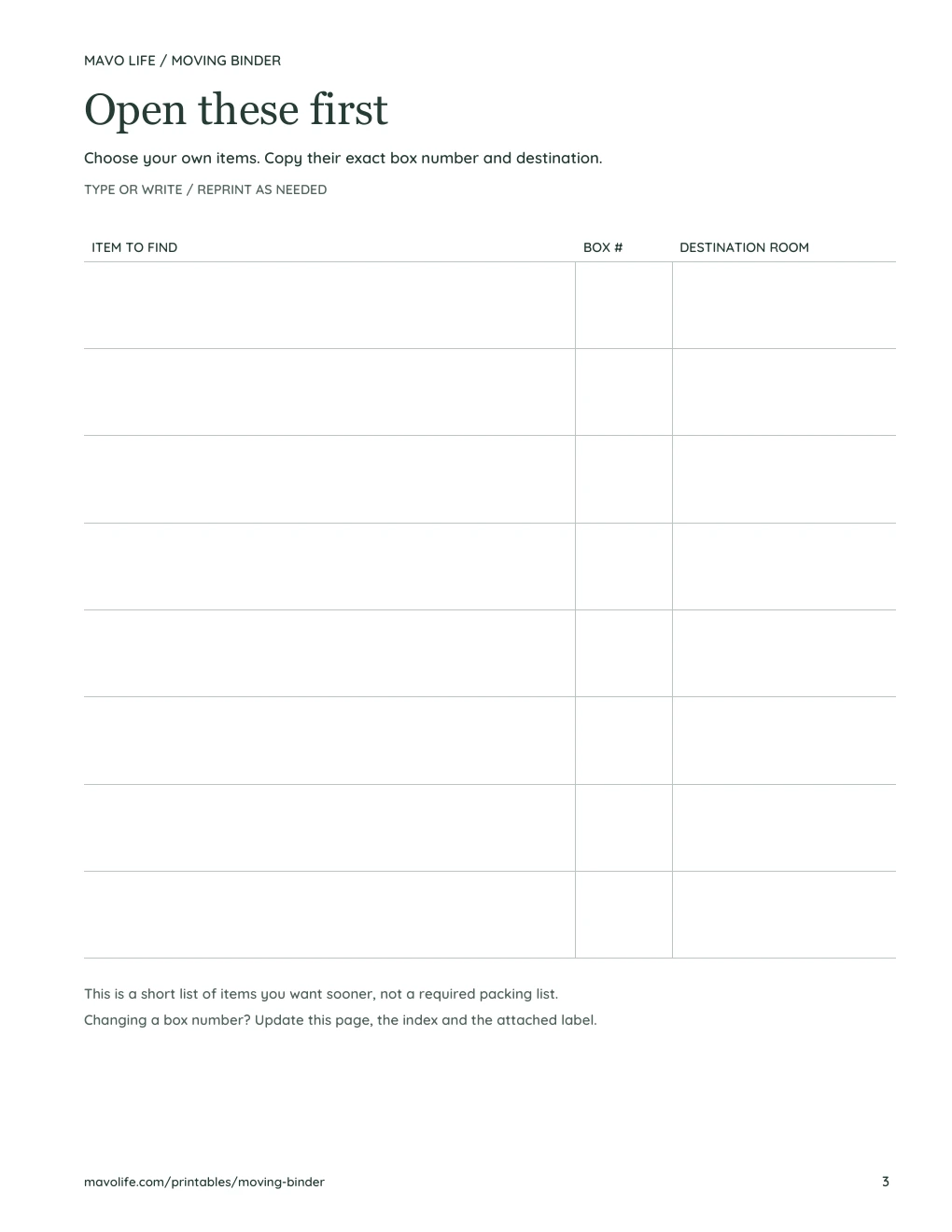
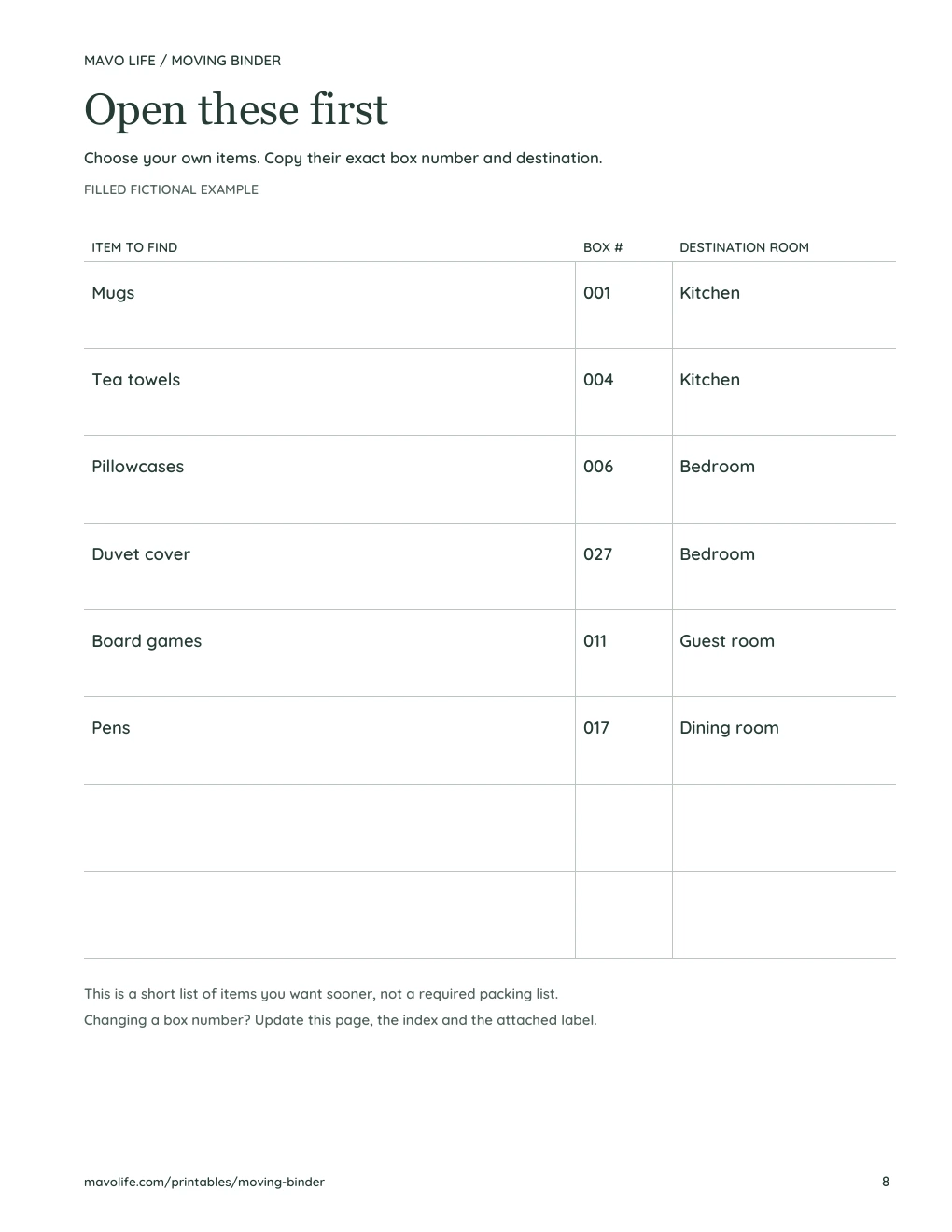
Open these first
Eight rows for items you choose to find sooner, with their box number and destination room. Use it as a short lookup list, whether you want the mugs, a favorite blanket or a board game.
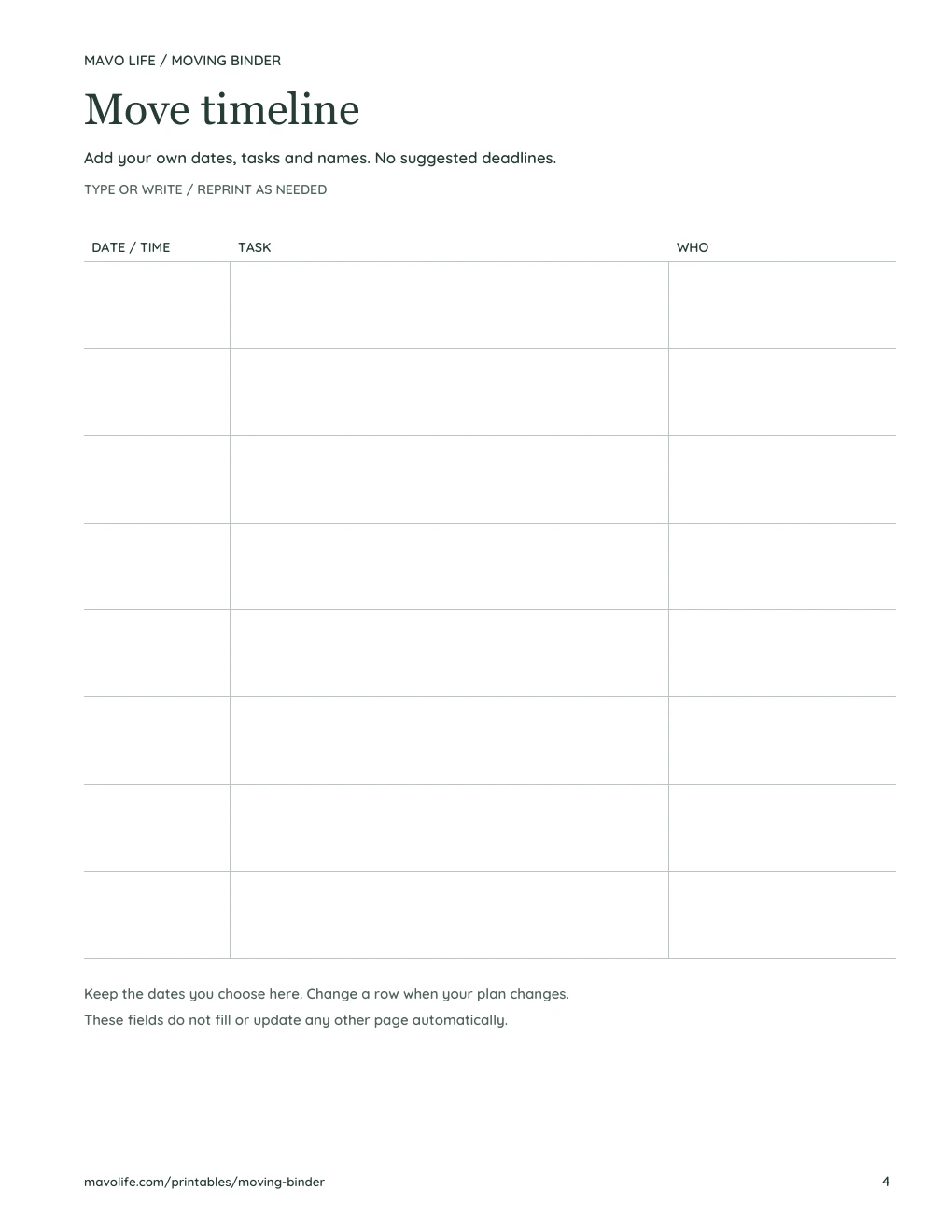
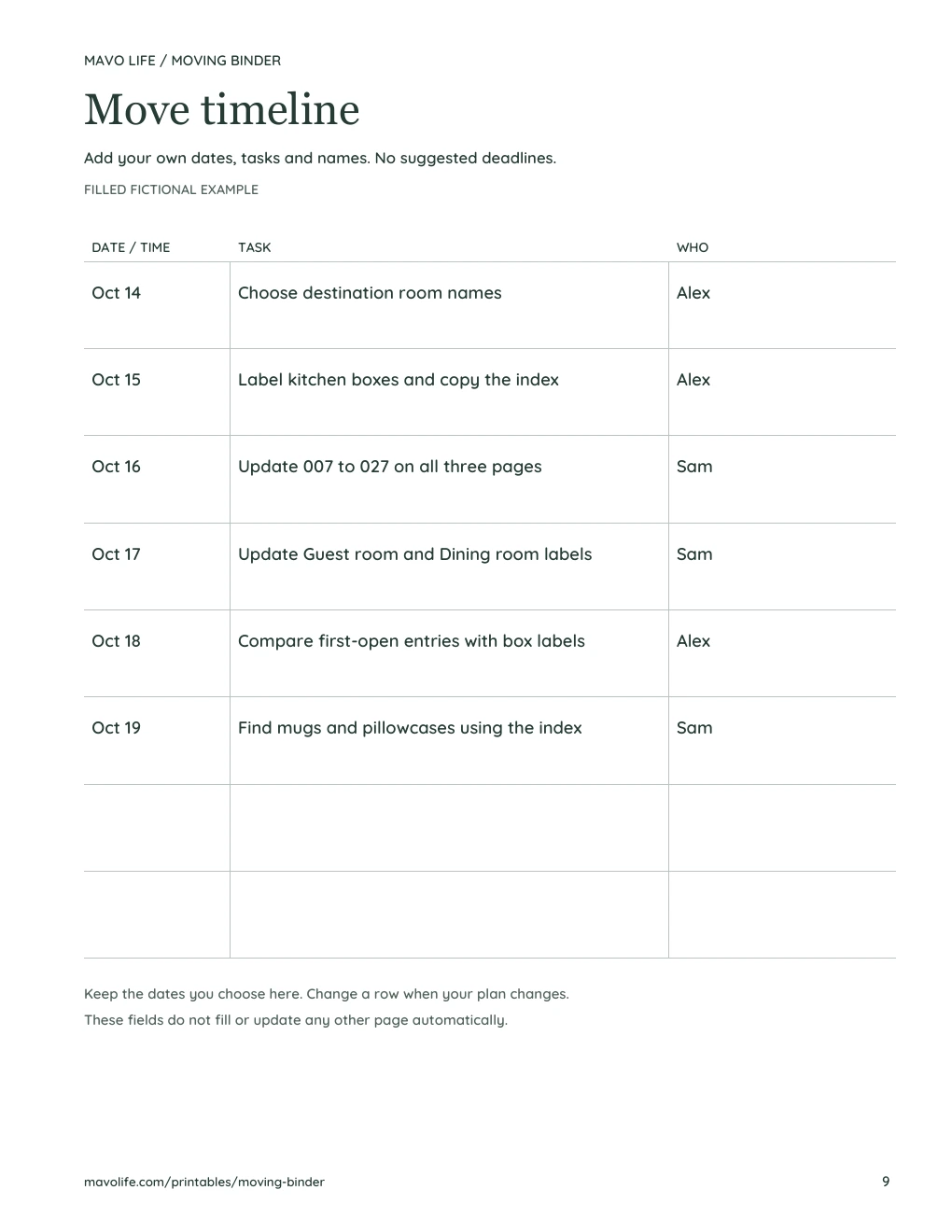
Move timeline
Eight rows for your own dates, tasks and the person doing them. Add the packing and unpacking steps you have chosen. The dates and names in the separate filled example are fictional.
Use one box number throughout the move
Start with 001 and give the next box a different number, even if it belongs to another room. Write the destination room separately. That lets you change “Living room” to “Guest room” without changing the identity of the box.
On the index, use contents you would search for: “Duvet cover, spare pillowcases” is easier to find than “Bedroom stuff.” Put the same number on the attached label. The contents can be brief on the label and longer in the index, provided they describe the same box.
To find an item, scan the contents column, read the box number and destination, then look for that label. If you start with a box instead, use its label number to find the index entry. Keep the binder with the pages you are using rather than packing it inside a numbered box.
Two people can pack at once by choosing different number ranges, such as 001–050 and 051–100. Before adding their pages to the binder, check that a number has not been given to two different boxes. If a number was duplicated, choose an unused replacement and update every place where that box appears.
A complete 20-box example, including corrections
The separate nine-page sample contains two completed index pages, all twenty matching labels, a six-item first-open list and a filled timeline. It shows fictional belongings packed from four rooms. These entries are examples to learn from; the main download is blank.
In this sample, box 007 has been renamed 027. The duvet cover now points to 027 in the index, on the label and on the first-open list. The Living room boxes are going to the Guest room, and the Study boxes are going to the Dining room. Their numbers stay the same while their destination entries change.
Index entry
027 · Bedroom
Duvet cover, spare pillowcases
Attached label
027 · Bedroom
Duvet cover, spare pillowcases
First-open entry
Duvet cover
027 · Bedroom
For a correction on paper, cross out the old entry so one current number remains readable. On a typed copy, replace the value and reprint the affected page or label. Finish by checking one item in both directions: its index entry should lead to the label, and that label should lead back to the same contents. The PDF does not make these changes for you.
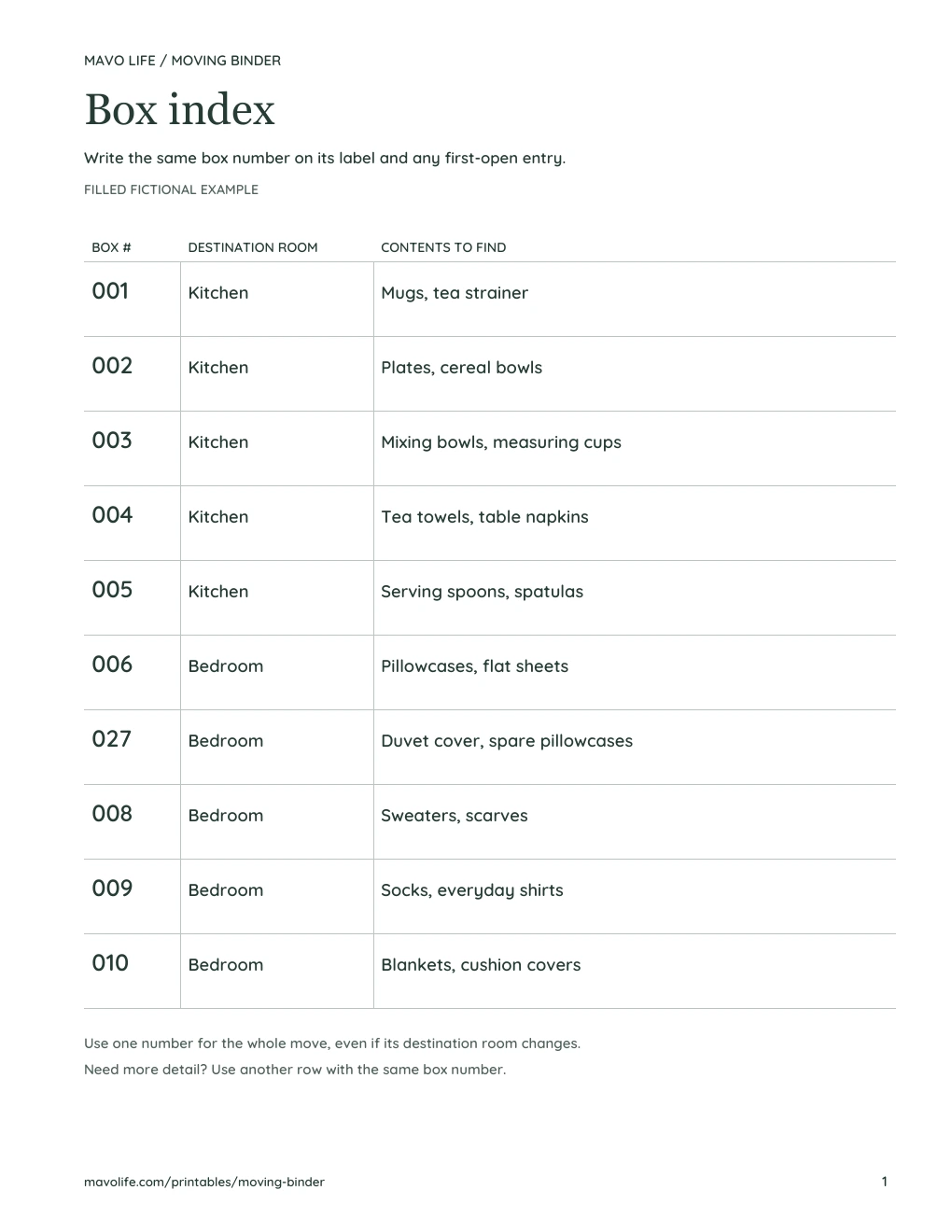
Read all 20 example box entries
- 001 · Kitchen: Mugs, tea strainer.
- 002 · Kitchen: Plates, cereal bowls.
- 003 · Kitchen: Mixing bowls, measuring cups.
- 004 · Kitchen: Tea towels, table napkins.
- 005 · Kitchen: Serving spoons, spatulas.
- 006 · Bedroom: Pillowcases, flat sheets.
- 027 · Bedroom: Duvet cover, spare pillowcases.
- 008 · Bedroom: Sweaters, scarves.
- 009 · Bedroom: Socks, everyday shirts.
- 010 · Bedroom: Blankets, cushion covers.
- 011 · Guest room: Board games, playing cards.
- 012 · Guest room: Novels, bookmarks.
- 013 · Guest room: Photo frames, shelf ornaments.
- 014 · Guest room: Throws, sofa cushions.
- 015 · Guest room: Drawing pads, colored pencils.
- 016 · Dining room: Notebooks, folders.
- 017 · Dining room: Pens, ruler, paper clips.
- 018 · Dining room: Desk organizers, bookends.
- 019 · Dining room: Reference books, sticky notes.
- 020 · Dining room: Envelopes, blank paper.
Print or type, then repeat only the pages you need
Choose US Letter for 8.5 × 11-inch paper or A4 for 210 × 297-millimeter paper. Print in portrait at Actual size or 100%. The working pages use white backgrounds and dark type, so they can be printed in black and white. Check the first page in your printer’s preview before printing the whole kit.
The binder pages leave a three-quarter-inch margin on the left. Use single-sided pages if you plan to punch them; a double-sided copy would put that margin on the wrong side of its back page. You can also slip the pages into protectors. Cut the label sheet on the dashed lines and attach the labels to your boxes.
For twenty boxes, print two blank index pages and five label pages. The four-page kit includes one of each, so choose extra copies of pages 1 and 2 in your print dialog. Keep each box number unique across those copies.
To type first, download the PDF and open it in a viewer that supports fillable forms. Save a copy, close it, reopen it and check that your entries remain before printing. If the browser preview will not retain your typing, use a form-capable PDF viewer or print the blank pages and write by hand. These files have text fields, but no calculations or automatic matching.
When the index fills up, continue on another copy. If you want to type different entries into several index pages, save a separate copy of the kit for each set; printing the same filled page twice repeats its entries. Once a box has been unpacked, you can cross through its index row while keeping the remaining numbers intact.
The same number on the box and in the binder
Deciding what goes to the new place?
The new house essentials list helps you choose what you already have, what to bring, what to borrow and what can wait. Use that for belongings decisions, then use this binder to locate the boxes you packed. The printable library has more free household resources.
Published October 7, 2026.