Free dots and boxes template
Print a board, choose who goes first, and take turns joining the dots. Start with nine boxes to get used to the extra-turn rule, or choose the 36-box board for a longer game. Each sheet has the rules, space for two names and a final score, and a picture of the move that closes two boxes at once.
Two pages in each file: page 1 has a 3 × 3 box board, and page 2 has a 6 × 6 box board. The playing grids are blank. No account or email is needed.
Choose your board
For the small board, print page 1. Its four rows of four dots leave plenty of space to draw lines and write initials. The larger board has seven rows of seven dots, making 36 boxes. Print only the page you want to play.
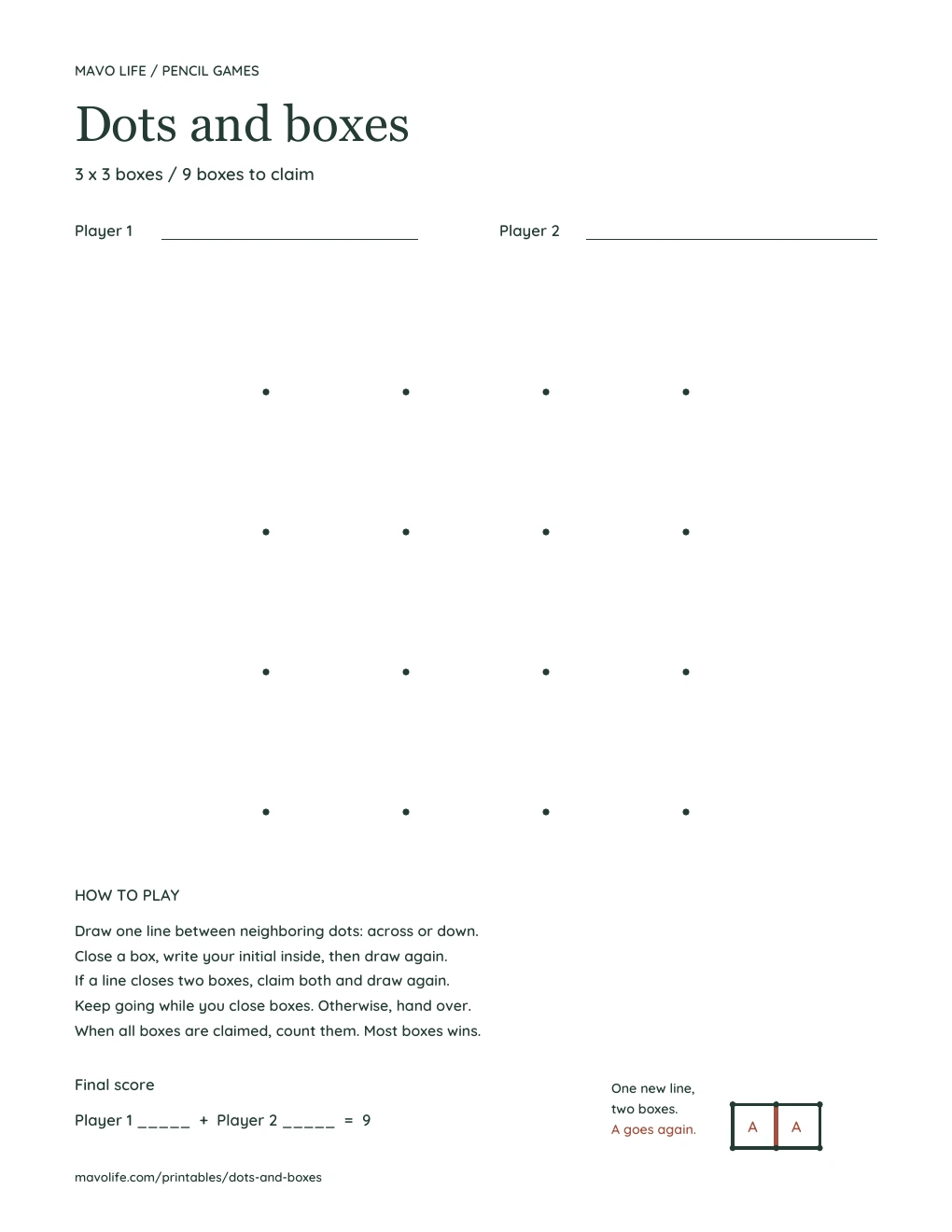
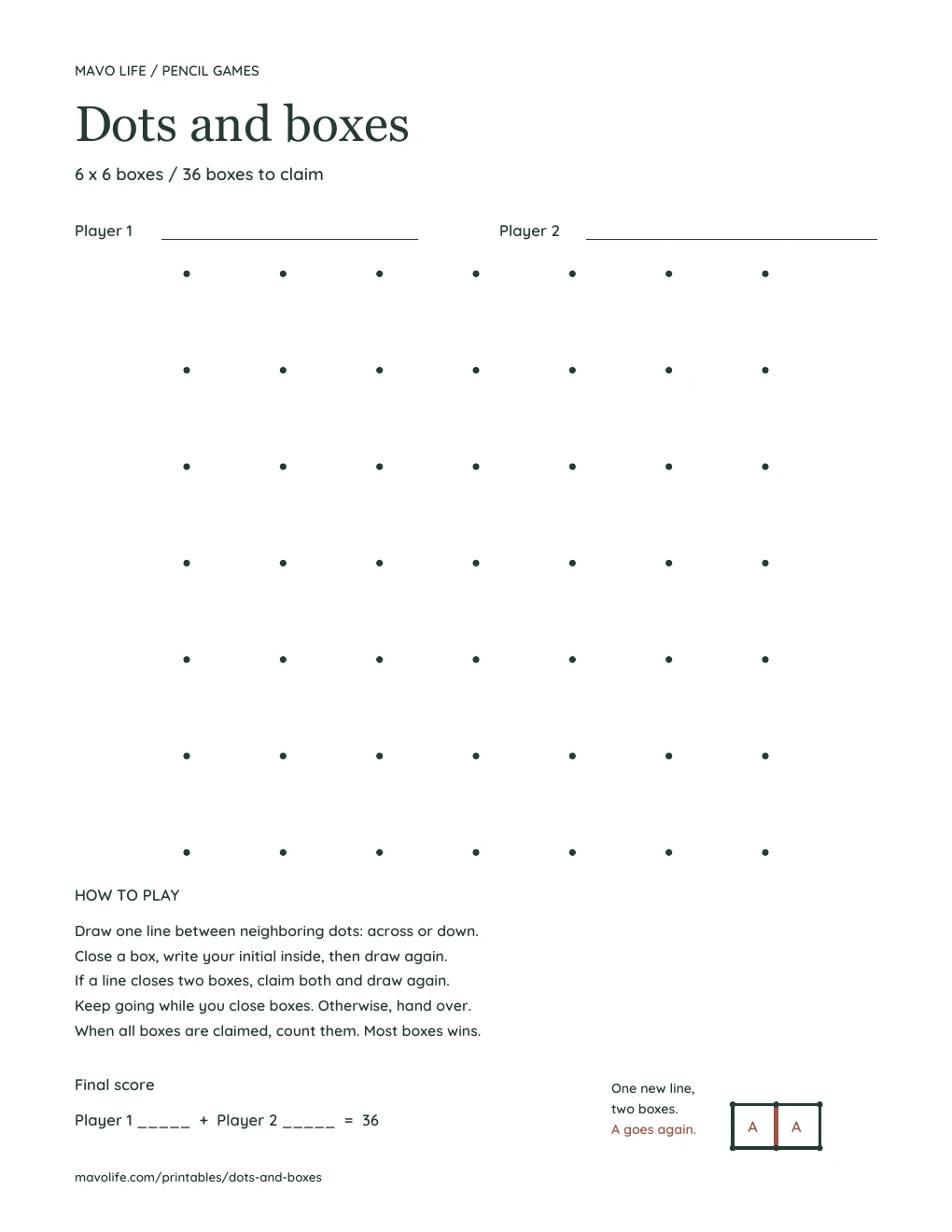
Print at Actual size or 100%, with the paper size matching the PDF. The dots and text are dark enough for black-and-white printing. These are fixed game sheets to mark with a pencil or pen; the PDFs have no editable fields.
How to play
- Write both names at the top. Use different initials or symbols if your names start with the same letter. Choose a first player; one shared pencil is enough.
- On your turn, draw one horizontal or vertical line between two neighboring dots. Skip diagonals, long lines that pass over a dot, and sides already drawn.
- If your line completes the fourth side of a box, put your initial inside and take another turn. If it completes two boxes, claim both and take one more turn. Keep drawing while your moves close boxes; when a move closes none, pass the pencil.
- Stop when all boxes are claimed. Count each player’s boxes and write the totals. They should add up to 9 on page 1 or 36 on page 2. The player with more boxes wins; equal scores on the larger board are a tie.
These rules follow the University of Texas dots and boxes game sheet. The boards and worked example here are original Mavo layouts.
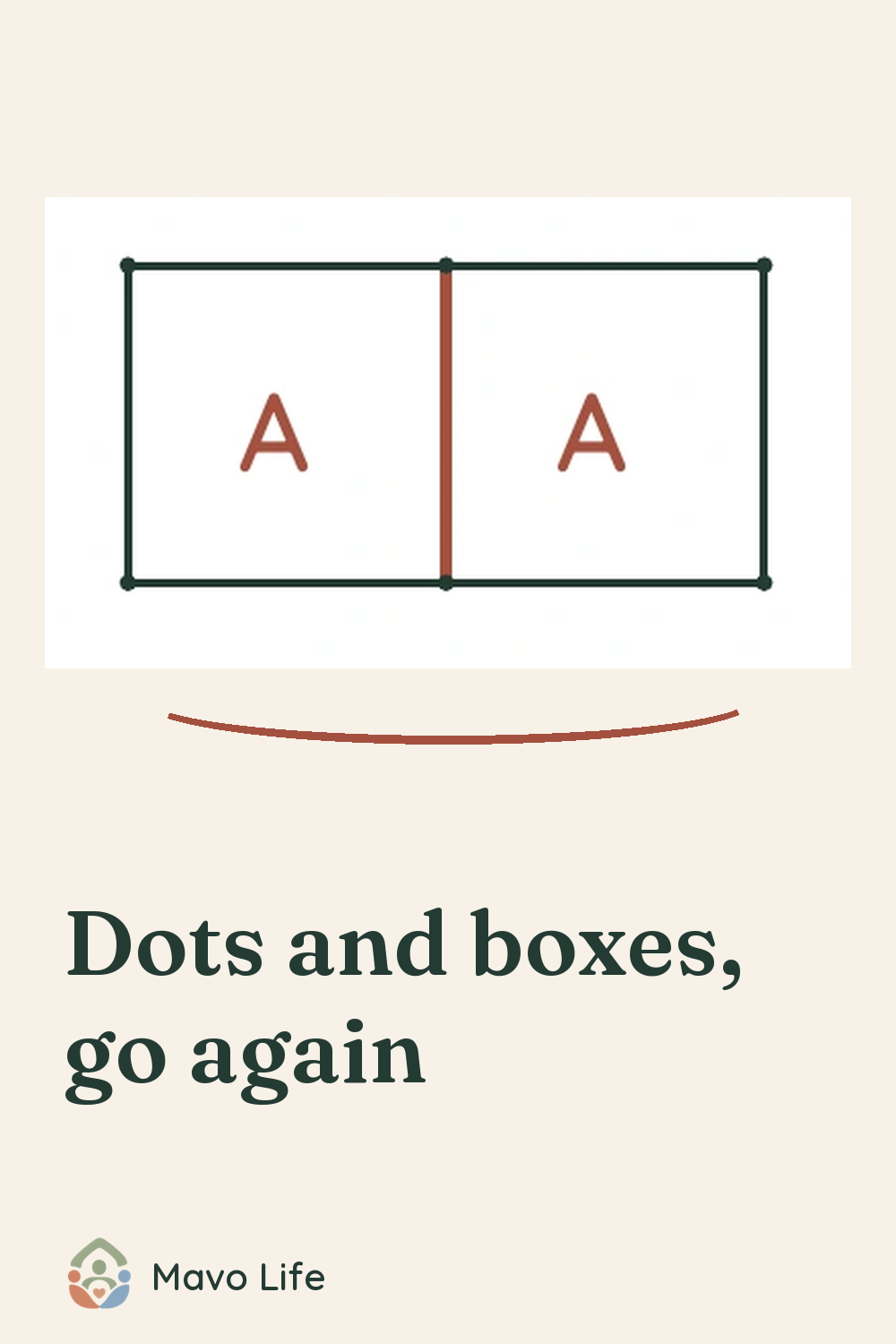
One line can win two boxes
In this example, both boxes have three sides. Player A draws the missing middle line. It is the fourth side of both boxes, so A writes an initial in each and goes again. Closing two boxes earns two points and one further move, rather than two further moves.

A run of completed boxes can keep the same player drawing for several moves. Follow the same rule after each line: claim any newly closed boxes, then check whether the pencil stays with you or passes to the other player.
Save a game for later
For games based on things you spot outside, try the four-page road trip game pack. More pencil-and-paper downloads are in the free printable library.