Home systems · July 29, 2026 · 9 min read
Family Emergency Binder: Free Printable Kit
Build a family emergency binder that works like a map, not a vault: free fillable sheets for trusted contacts, record locations, and an annual review.
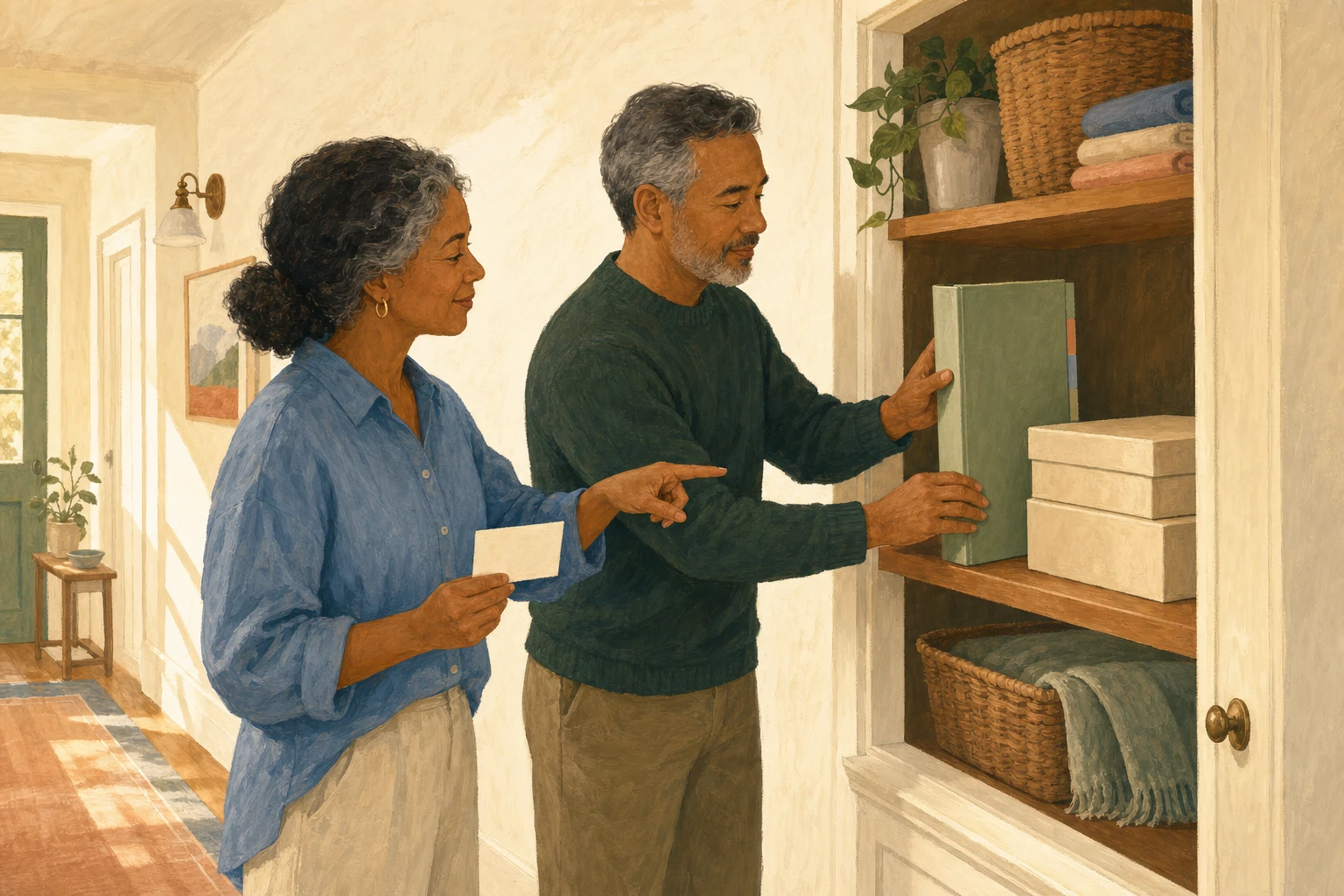
Every family has one person who knows where everything is. Which drawer holds the passports, which app has the insurance card, which shelf in the basement has the folder marked House. A family emergency binder exists for the day that person can't answer the phone.
So write it for its actual reader. Not you. The sister who flew in, or the neighbor who holds your spare key. Someone is standing in your kitchen with a list of questions: who covers the kids' Wednesday pickup, which company insures the house, where you keep the will, whether the dog has a vet. Read those questions again. Every one is a who or a where. Not one of them is answered by an account number.
Most emergency binder templates get this backwards. They have you photocopy identity documents, list every account, and file medical history into a three-ring binder, then leave it somewhere findable. A binder complete enough to restart your life is also complete enough to steal one, so now it has to be guarded like the originals it duplicates, and it starts going stale the day you print it. Meanwhile the questions your sister actually has still aren't on any page.
There are two honest jobs a binder can do. A vault holds protected copies, and some households genuinely need one. A map holds names, contacts, and locations, and every household needs that one. This guide and the free printable kit below build the map: who to call, where the real records live, and when someone last checked. The vault, where you need it, stays locked up where it belongs.
What should go in a family emergency binder?
Enough for a trusted adult to act, and no more. FEMA's Emergency Financial First Aid Kit sorts household records into identification, financial and legal, medical, and household contact information, and those categories are the right checklist. The mistake is assuming every category earns pages. Most earn a single line.
| Record group | What's in it | What the binder holds |
|---|---|---|
| Household identification | Passports, birth certificates, Social Security cards | One line naming where the originals live. Copies belong in protected storage, not on a shelf. |
| Insurance and property | Home, renters, auto, and health policies; deeds, titles, a household inventory | The agent or company contact, plus where each policy lives. |
| Medical needs | Insurance cards, medication lists, clinician contacts | Clinician and pharmacy phone numbers at most. Health details keep their own protections. |
| Financial and legal | Account records, tax files, wills, powers of attorney | Institution names and document locations. Numbers stay off the page. |
| Contacts and plans | Trusted adults, an out-of-area contact, meeting places, pet plans | The full details. This is the binder's home turf. |
Each record gets one deliberate choice: keep the original in protected storage, keep a protected paper copy, keep a secure digital copy, or write a one-line pointer to wherever it already lives. The pointer does more work than people expect, and it's the only option of the four that's safe to leave in a kitchen cabinet.
Should the binder hold copies or just a record-location index?
Copies earn their place when the binder might leave the house with you. If evacuation is a live possibility where you live, take the storage advice as seriously as the copying advice: Ready.gov recommends flood-safe containers for papers like passports and birth certificates and digital copies for insurance policies, and the FTC's important-papers guide adds a lockable fireproof box for the grab-and-go set, off-site storage for hard-to-replace originals, and strong passwords with multifactor authentication for anything in the cloud. Provision Planner's family emergency binder guide is a thorough worked example of building that kind of binder.
A location index earns its place everywhere else, because a pointer has two properties a copy can't
match. It leaks nothing: Home insurance, locked file box in upstairs closet starts a trusted
adult in the right place without exposing a policy number. And it barely ages: a copied policy goes
stale at every renewal, while the file box stays put for years.
You don't have to pick a philosophy. Pick per record. The question for each one is whether it might need to leave the house in your hands, or just needs to be findable by someone else's.
Whichever way a record goes, remember what paper can't do: a binder grants no authority. A location label doesn't make anyone an executor or a guardian. It just saves them a search.
What does the free Mavo emergency binder include?
Three fillable sheets, one for each part of the map. A trusted contacts page names the people. A record location index says where every group of records lives. An annual review page records that someone actually checked. Nothing on any page is worth stealing, which is exactly what lets the binder live somewhere findable.
Download the free family emergency binder PDF kit
Download the complete fillable family emergency binder kit (PDF, 3 pages)
Each page is fillable on a computer and roomy enough for a pen. Contacts up front, the index in the middle, the review page at the back. The sheets are also available individually:
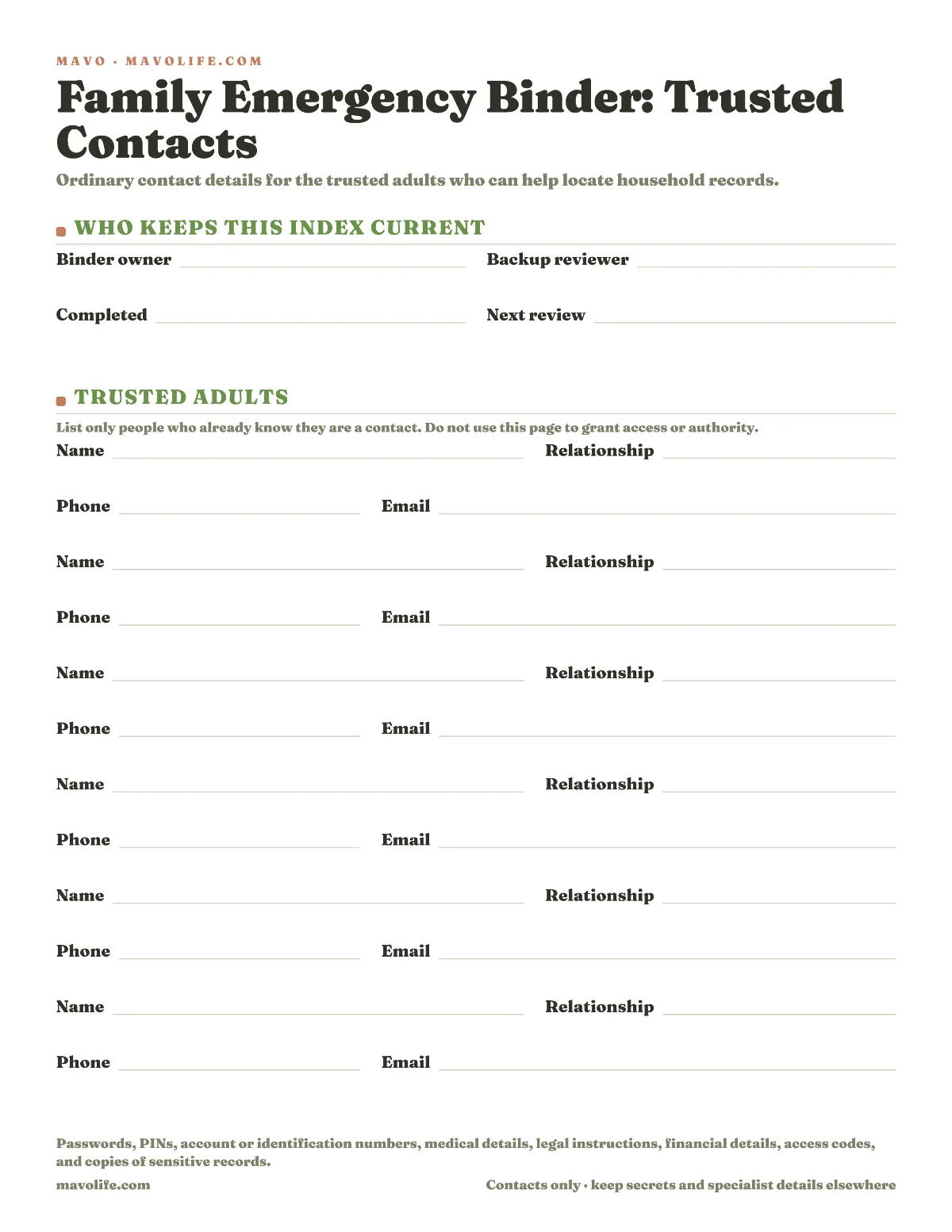
Download the fillable trusted contacts sheet (PDF)
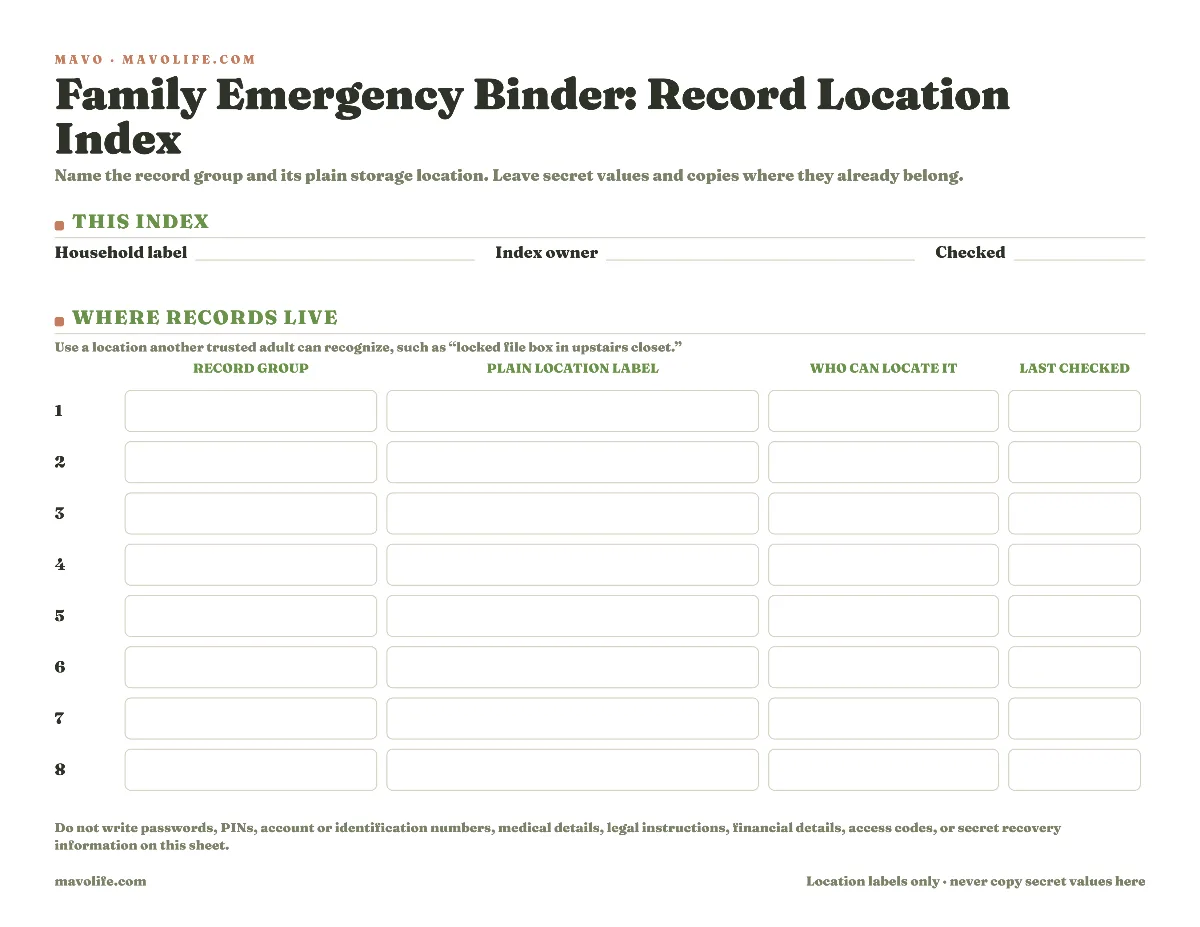
Download the fillable record location index (PDF)
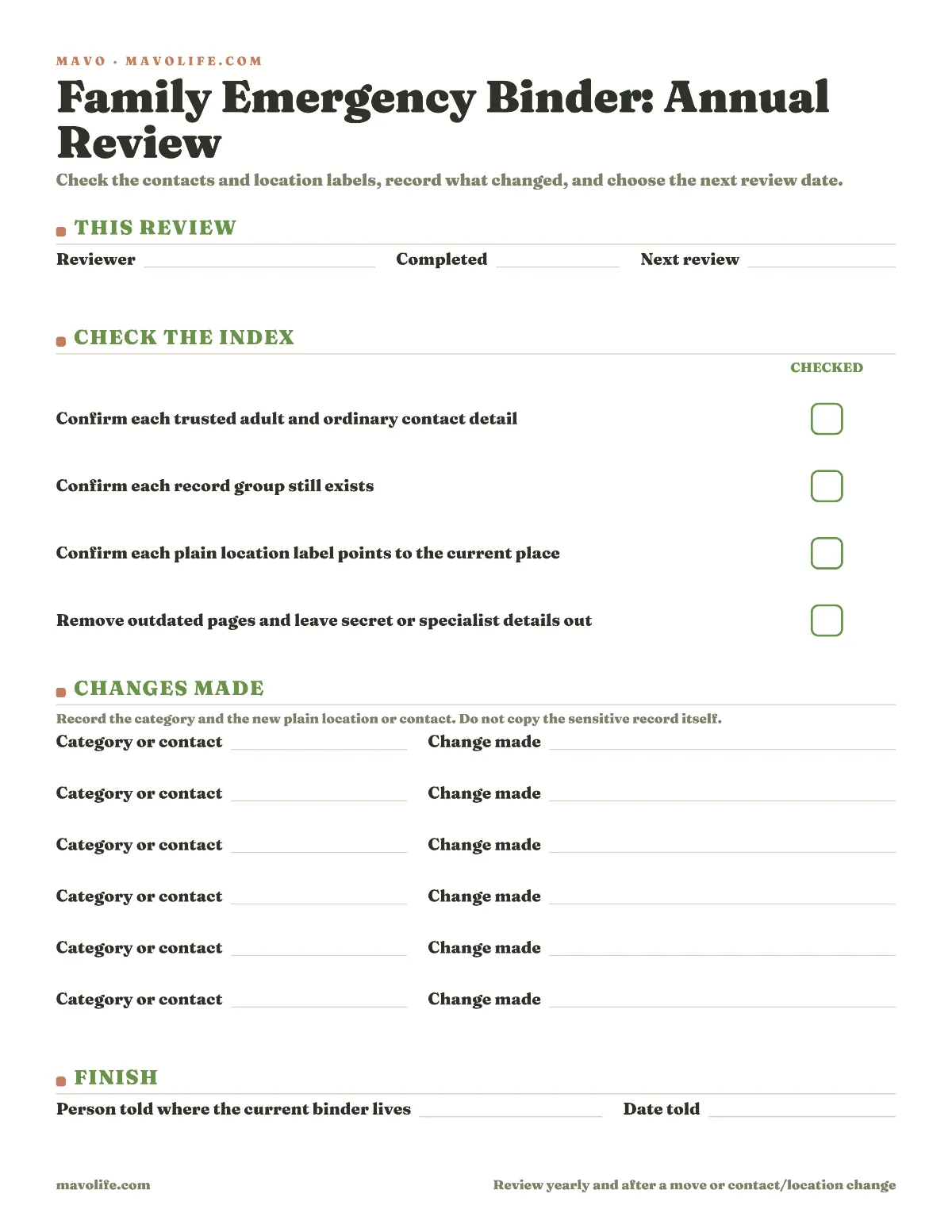
Download the fillable annual review sheet (PDF)
Skip what your household doesn't need. Two adults who already share every record location may only want the index and the review page. Empty space is better than a name added to make a page look complete.
Start with the trusted contacts sheet
Name one person who keeps the index current and one backup. These aren't legal roles, and the sheet grants nobody access. They're just the two people who agreed to notice when a phone number dies or a file box moves.
Then list the adults someone should reach when the usual person can't be: name, relationship, phone, email. Every listed person should already know they're on the page. Send each one a message before you print, confirm the number still works, confirm they're still willing. The binder records an existing arrangement. It shouldn't surprise anyone with a role they never accepted.
Keep child and caregiver instructions off this sheet: no school details, pickup permissions, or daily schedules. A regular caregiver needs more than a contact card, and that's a different document with different care behind it. Mavo's caregiver handbook covers that job.
Map records without copying sensitive details
One row per record group: a category your family actually says out loud, then the place where the
originals live. Warranty records, cream folder on the office shelf. Vehicle service records, garage cabinet, top drawer. The label has to name a real destination. Somewhere safe is a
memory, not a location.
Use the third column for who can find that group and the fourth for the date it was last checked.
Then run the decode test: if only its author can follow a label, rewrite it together. Office folder is obvious to the person who filed it and useless to everyone else.

When the underlying records are sensitive, keep the row general. Specialist records, locked cabinet is plenty. Don't name individual documents, copy their contents, or explain how to get
past whatever protects them.
Run the emergency binder checklist before it goes on the shelf
Give every row two passes. Cover the location column and ask whether what's left reveals anything worth protecting; if it does, make the category broader. Then cover the category and ask whether the location alone would put a trusted adult in the right room; if it wouldn't, make the place more concrete.
Then sweep the whole binder for things that never belong on its pages:
- Passwords, PINs, recovery codes, and any identification numbers or copies
- Bank, credit, insurance, tax, or payment details, balances, assets, or debts
- Diagnoses, medications, allergies, treatment notes, or medical records
- Wills, powers of attorney, guardianship or custody instructions, final wishes
- Evacuation routes, utility shutoffs, first aid, and other survival instructions
- Child profiles, school and childcare details, and daily routines
Most of those deserve their own well-kept documents, a few of them with professional help. The binder doesn't replace any of them. It tells the right person where the household decided to keep them.
Adapt it for two homes, a move, or a small household
With records split across two homes, put the home first in every label: North home, office shelf, blue box. During a move, keep each row pointed at one current place. Sealed box 14, new-house study works if another adult can recognize it; update the row again when the box is unpacked
rather than leaving two candidate locations behind.
A household of one still has a reader, just one who lives outside the walls. A relative, a close friend, or a neighbor who agreed to help can be the backup reviewer. And if truly nobody else will ever need the index, a private note on your phone does the same job. A printable earns its place when a second person can read it without calling the person who wrote it.
Once the binder has a home and a next review date, stop adding sections. The home reset guides cover the rest of the house. This index does its job best thin.
Review the binder once a year
Pick a month with a built-in reminder (a birthday month, or the week the clocks change) and write the next review date on the sheet before the binder goes on the shelf. The review itself is a short scan, not a project:
- Confirm each trusted adult and their ordinary contact details.
- Confirm each record group still exists.
- Check every location label against where things are now.
- Pull anything that crept in from the keep-out list above.
Use the change rows only for what moved. Warranty records moved to cream folder in office is a
complete entry. Between reviews, fix drift the moment you notice it: cross out the stale location,
write the current one, done. No ceremony required.
One entry can't go on any page: where the binder itself lives. Say it out loud to the people on the contacts sheet.
Then it's finished. The next time someone stands in your kitchen holding a list of questions, the binder answers the two underneath all of them: who to call, and where to look.