Caregiver handoffs · July 10, 2026 · 7 min read
The pickup text you send your nanny every week
Your nanny knows the routine by now, and you're still texting it every week. Write the schedule, house rules, pay, and contacts once, on two printable sheets.

Your nanny knows the routine by now. You're the one still sending it: the pickup time typed from the back of a meeting, same as last Thursday, same as the Thursday before that. The schedule is steady. It just lives in your head and your thumbs, and it goes out a piece at a time.
The instinct is to write a better sitter note. Longer, more thorough, everything spelled out. But a sitter note is built to be read once and thrown away, and a regular caregiver isn't there for one evening. They come back Tuesday, and the Tuesday after that. What holds up for them is a page that barely changes, read on day one and checked all year.
What a weekly caregiver needs that a sitter doesn't
A one-night babysitter needs tonight: the plan, the contacts, when bedtime is, what's different this evening. You can capture all of that on a single handoff sheet and hand it over at the door.
A grandparent covering a whole week while you travel needs something bigger, a day-by-day week-long care sheet that walks through every pickup, meal, and bedtime, because they're running the show solo.
A regular nanny, an after-school sitter, or an au pair sits between those two. They're not solo, and they're not one-and-done. They come back into a week that mostly repeats, so what saves you is getting the standing parts down: the weekly schedule, the house rules, the calls they're trusted to make on their own, and the numbers that never change. Write those once and you stop re-explaining the basics every Monday.
The weekly schedule, and each kid's day
Start with the part that repeats. A regular caregiver mostly needs to know what a normal Tuesday looks like, not a one-off evening.
Lay out the standing hours first:
- The days and times they cover, and who's home when they arrive and leave.
- School or daycare hours, and who does drop-off and pickup on each day.
- The standing activities: swim on Monday, the Wednesday piano lesson, the Thursday playdate that's always on.
- Nap or quiet time, snack times, and the rough shape of meals.
- What the afternoon and the pre-dinner stretch usually look like.
Then go kid by kid, because a caregiver watching two or three children is really running two or three routines at once. For each one, write down:
- Nap or rest windows, and what helps them settle.
- Snacks that are a yes, and how much screen time is allowed and when it stops.
- Allergies, medicines, and health notes. Keep the full version on a one-page kid health sheet the caregiver can read in ten seconds, so the handbook points to it instead of burying it.
- The small stuff that prevents friction: the cup that leaks, the stuffed animal that goes everywhere, the sibling dynamic to watch.
The things that happen on a clock, the 4:00 allergy medicine, the every-other-Wednesday early release, are the easiest to forget and the worst to miss. Those are the ones worth a reminder in Mavo, set to go to whoever is handling that afternoon, instead of a text you have to remember to send from work.
What they can decide, and what they check first
A one-night sitter texts you about everything because they don't know your house yet. A nanny who's there every week can make most of those calls on their own, once you've told them where the line is. Write down both sides so nobody has to guess.
| Situation | Green light | Check with you first |
|---|---|---|
| Weather ruins outdoor play | Move it inside or to the porch | Driving somewhere new to get out of the house |
| Food | Anything on the approved snack and meal list | A new food, or anything with allergies in play |
| A rough afternoon | Rearrange the plan, add a book, more rest time | Anything about discipline you'd want handled your way |
| Bumps and scrapes | Bandage, ice, a cool cloth, comfort | A kid who seems sick, hurt, or not themselves |
| Medicine | Comfort for a low-grade complaint | Any medicine, including over-the-counter |
| Screens | Up to the daily limit | Going past the limit |
| Who's around | Keep a playdate already on the schedule | A new guest, or letting anyone into the house |
| Pickup | Follow the schedule as written | Any change to who does pickup or where |
The gray areas are where the texts pile up, so spend your specifics there. A caregiver who knows the porch is a yes, and knows any medicine is a phone call, runs the afternoon instead of narrating it to you from the kitchen.
Pay, hours, and the contacts that don't change
Money and hours are the part everyone means to nail down and then handles by memory. Put the numbers in writing so there's nothing to relitigate on a Friday.
Write down:
- The hourly rate, and how extra hours or overtime work.
- The regular weekly hours, and the earliest and latest they might be needed.
- How they log hours and when they submit them.
- Payday and how they're paid.
- What happens on a sick day, a holiday, a snow day, or when you're running late: paid, unpaid, or made up later.
- Time off, and how much notice each side gives.
A regular nanny can also change your own paperwork. Once you're paying a caregiver steadily, you may count as a household employer, with Social Security, Medicare, and unemployment obligations a one-off babysitter never triggers. The IRS lays out the thresholds and forms in its Household Employer's Tax Guide, and it's worth ten minutes before the first payday rather than a scramble at tax time.
Then the contacts that don't change, the ones worth their own line because a caregiver may need them months from now:
- Both parents, and who to try first.
- A backup adult nearby who can step in.
- The pediatrician or clinic.
- The school or daycare, and the after-school program.
- Your home address, spelled out, for anyone who has to give it to a dispatcher.
Those are the contacts a caregiver needs for the day. For the family-wide record of key contacts, where important documents live, and the date you last checked them, use the family emergency binder instead.
For real danger, the caregiver calls 911 or your local emergency number first. The handbook only holds the everyday context, kept in one place so a capable adult can act calmly.
The two sheets, ready to fill in
Here's the whole thing as two printable sheets: the weekly rhythm (the standing schedule and each kid's day), and the house rules, pay, and contacts that rarely change. Type into them on a computer, or print them and write by hand. After the first pass, you're only updating the lines that change, and most of it you write a single time.
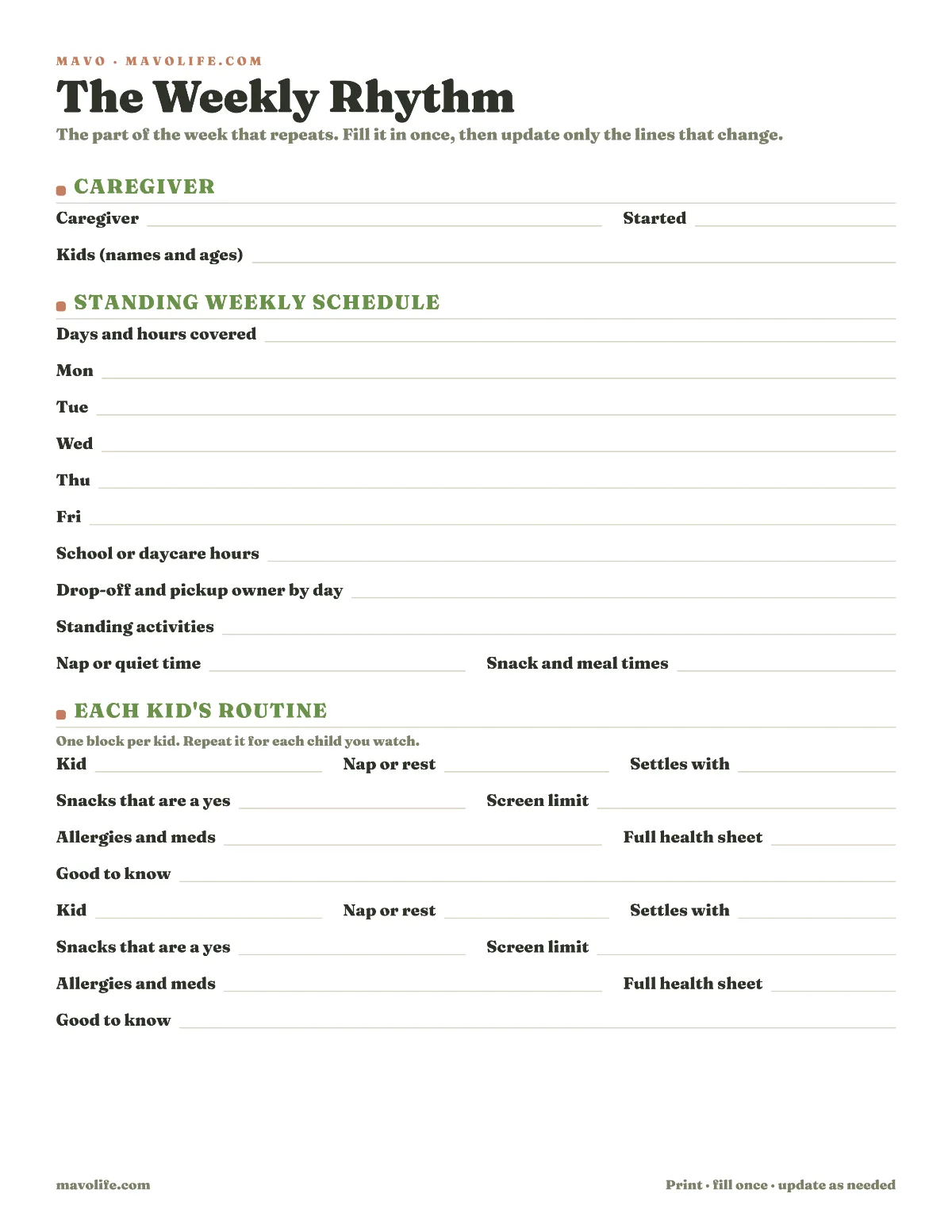
Download the weekly rhythm sheet (PDF)
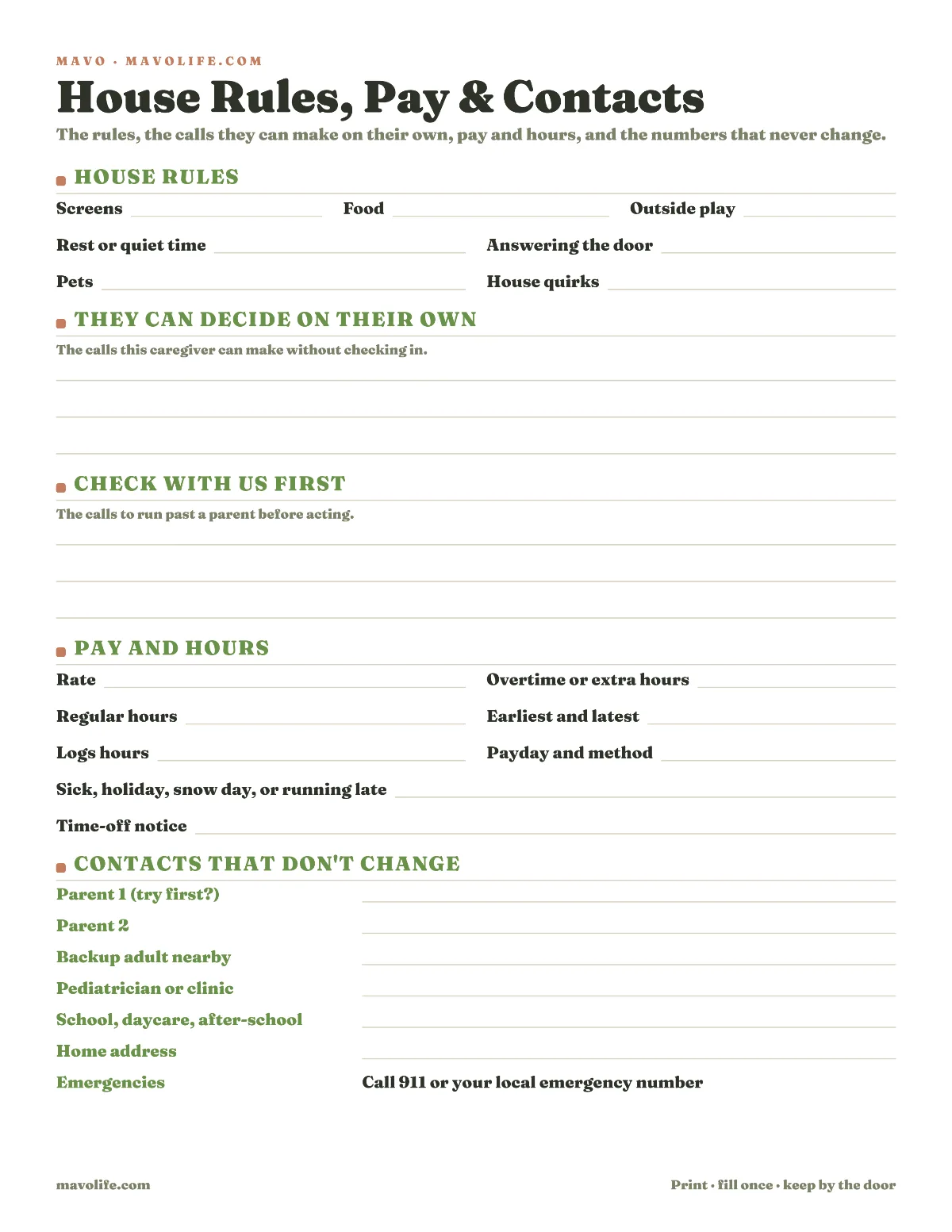
Download the house rules and pay sheet (PDF)
Keep the schedule where you both can see it
The handbook covers the things that hold still. The schedule is the part that moves: a season ends, piano shifts to Wednesday, one parent takes Thursday pickup for a month. A page taped to the fridge goes stale the first week that happens, and once it's wrong you're back to texting the nanny from a meeting.
So keep the standing schedule somewhere you both actually look. In Mavo, the weekly rhythm sits on a shared family calendar the whole household can see, and each pickup, lesson, and handoff can say who's handling it, so the nanny opens Thursday and knows who's driving without asking. Invite them into your family and they see the same plan you do, plus the reminders you set for the things that run on a clock.
Fill the sheets in this week, and invite the nanny into the plan. After that, a normal Thursday doesn't ride on whether you can get to your phone. They walk in, read what the day holds, know which calls are theirs, and your phone stays face-down for the whole meeting.