Hosting & celebrations · September 14, 2026 · 11 min read
8 Christmas Party Theme Ideas with Looks to Copy
Compare eight illustrated Christmas party themes for your home, with color palettes, concrete decorating examples, and invitation wording you can copy.
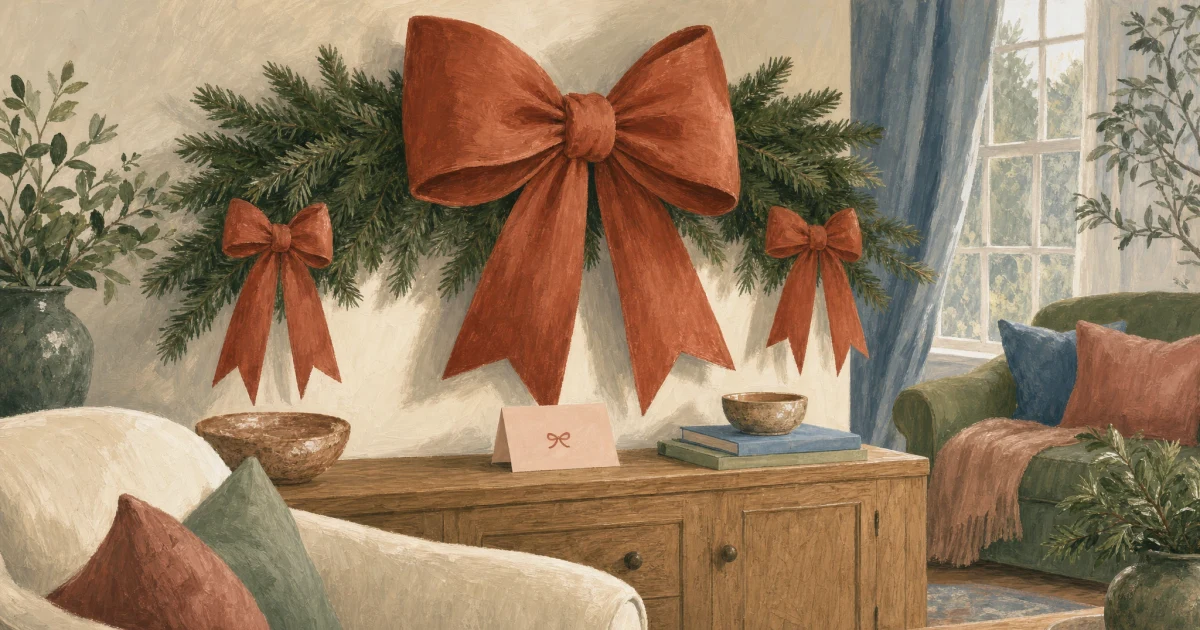
Choose a Christmas party theme around the space you'll use. A big ribbon bow can dress one wall above a console, while a plaid throw brings the party's colors into the sitting area. If you'd rather decorate a shelf, arrange a little paper forest.
These eight Christmas party theme ideas each include an original arrangement illustration, a color palette, a concrete decorating example, and an invitation you can copy. The drawings show suggested arrangements, not finished decorations to print. Tap an illustration to open the full-size view.
Choose a theme for your room and the preparation you enjoy
| Theme | A place to use it | What you'll put together |
|---|---|---|
| Big-bow Christmas | One wall above a console | Repeat ready-made bows in different sizes |
| Paper-forest Christmas | A picture ledge or shelf | Arrange paper trees in overlapping rows |
| Snowfall window | A window beside the gathering area | Cut or arrange flat snowflakes and circles |
| Christmas parcel display | A broad side table | Wrap empty boxes and vary their height |
| Plaid Christmas lounge | A sofa and the seats around it | Arrange a patterned throw and plain cushions |
| Christmas fan wall | A wall above a sideboard | Open paper fans and compose one cluster |
| Oversized paper baubles | A wall above a shelf | Make large flat ornament shapes from card |
| Starry-night Christmas | A picture ledge | Arrange paper stars on one dark display board |
For an arrangement without paper cutting, look at the bows or plaid lounge. If you enjoy making repeated shapes, try the forest, snowfall or baubles. The fan wall and starry-night board give you one display to compose; the parcel theme puts the wrapping itself on show.
Use the quantities below to copy the illustrations, or make a smaller version with fewer pieces. Replace the bracketed details in your chosen invitation before sending it.
Big-bow Christmas
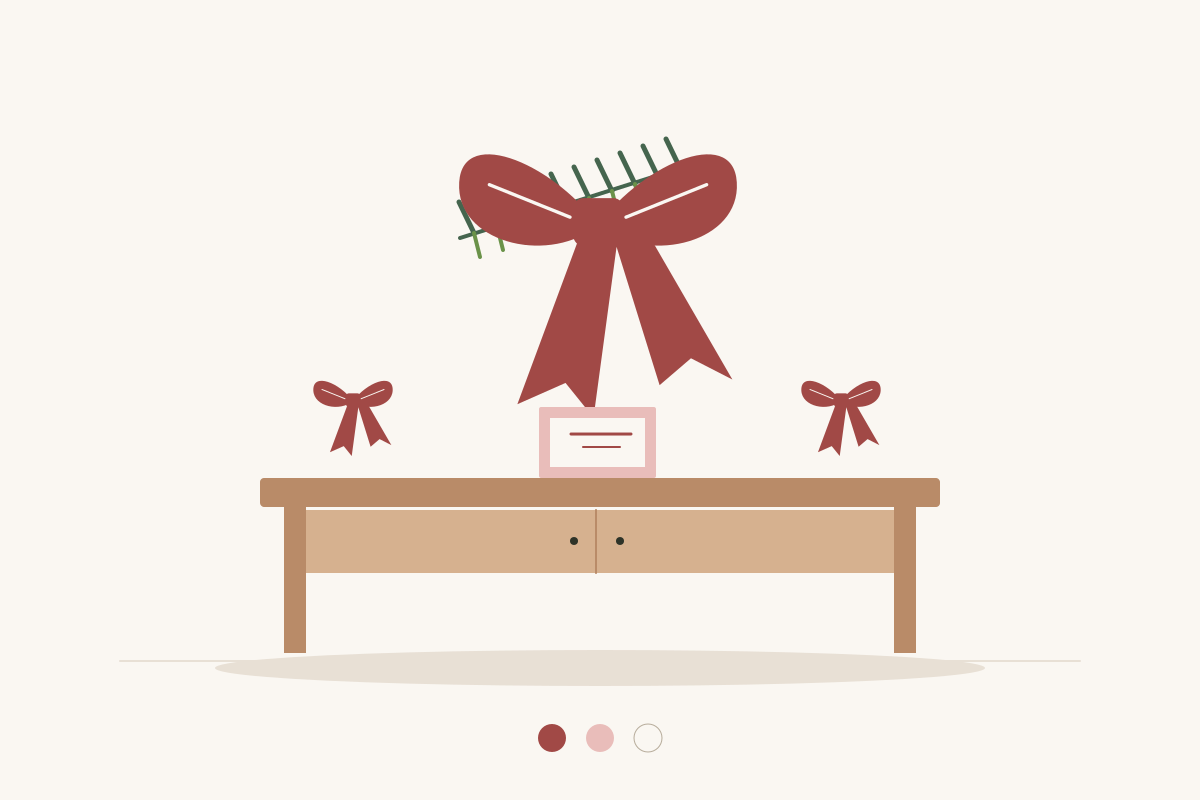
Palette: cranberry, blush and cream.
The oversized bow makes this feel like Christmas wrapping brought into the room. Choose one large fabric bow and two smaller ones in the same color, with a short decorative evergreen sprig behind the large bow. Add a blush folded card on the console underneath; it can carry the party's name or repeat the invitation's opening line.
In the example, the large bow sits in the middle of the wall, with its tails pointing toward the card. The smaller bows sit lower, above the two ends of the console. Leave the rest of the surface mostly clear so the long tails and loops remain easy to see. A second large bow would change the balance; repeating the small ones elsewhere is a subtler way to extend the theme.
Invitation to copy:
A Christmas get-together, tied up with a bow. Join us at [place/address] on [day, date], from [start] to [end]. We'll have a red-and-blush room ready for an evening together. Come as you are. Please reply to [name/contact] by [date].
For a matching invitation design, put one simple bow illustration above the words and leave space around it.
Paper-forest Christmas

Palette: evergreen, sage and cream.
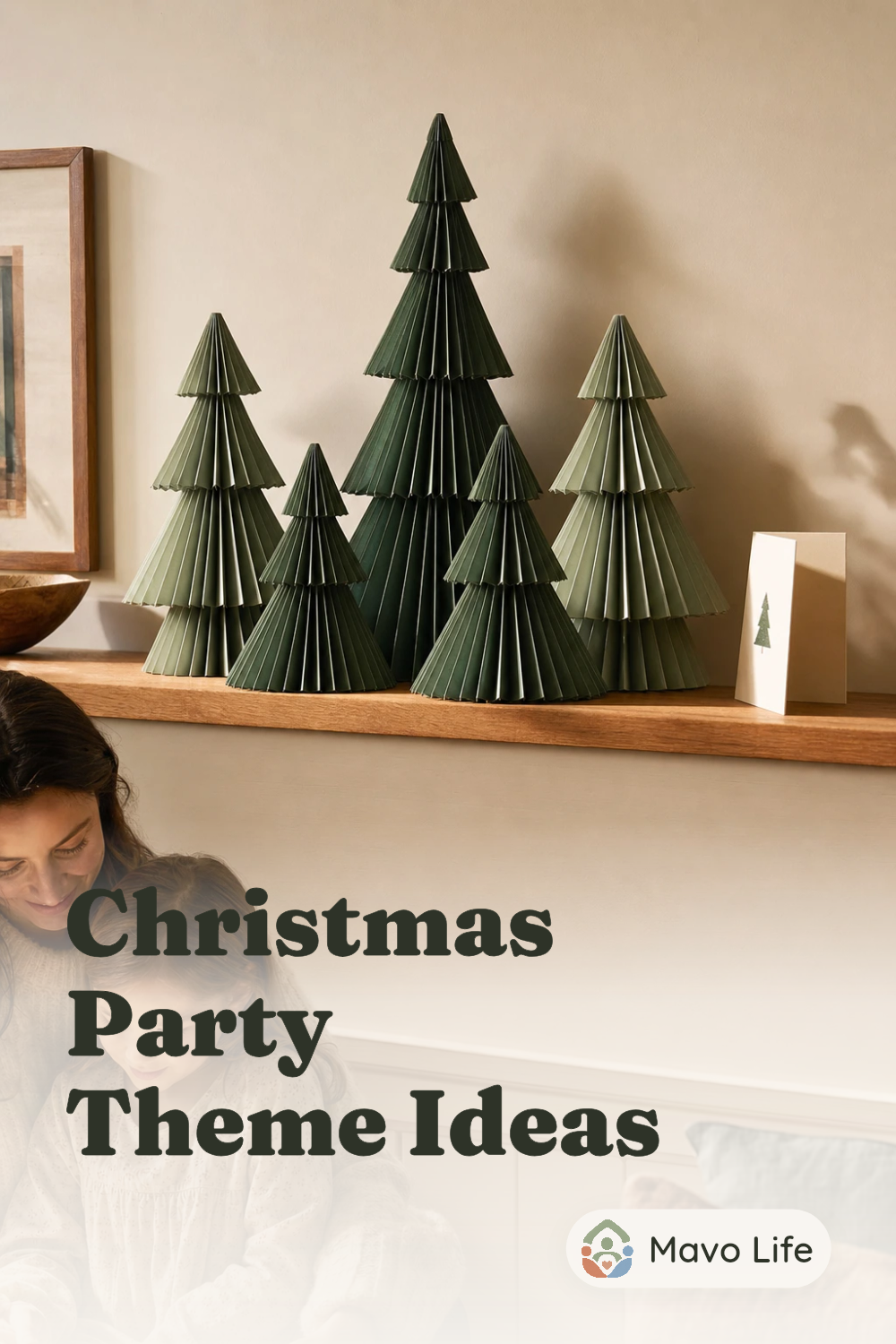
A group of paper trees gives a narrow shelf a whole Christmas scene. Use five freestanding paper tree decorations: one tall, two medium and two short. Folded paper trees or ready-made card trees both suit the arrangement. Keep their shapes plain enough that the overlapping outlines stay visible.
Place the tallest tree at the back. Put the medium pair to either side, then bring the two shortest trees forward so they overlap the gaps. The illustration uses darker green in both the back and front rows; that helps separate the shapes instead of turning them into one green triangle. An invitation card at one end repeats a single small tree.
This is a good choice when you want the decorations to fit on a ledge and leave the main table available for the gathering.
Invitation to copy:
You're invited to our little Christmas forest. Come over to [place/address] on [day, date], from [start] to [end], for a get-together among the paper trees. Wear whatever you like. Let [name/contact] know by [date] if you can join us.

Snowfall window
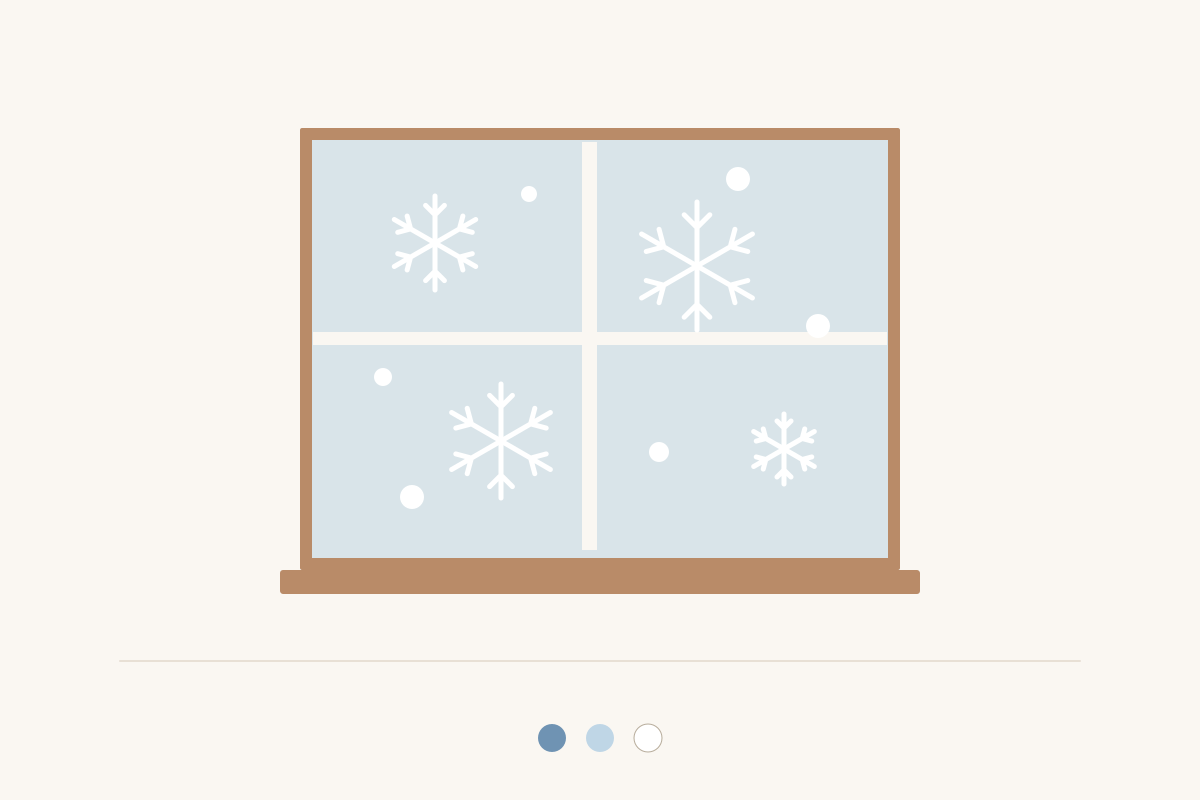
Palette: white, pale blue and dusty blue.
Choose a window that people can see from the seats they'll use. The example has four flat paper snowflakes in different sizes and six small white circles. Ready-cut shapes work, or draw and cut the shapes you want. Arrange them across the window so some areas are busy and others stay open.
Put the largest snowflake in the upper-right part of the display, the next largest lower left, and the smaller pair in the spaces around them. Scatter the circles between the snowflakes rather than lining them up. The blue in this theme can come from a throw or invitation; your actual window view doesn't need to match the drawing.
On a white wall, the shapes will be harder to see. Use a blue display board as the background if that gives you a clearer result.
Invitation to copy:
A little paper snowfall is coming to [place/address]. Join us for a Christmas gathering on [day, date], from [start] to [end]. No snow in the forecast required. Please reply to [name/contact] by [date]. We'd love to see you.
Keep the invitation pale blue with a few white snowflakes near one corner, leaving the event details easy to read.
Christmas parcel display

Palette: kraft brown, clay and green.
Use empty boxes as decorations for a Christmas party with a wrapping-paper look. The boxes in this display don't hold presents, and the invitation makes clear that guests don't need to bring one.
Wrap one broad rectangular box in kraft-colored paper, a smaller box in green, and a third in clay. Put a broad contrasting ribbon band across each box. In the illustration, the green box sits on the large kraft box, while the clay box sits beside them on the console. Their three different heights make a small group feel more substantial than a straight row of matching boxes.
If you prefer everything on one level, use a tall empty box at the back and the shorter boxes in front. The color blocks and ribbon crossings will still carry the look.
Invitation to copy:
We're wrapping the room for Christmas. Come to [place/address] on [day, date], from [start] to [end], for a get-together with a parcel-themed display. The boxes are decorations; no gifts to bring. RSVP to [name/contact] by [date].
A ribbon-like cross on the invitation repeats the boxes. Keep the writing together in one open area rather than running it over the bands.
Plaid Christmas lounge
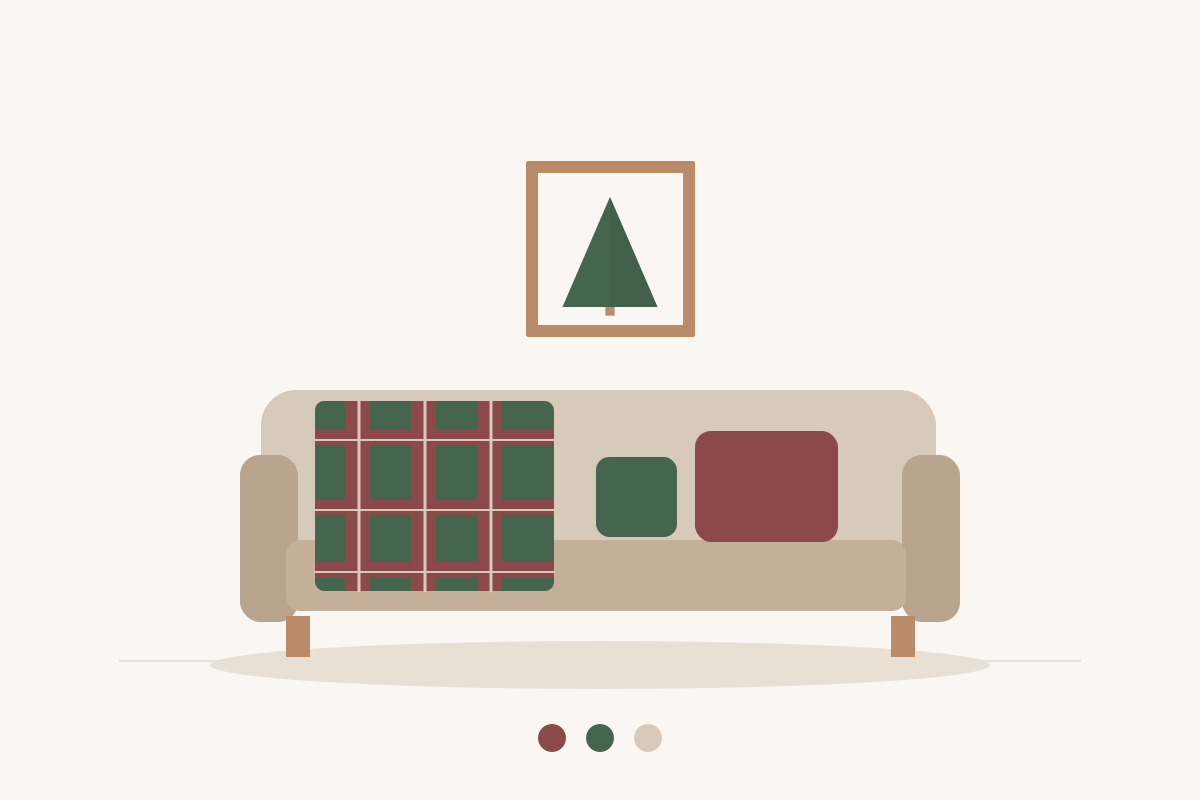
Palette: muted red, forest green and oatmeal.
Let the sitting area be the decorated part of the party. Start with one plaid throw, add two plain cushions that pick up its colors, and put a small Christmas tree picture nearby. The tree picture supplies the seasonal detail; the fabric makes the room feel inviting without requiring a separate backdrop.
The example keeps the plaid at one end of the sofa and groups the plain cushions at the other. Fold the throw so both its horizontal and vertical stripes show. If your throw has blue or tan in it, use those colors for the cushions instead of trying to match the illustrated red and green.
This look suits a gathering centered on sitting and talking. Keep the invitation relaxed, too; plaid clothing can be welcome without becoming an assignment.
Invitation to copy:
Settle in for a plaid Christmas get-together at [place/address]. We'd love your company on [day, date], from [start] to [end]. Wear plaid if you feel like it, or come as you are. Please let [name/contact] know by [date].
Christmas fan wall

Palette: clay, sage and ochre.
Pleated paper fans give you a bolder, rounder Christmas backdrop. Use five fans in varying sizes, with the largest toward one side. The example starts with a large clay fan on the left, a medium sage fan higher in the middle, and an ochre fan lower on the right. Two small fans fill the spaces between them.
Let a few edges overlap and keep the outline uneven. A perfectly straight row can look like a border; a loose cluster becomes the thing people notice when they enter the room. Place a folded Christmas greeting card below the fans to connect the abstract shapes to the occasion.
Choose opened, ready-made paper fans if arranging the colors is the part you want to do. A familiar fold-and-fan method works too. The arrangement depends on the mix of sizes, so keep that variation even if you change the palette.
Invitation to copy:
Come celebrate Christmas in a room full of paper fans and warm color. Join us at [place/address] on [day, date], from [start] to [end]. No theme outfit needed. Please reply to [name/contact] by [date].
For the invitation, repeat a partial fan in one corner rather than filling the background with pattern.
Oversized paper baubles
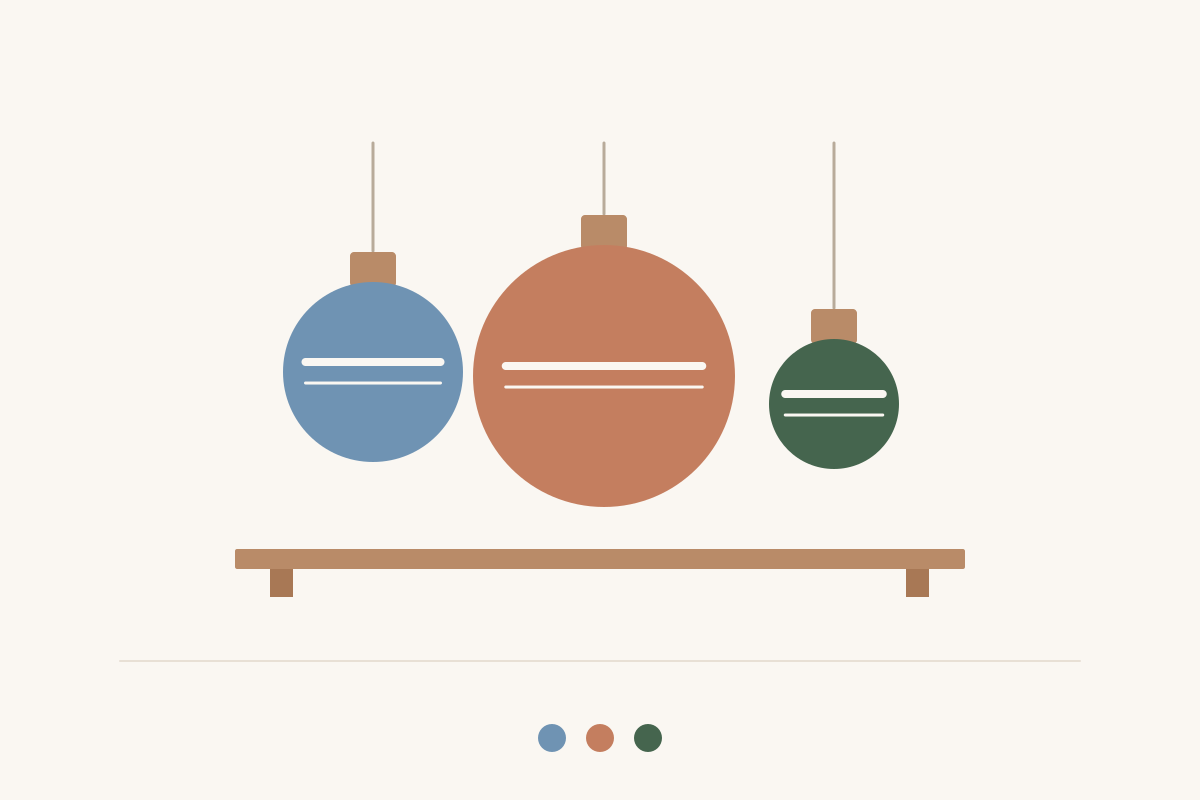
Palette: dusty blue, clay and evergreen.
Turn the familiar Christmas ornament shape into a wall display using flat card. Make three circles in different sizes, add a short rectangular cap at the top of each, and use thin cord above the caps for the hanging lines. These are paper shapes, not oversized glass ornaments.
The illustrated middle bauble is about twice as wide as the smallest one. Its larger size gives the arrangement a center, while the slightly different hanging heights keep it from looking like a set of signs. Add two cream paper stripes across each circle to repeat one detail throughout the group.
If the available space is narrow, arrange the circles in a vertical column and shorten the gaps. Keep each cap visible so the shapes still read as ornaments.
Invitation to copy:
Big baubles, a small Christmas gathering. You're invited to [place/address] on [day, date], from [start] to [end]. We'll have a colorful ornament display ready; you just need to bring yourself. Reply to [name/contact] by [date].
A single bauble in the invitation's top corner is enough to preview the theme.
Starry-night Christmas
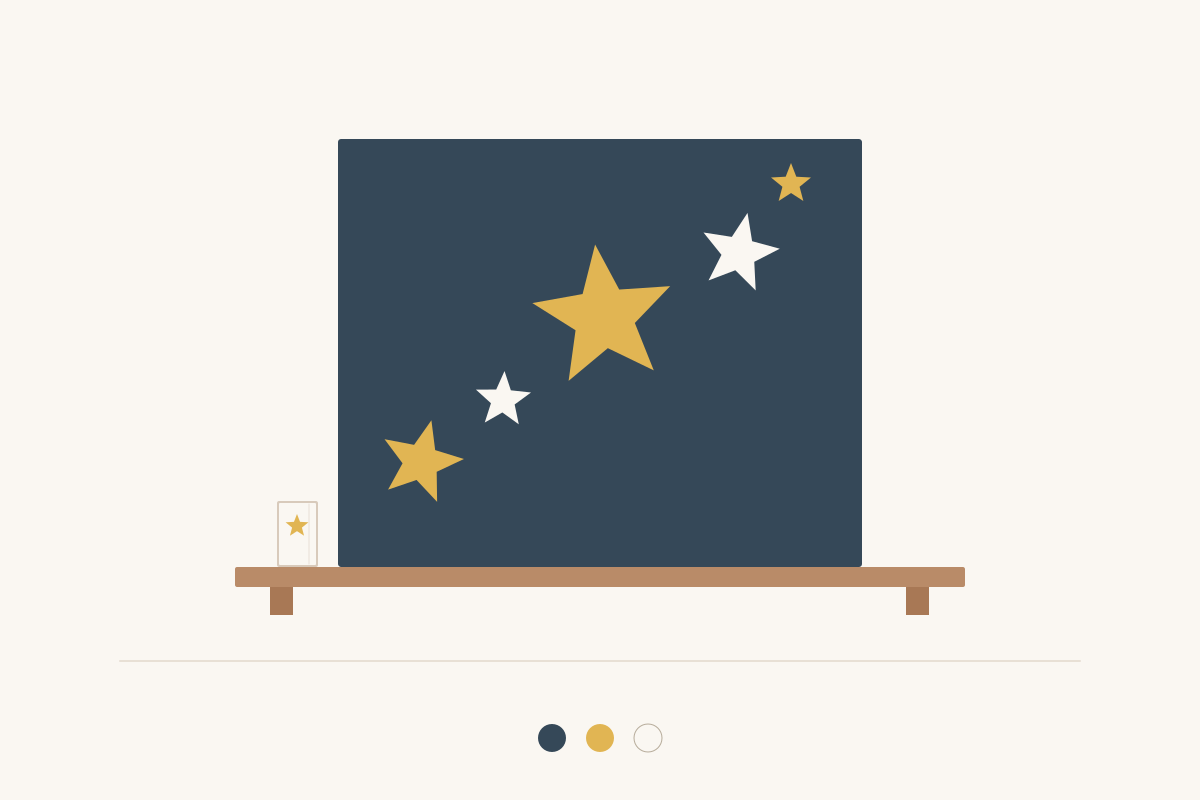
Palette: midnight blue, ochre and cream.
Make one dark display board the background for a diagonal sweep of paper stars. The example uses five stars: a large ochre star near the middle, two medium stars farther apart, and two small ones between and above them. Their sizes and gaps do more for the composition than covering every bit of the board.
Start near the lower-left corner and work toward the upper right. Turn some stars slightly so the points don't all face the same way. Rest the finished board on a picture ledge, with a cream invitation card beside it. This gives you a complete display to move into place for the party.
For a smaller board, use three stars and preserve the diagonal. The dark background is what makes the pale shapes stand out.
Invitation to copy:
Join us for a starry-night Christmas gathering at [place/address] on [day, date], from [start] to [end]. We're bringing a little paper night sky indoors for the occasion. Come as you are, and reply to [name/contact] by [date].
Repeat the dark blue and cream on the invitation, with the words in a clear area below one star.
Finish the invitation before adding more decorations
Once you've chosen a look, check the invitation's day and date, full location, start and end time, and reply details. Replace every bracketed placeholder, then read it once as someone who hasn't heard about the party yet. The opening line gives a hint of the room; the remaining lines should make attending straightforward.
You can use the wording in a text message or add it to your own invitation design. For the dates and tasks around the wider holiday season, use the Christmas planning checklist.
For a seated activity to go with the gathering, choose one of these printable holiday party games.