Printable battleship grids
Play a pencil-and-paper sea battle with two people, two sheets and hidden fleets. Choose the 6×6 starter board to learn the calls, or the 10×10 board for a larger fleet. Each download includes a blank playing sheet and a separate rules page showing how one turn appears on both players’ sheets.
10×10 full game
Five ships: 5, 4, 3, 3 and 2 squares.
10×10 full game: US Letter PDF10×10 full game: A4 PDFFour two-page PDF choices. No account or email needed. These are blank paper boards, with no editable fields or online game. Print page 1 twice for two players; share page 2 while learning.
Start small, or use the whole fleet
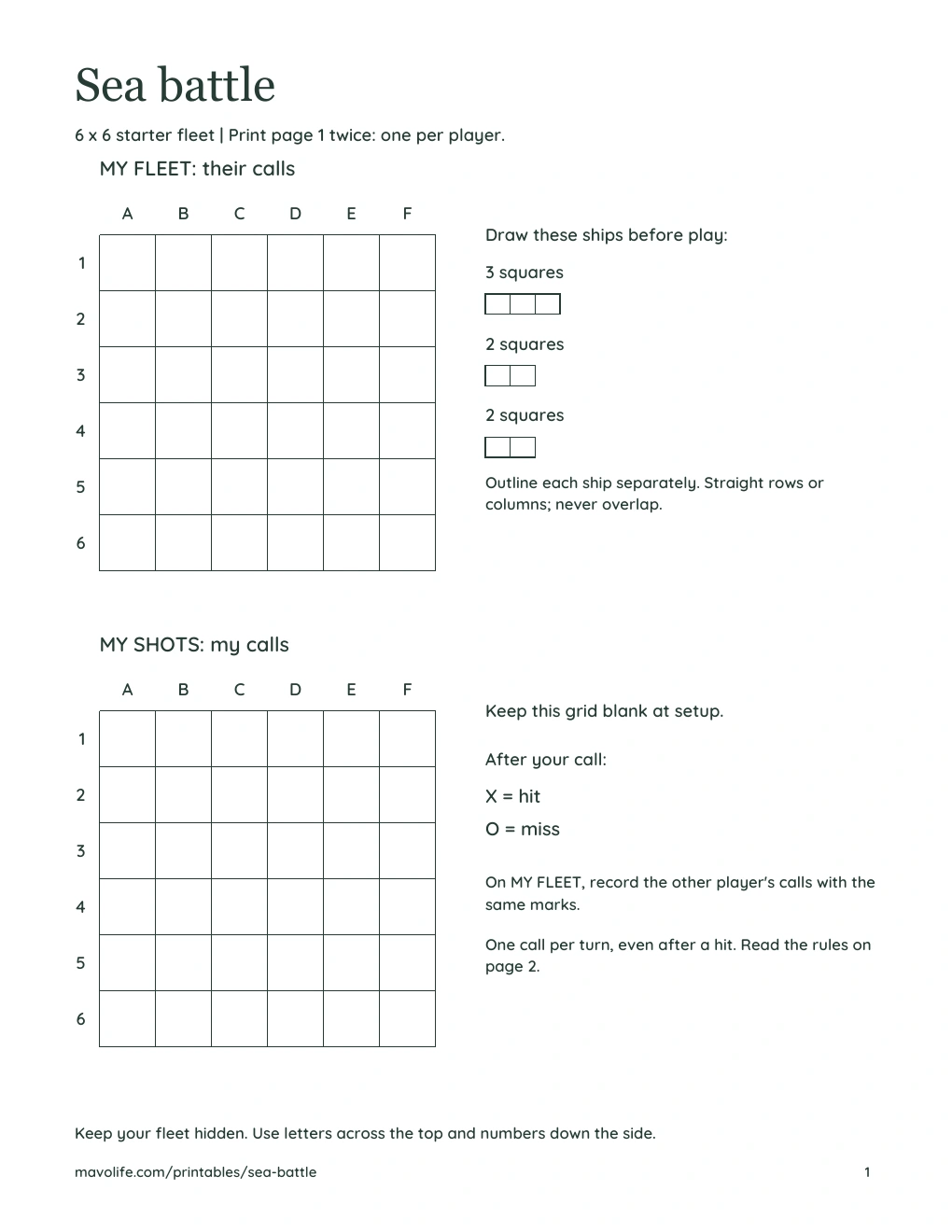
The starter board has letters A–F and rows 1–6. Its half-inch squares leave room to outline ships and write hit or miss marks. Start here if either player is still getting used to reading a coordinate.
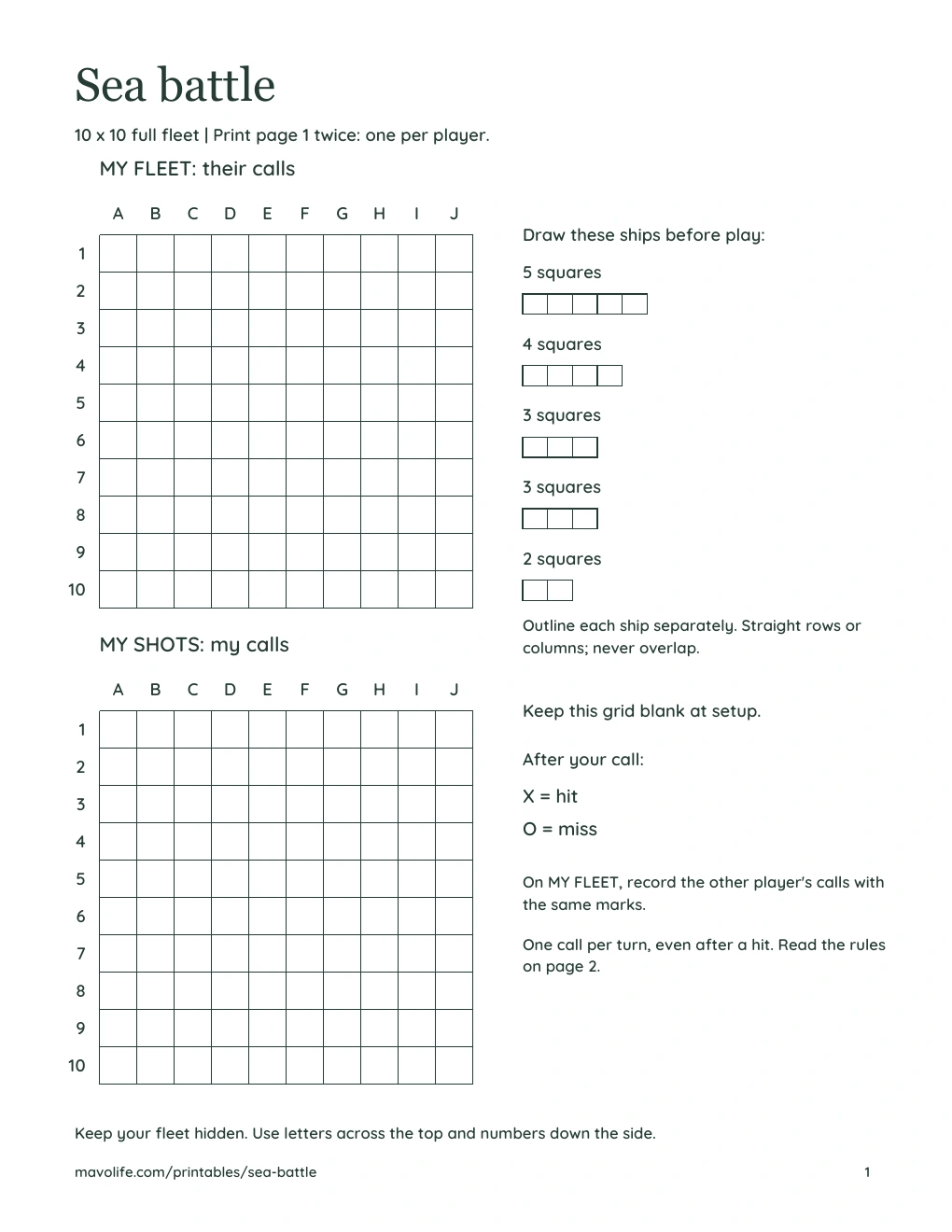
The full board runs from A–J and 1–10. Its squares are a third of an inch wide at full size, enough for an X or O. Both players must use the same board and fleet. Keep the two ships of length three separate when you draw the full fleet.
Place ships on MY FLEET
Each person gets a copy of page 1. Draw the listed ships on the upper grid, labeled MY FLEET: their calls. Outline each ship separately so you can still identify it after some squares have been hit. A ship occupies adjoining squares in one straight row or column; it cannot bend or run diagonally.
Keep every ship inside the grid. Ships may touch, including at a corner, but cannot share a square. A three-square ship could run across B2, C2 and D2, or down B2, B3 and B4. Choose the positions privately and keep them fixed once play begins.
Leave the lower grid, MY SHOTS: my calls, blank. That’s where you record your guesses about the other person’s fleet. Sit so you cannot see each other’s sheets, or put an upright book between them. Agree who calls first.
Call a square, then mark two grids
Say the column letter followed by the row number: “C2.” The other player checks that square on their MY FLEET grid and answers “hit” if a ship occupies it, or “miss” if it is empty.
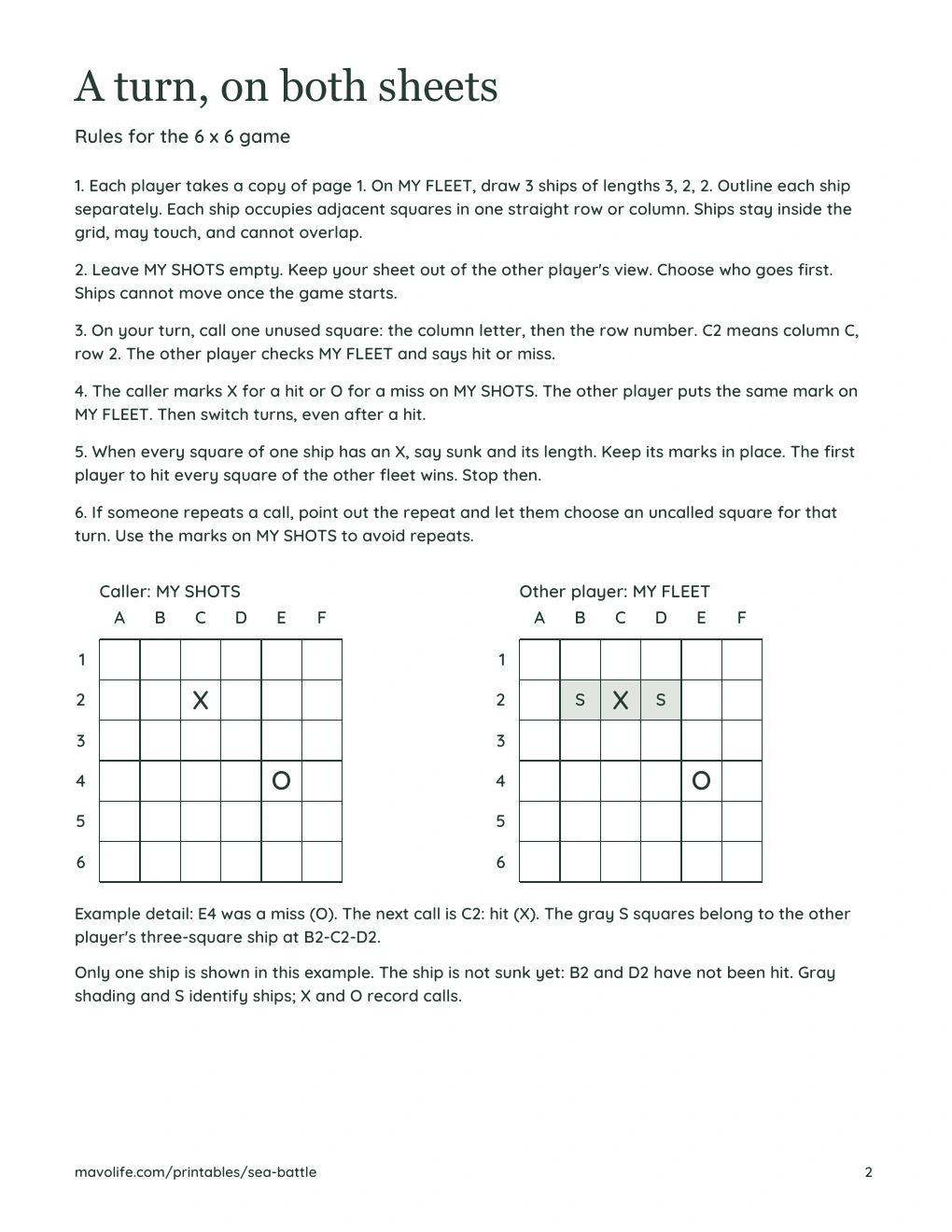
You write X for a hit or O for a miss on your MY SHOTS grid. The other player puts the same mark on their MY FLEET grid. You are recording the same call on two different sheets. Then switch turns, even after a hit.
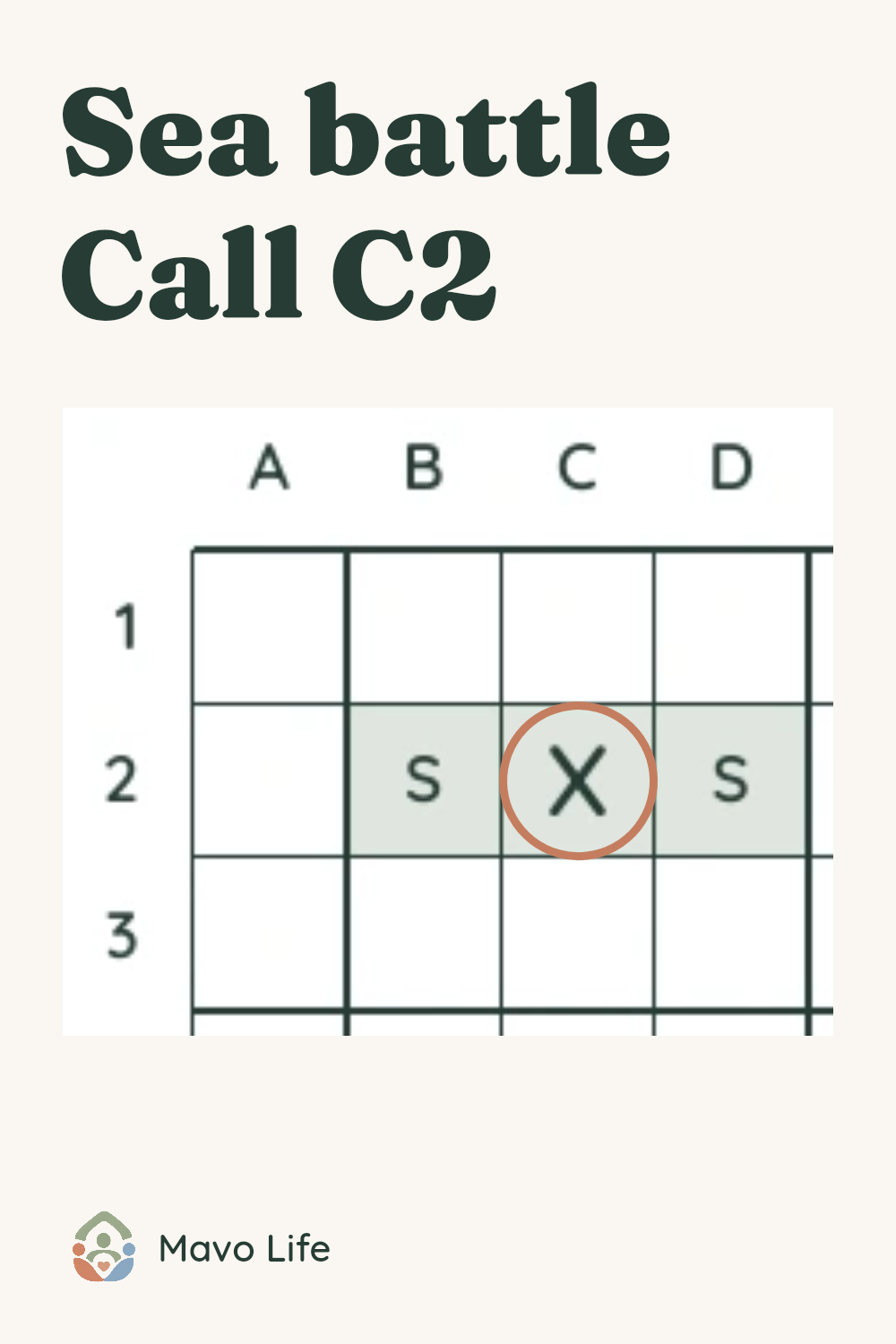
Here, E4 was a miss on an earlier turn. C2 is the new call, and it hits the middle of a three-square ship. Only that ship is shown in this example detail; the gray squares and S marks identify its remaining unhit squares.
| A | B | C | D | E | F | |
|---|---|---|---|---|---|---|
| 1 | ||||||
| 2 | X | |||||
| 3 | ||||||
| 4 | O | |||||
| 5 | ||||||
| 6 |
| A | B | C | D | E | F | |
|---|---|---|---|---|---|---|
| 1 | ||||||
| 2 | S | X | S | |||
| 3 | ||||||
| 4 | O | |||||
| 5 | ||||||
| 6 |
Is the ship sunk after C2?
No. C2 is only one of its three squares. B2 and D2 have not been hit. When all three have X marks, the owner says “sunk, three squares.” Keep the marks on both sheets so neither player calls those squares again.
If you accidentally repeat a coordinate, choose another uncalled square for that turn. Check MY SHOTS before calling; a hit does not let you call again immediately.
Finish the fleet, then play again
A ship is sunk when all its squares have been hit. Announce its length, without giving away the positions of your other ships. The first player to hit every square of the opposing fleet wins, and the game stops on that call.
The starter fleet occupies seven squares in total; the full fleet occupies seventeen. You’ll usually make more calls than that because misses count as turns too. For a rematch, take fresh sheets, choose new ship positions, and let the other player start.
Print two boards and one shared rules page
Choose US Letter for 8.5 × 11-inch paper or A4 for 210 × 297-millimeter paper. The content is the same, laid out for each paper size. Use portrait orientation and Actual size or 100%; check the print preview for clipped edges.
Print two copies of page 1 for the players and one copy of page 2 if you want the rules beside you. Print single-sided so each person can keep their own board hidden while you share the example. The white background, dark lines and X/O marks work without color printing.
Use the PDF to print. The page previews help you choose a board, but are images rather than editable sheets. A pencil lets you correct a mistaken mark; keep the ship outlines visible as you add Xs. Keep your paper sheet if you want to finish later.
Save the next game
More pencil games
For a game where both players can see the whole board, print tic-tac-toe sheets. Dots and boxes gives you a different choice on each turn: draw an edge, or close a box and go again. Browse the printable library for more paper games.
Published October 11, 2026.