Printable math bingo cards: addition to 20
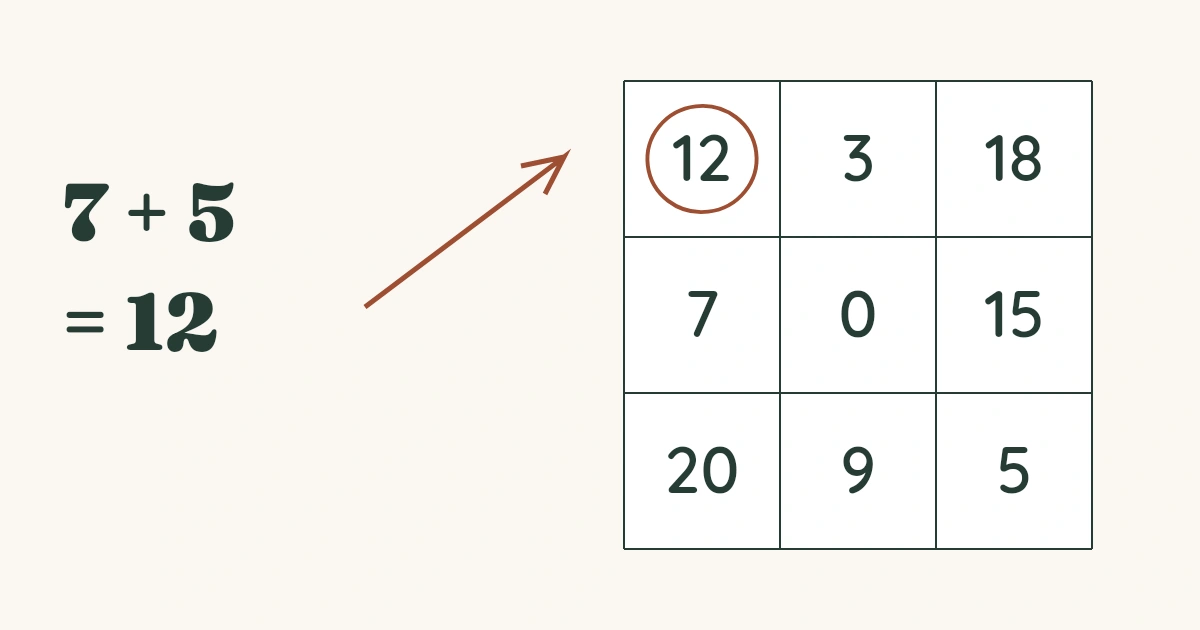
The caller says “7 plus 5.” Players work out 12 and mark it if it’s on their board. These four different math bingo cards use nine numbers each, with a separate caller sheet and answer key. Three marked squares in a straight line win.
Free PDFs, no account or email. Print all three files in your paper size for the complete four-page set. Fixed layouts for pencil play; the numbers aren’t editable.
Four boards with room to mark
Boards A, B, C and D each have a different selection and arrangement of numbers from 0 to 20. Every number appears somewhere in the set, but no board has them all. There are no repeated numbers within a board and no free square.
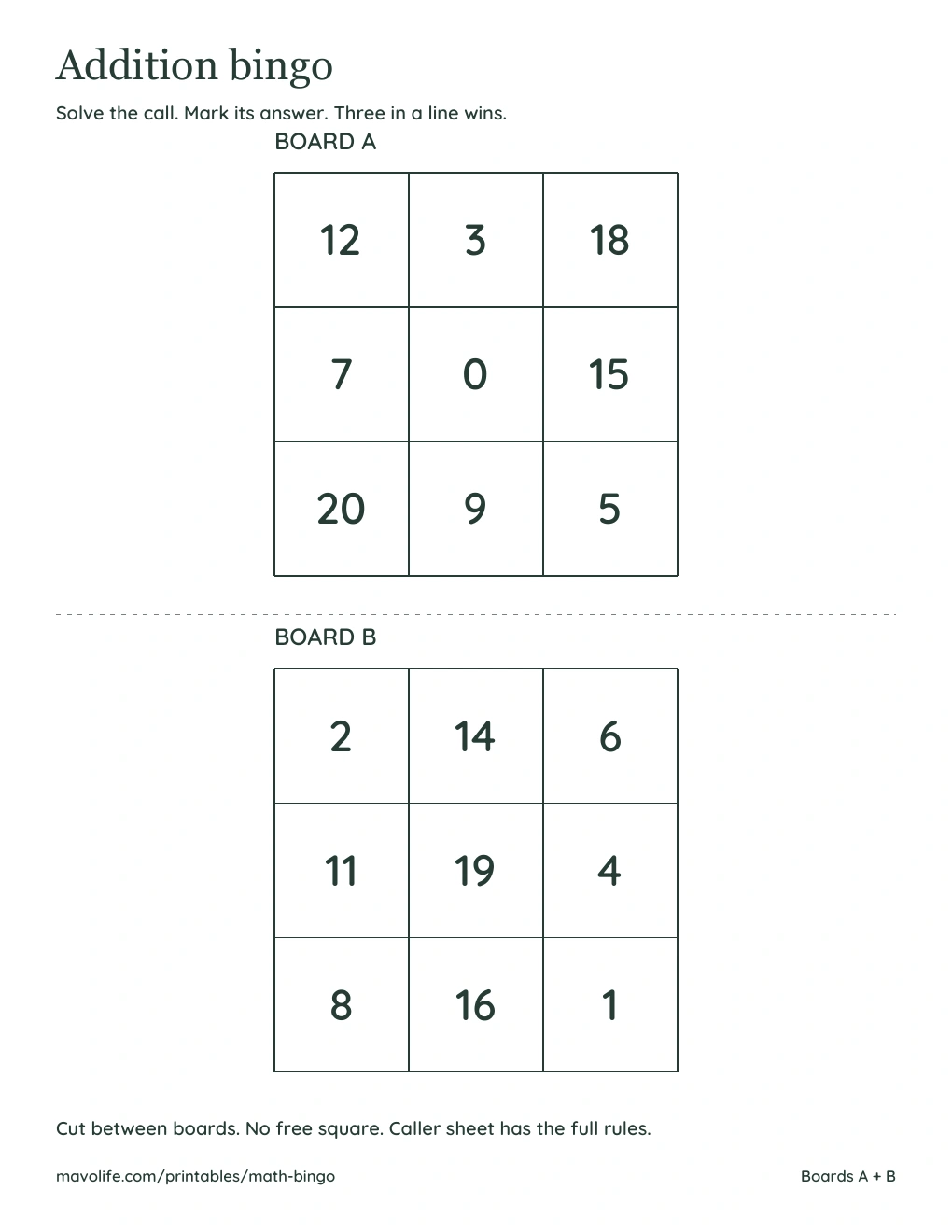
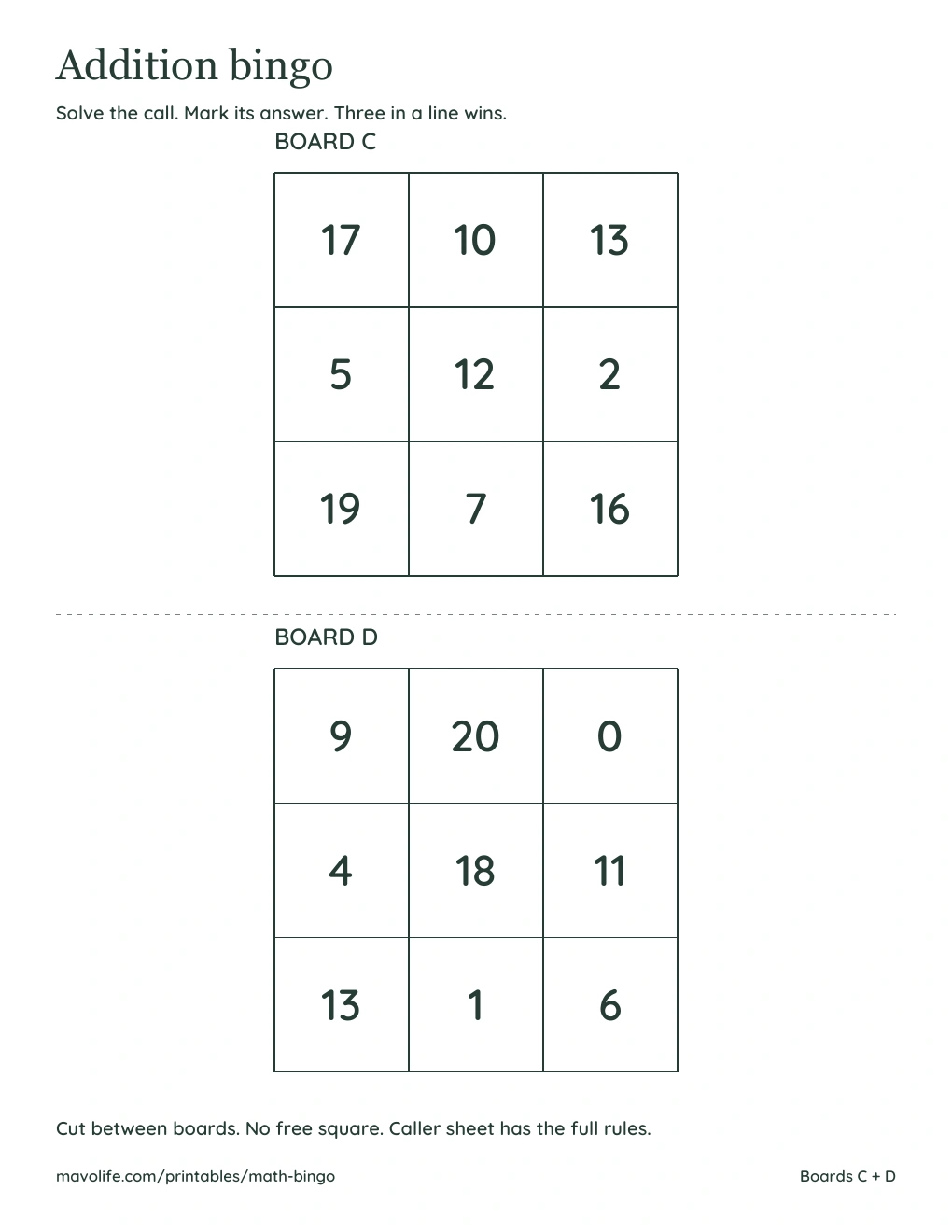
Read all four boards as web tables
| 12 | 3 | 18 |
| 7 | 0 | 15 |
| 20 | 9 | 5 |
| 2 | 14 | 6 |
| 11 | 19 | 4 |
| 8 | 16 | 1 |
| 17 | 10 | 13 |
| 5 | 12 | 2 |
| 19 | 7 | 16 |
| 9 | 20 | 0 |
| 4 | 18 | 11 |
| 13 | 1 | 6 |
Give each player a different board. The set supports up to four players plus a caller; for more people, share boards in pairs. Extra copies of the same board will mark the same answers and may finish together. Downloading again gives you these same four boards.
Read an equation, mark the answer
- Hand out boards and pencils. Give the caller the caller sheet and separate key.
- The caller chooses any unchecked equation and reads it aloud. Pause while everyone adds the two numbers; scratch paper is fine.
- If the answer is on your board, circle it or draw an X through that square. If it isn’t there, wait for the next call.
- The caller ticks the equation’s box after reading it. Choose another unticked equation so each answer is called only once.
- Call “bingo” when three marked squares make a full row, column or corner-to-corner diagonal. Check all three answers against the caller’s ticked equations. If several players finish on the same call, share the win.
Try the first call together
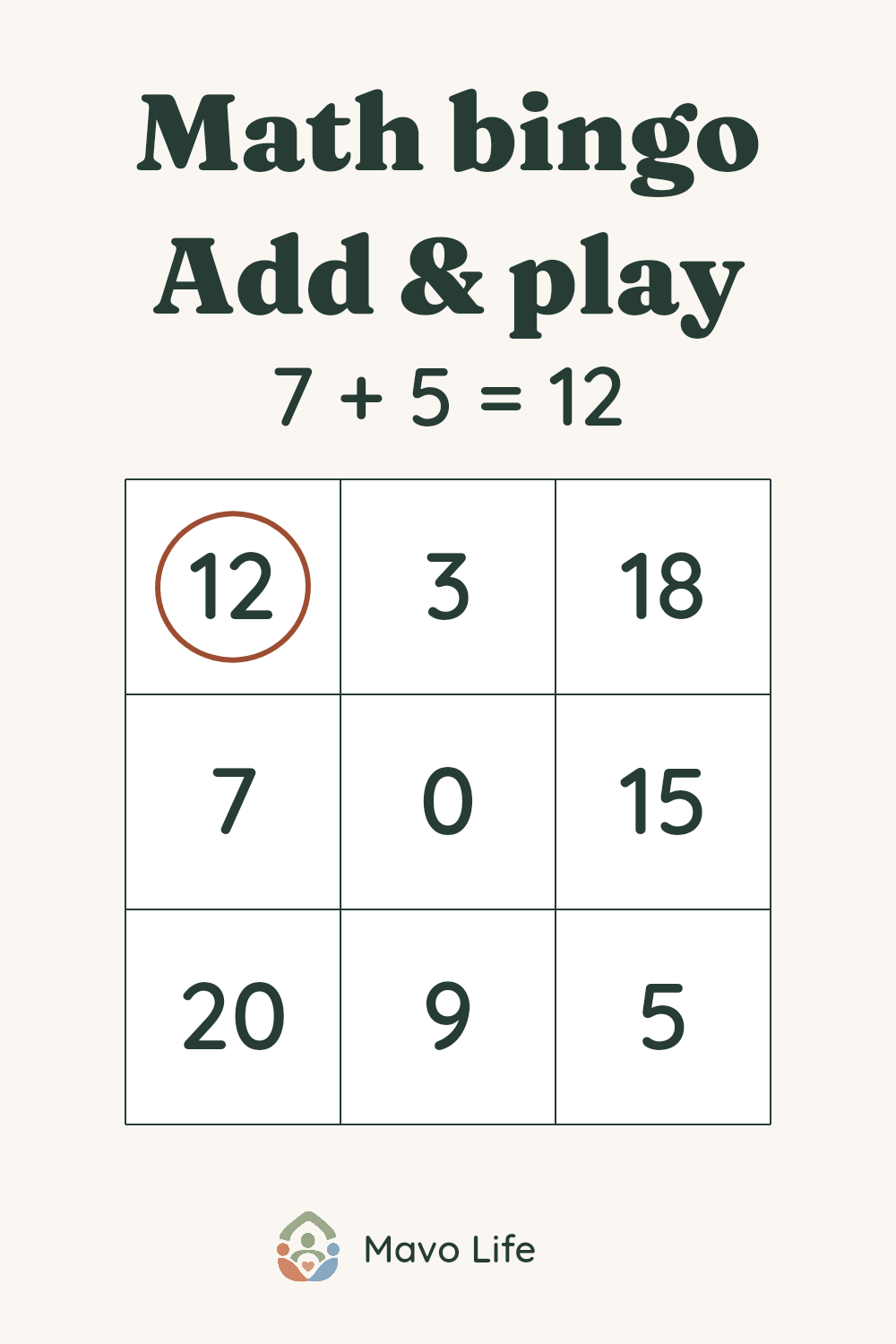
Call A on the sheet is 7 + 5 = 12. Board A has 12 in its top-left square; board C has it in the center. Those players mark 12. Boards B and D don’t have 12, so they wait. The letters on the caller sheet identify equations for checking; players look for the numeric answer.
| 12 | 3 | 18 |
| 7 | 0 | 15 |
| 20 | 9 | 5 |
If calls D (2 + 1 = 3) and J (9 + 9 = 18) come next, board A has a marked top row: 12, 3, 18. That’s a winning line. Erase this practice turn or use clean boards before starting the round.
What if someone marks the wrong answer?
Use the answer key to check the addition, then erase the incorrect mark. The caller’s ticked boxes show which answers have been called. A winning line must have three called answers; three scattered marks or a bent path don’t count.
The caller can repeat an equation so everyone hears it, but it earns only one tick and one mark per matching board. Zero is an ordinary answer here: 0 + 0 lets players mark 0. It isn’t a free square.
The caller sheet and matching key
The 21 calls use addition with nonnegative whole numbers. Their answers cover 0 through 20 exactly once, so a player never needs to wonder whether two different calls mean another mark on the same number. Read in any order, leaving time between calls.
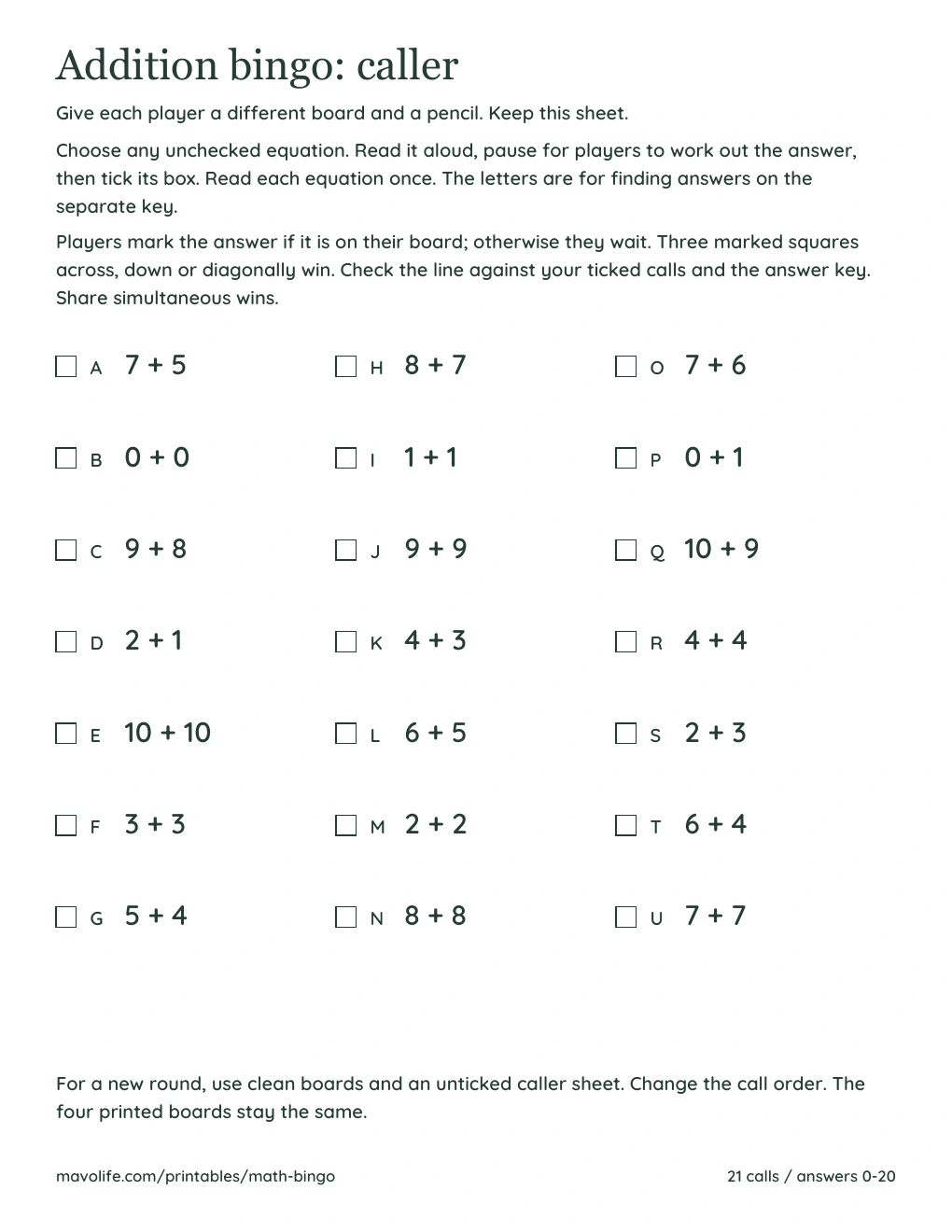
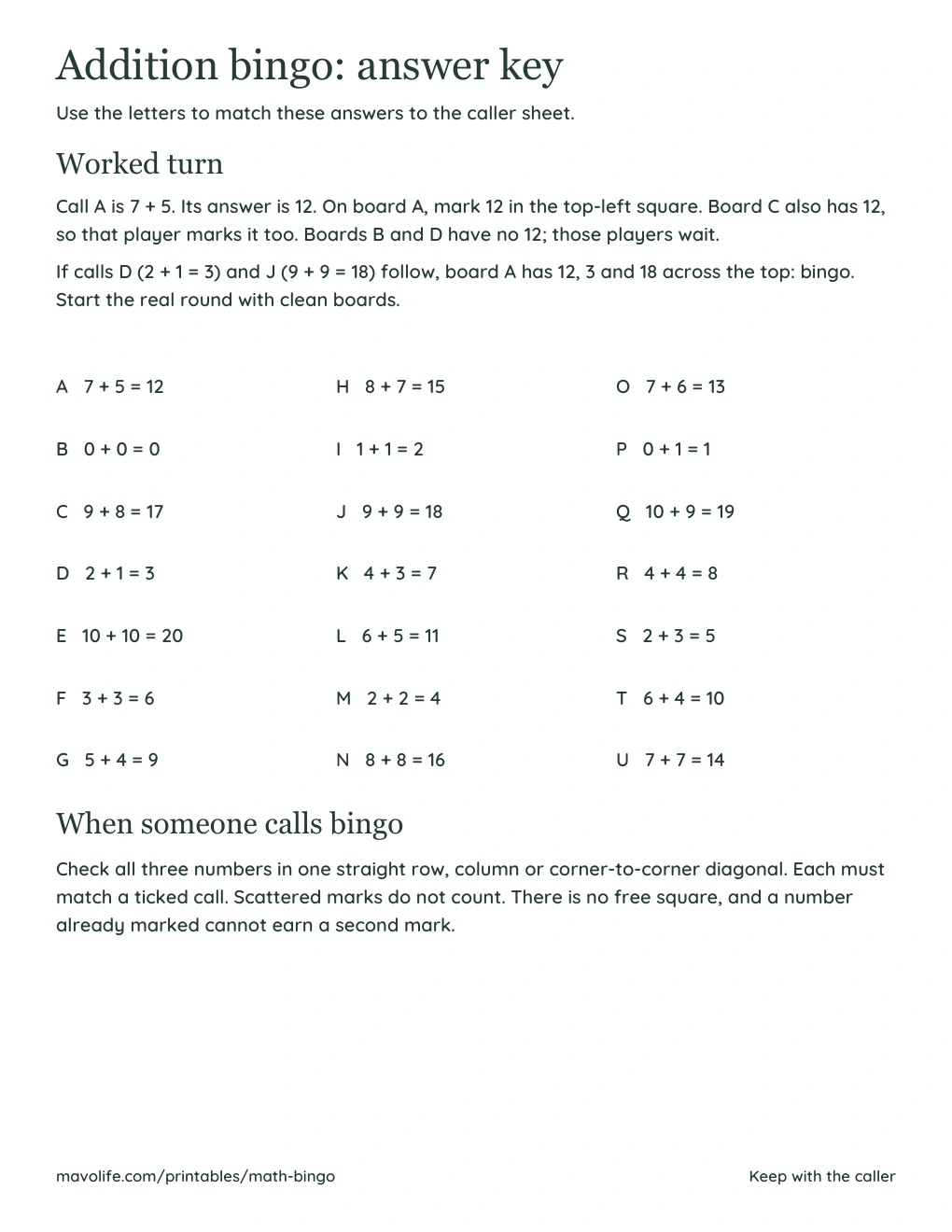
Read all 21 equations and answers
| Call | Equation | Answer |
|---|---|---|
| A | 7 + 5 | 12 |
| B | 0 + 0 | 0 |
| C | 9 + 8 | 17 |
| D | 2 + 1 | 3 |
| E | 10 + 10 | 20 |
| F | 3 + 3 | 6 |
| G | 5 + 4 | 9 |
| H | 8 + 7 | 15 |
| I | 1 + 1 | 2 |
| J | 9 + 9 | 18 |
| K | 4 + 3 | 7 |
| L | 6 + 5 | 11 |
| M | 2 + 2 | 4 |
| N | 8 + 8 | 16 |
| O | 7 + 6 | 13 |
| P | 0 + 1 | 1 |
| Q | 10 + 9 | 19 |
| R | 4 + 4 | 8 |
| S | 2 + 3 | 5 |
| T | 6 + 4 | 10 |
| U | 7 + 7 | 14 |
For a slower round, let players write the equation on scratch paper or work it out together before anyone marks a board. To play again, use clean boards and a fresh caller sheet, then change the call order. You can also keep calling after the first bingo so others can finish a line.
Print four pages, cut out four boards
Choose US Letter for 8.5 × 11-inch paper or A4 for 210 × 297-millimeter paper. Download the boards, caller sheet and key in that size. Print portrait, single-sided, at Actual size or 100%. Each complete set uses four sheets: two board pages, one caller and one key.
Cut along the dashed line between each pair of boards. Keep the caller and key sheets whole. The answer squares measure 1.2 × 1.2 inches at 100%, with 28-point numbers and space to circle or cross them. Print in grayscale if you prefer; the working pages use dark ink on white.
Check your print preview for clipped edges or automatic scaling. Use the PDFs for printing; the web images are previews of the actual files. The files have no fields to type into.
Save the game for another afternoon
More number and spotting games
For a number puzzle without a caller, try the beginner sudoku sheets with worked starts. During an American-football broadcast, use the watch-and-spot football bingo boards. The printable library has more paper activities.
Published October 16, 2026.