School emails · July 15, 2026 · 8 min read
Parent-teacher conference questions: choose five
Parent-teacher conference questions for every grade, plus a printable sheet to choose five, take useful notes, and leave with a clear follow-up.
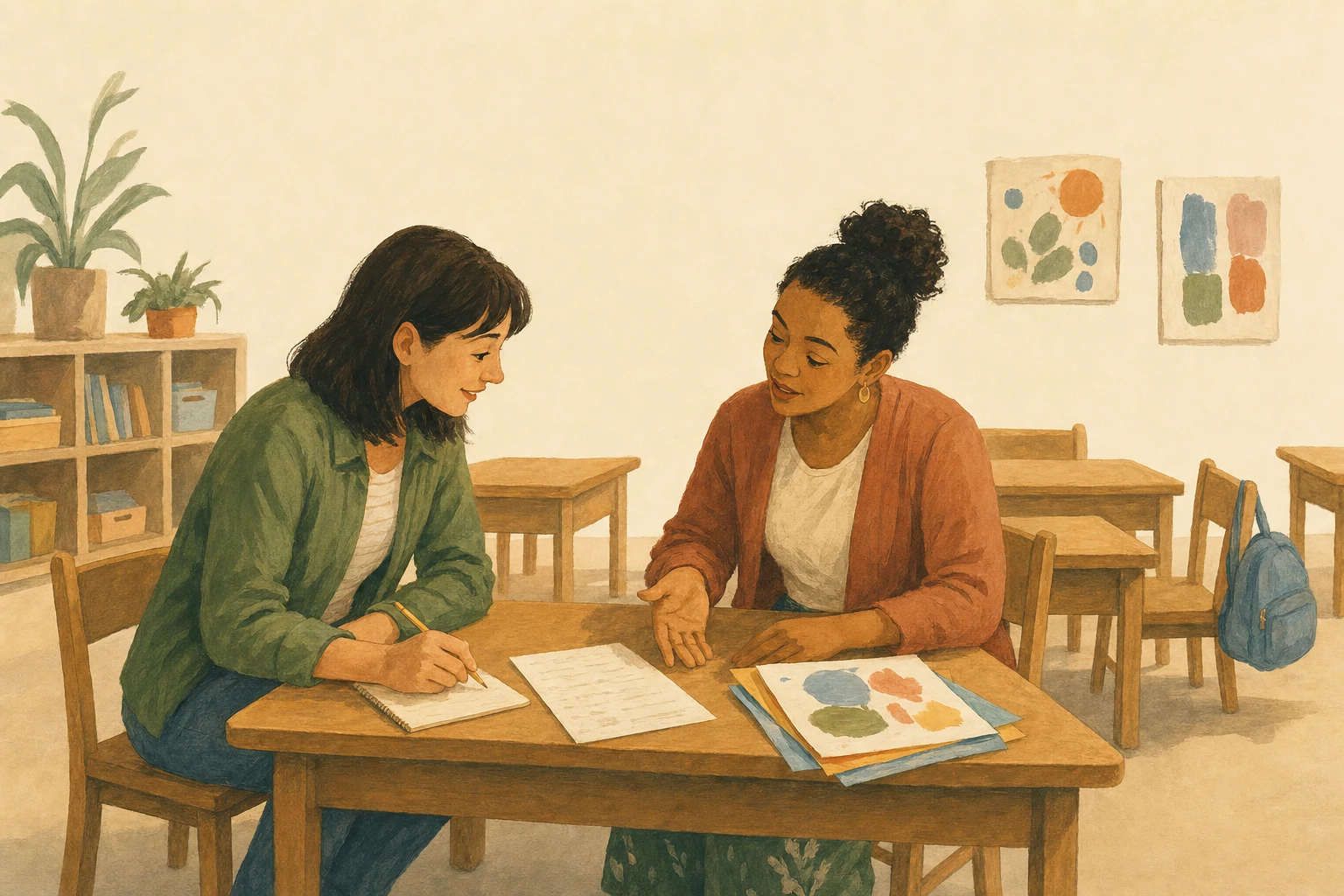
Maya's conference starts in seven minutes. Her dad is sitting on a bench outside the classroom, scrolling through twenty-three questions in a phone note. Some are about reading. Some are about friends. One just says, "homework??" He knows the teacher has another family right after him, and he's trying to decide what he'll regret not asking.
Twenty-three questions won't make a better conversation. Five good ones can. Pick one question for each job the conference needs to do: understand progress, see classroom life, notice independence, agree on support, and set a follow-up. Then write down the answer while you're still in the room.
Print the parent-teacher conference question sheet
Fill in your five questions before you go. The bottom of the sheet is for the part that's easiest to lose later: what happens next, who is handling it, and when you'll check in again.
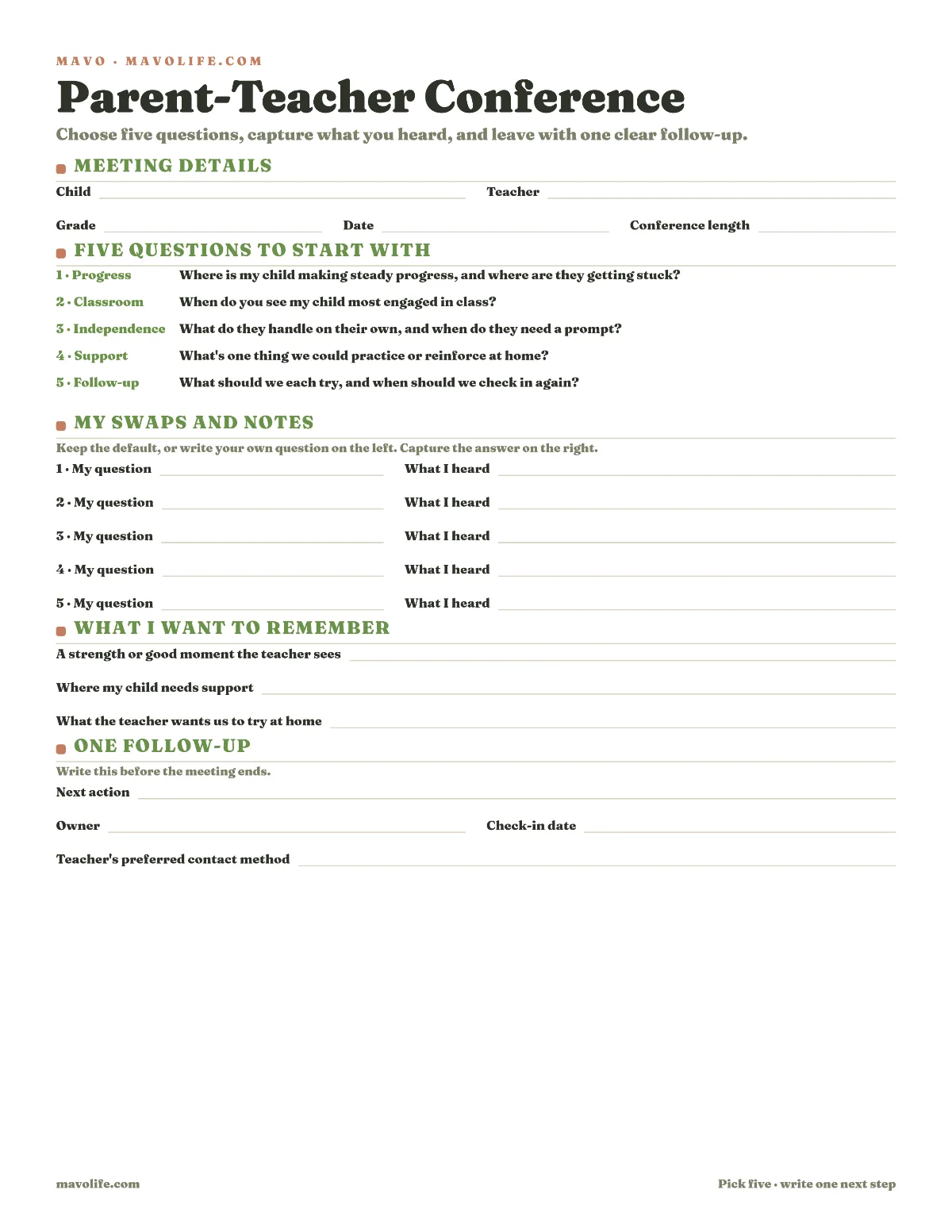
Download the parent-teacher conference question sheet (PDF)
If you don't want the PDF, copy this version into a note and replace each bracketed prompt.
PARENT-TEACHER CONFERENCE

Child: [write here]  Teacher: [write here]  Grade: [write here]
Date: [write here]  Conference length: [write here]

1. PROGRESS
Default: Where is my child making steady progress, and where are they getting stuck?
Swap for: [write here]
What I heard: [write here]

2. CLASSROOM LIFE
Default: When do you see my child most engaged in class?
Swap for: [write here]
What I heard: [write here]

3. INDEPENDENCE
Default: What do they handle on their own, and when do they need a prompt?
Swap for: [write here]
What I heard: [write here]

4. SUPPORT
Default: What's one thing we could practice or reinforce at home?
Swap for: [write here]
What I heard: [write here]

5. FOLLOW-UP
Default: What should we each try, and when should we check in again?
Swap for: [write here]
What I heard: [write here]

Strength or good moment: [write here]
Where my child needs support: [write here]
What the teacher wants us to try at home: [write here]

Next action: [write here]
Owner: [write here]
Check-in date: [write here]
Teacher's preferred contact method: [write here]
You don't have to fill every blank during the meeting. Circle a word, capture an example, or write the exact phrase you want to remember. Use the sheet to capture only the words you need to remember, so you can spend the rest of the meeting listening.
Pick one question for each job
Start with what you actually need from this conversation. A parent who wants to understand a sudden math struggle needs a different five than a parent wondering how kindergarten drop-off looks once the grown-ups leave.
| What you need to learn | A question to try |
|---|---|
| Progress | Where is my child making steady progress, and where are they getting stuck? |
| Classroom life | When do you see my child most engaged in class? |
| Independence | What do they handle on their own, and when do they need a prompt? |
| Support | What's one thing we could practice or reinforce at home? |
| Follow-up | What should we each try, and when should we check in again? |
Those five give you a balanced starting point. If one answer opens something important, stay with it. You can always skip question four. A real example and a clear next step are worth more than finishing the list.
Parent-teacher conference questions by what you need to learn
Choose the prompts that fit your child and leave the rest on the page. The goal is a focused conversation, so you don't need to work through the whole question bank.
Questions about progress
- Where is my child making steady progress right now?
- Which skill or kind of work is giving them the most trouble?
- Could you show me a recent example that helps me understand what you're seeing?
- Is the challenge understanding the material, getting started, staying with it, or showing what they know?
- If we focus on one skill before the next check-in, which one would help most?
"How are they doing?" often gets a broad answer. Asking for one recent example gives both of you something specific to discuss.
Questions about classroom life
- When does my child seem most interested or confident in class?
- What happens when they don't understand something?
- How do they take part in group work or class discussion?
- Who do they tend to work or spend time with?
- Are there routines or transitions that are harder than the lesson itself?
- Is there anything about my child at school that would surprise me at home?
The last question moves the conversation beyond grades and assignments. A child may be quiet at home and the first to volunteer in class, or chatty at dinner and hesitant in a group. That difference gives you context. You don't need to solve it on its own.
Questions about independence
- Does my child ask for help when they need it?
- Can they start work without repeated reminders?
- How do they keep track of materials, assignments, or due dates?
- What do they do after making a mistake?
- Which responsibility are they ready to handle more independently?
Ask what your child can handle next and leave personality labels out of it. "What can they own next?" keeps the answer tied to something you can observe. "Are they responsible?" doesn't.
Questions about support at home
- What's one thing we can do at home that matches what you're working on in class?
- Is there a book, activity, practice method, or school resource you recommend?
- How often should we practice before we look for a change?
- What should we avoid turning into extra homework?
- What change would tell us the support is helping?
If the teacher names three ideas, ask which one to start with. A plan your family can keep for ten minutes twice a week has a better chance of making it past Tuesday.
Questions about communication and follow-up
- What's the best way to contact you with a quick question?
- What will you try at school before we check in again?
- What should we try at home?
- Who should handle the next step?
- When should we compare notes again?
Write the answer to that last question on the sheet as an actual date or window. "We'll keep an eye on it" is easy to agree with and impossible to schedule.
Kindergarten parent-teacher conference questions
Kindergarten conferences often need more than a grades-and-assignments question. Choose from these prompts when you want to understand what the school day looks like after drop-off:
- After I leave, how long does it usually take my child to settle into the day?
- How does my child join play or respond when another child joins them?
- Which transitions feel easy, and which ones still need a reminder?
- What happens when a direction has two or three steps?
- What does my child do when they aren't sure what comes next or need help?
- Could you show me one recent reading, writing, or math example and tell me what you're watching for right now?
- What's one thing we could practice at home without turning the evening into more school?
- When should we compare notes again, and what change should we look for by then?
You still only need five. Pick the questions that match what you've noticed, then keep the final follow-up prompt so the conversation ends with a next step.
Question swaps for older grades
Keep the same five jobs as your frame, then change the prompts as school changes.
| Stage | Listen for | One question to ask |
|---|---|---|
| Upper elementary | Independent work, organization, group projects, and whether your child can explain where they're stuck | What tends to happen between receiving an assignment and turning it in? |
| Middle school | Patterns across classes or times of day, managing several teachers, and seeking help before work piles up | Where should my child start if they need support? |
| High school | Workload, self-advocacy, missing work, course choices, and the next conversation your teen can lead | What could my student ask you directly this week? |
If mornings are still the harder part, a school morning launch pad can keep the repeated home routine separate from what you need to discuss with the teacher.
When the conference is short, virtual, or shared across homes
If the slot is ten minutes, bring three questions: one about progress, one about classroom life, and one about the next step. Put the other two on the sheet in case there is time. Starting with "I'd like to leave knowing these three things" helps the teacher understand what you need without spending half the meeting explaining your list.
For a video conference, keep the sheet open beside the call and type only keywords. Before you hang up, read back the follow-up: "I have us practicing the reading routine, you watching how mornings start, and a check-in by the end of the month. Is that right?" That last thirty seconds gives both of you a chance to correct the plan while you're still together.
Across two households, use one shared copy of the five questions so the teacher doesn't have to repeat the same conversation through two separate lists. If both adults attend, divide the jobs beforehand. One can listen for progress and classroom life while the other captures support and follow-up. Then put one name beside each action. This is a practical handoff, not advice about any family's legal arrangement.
If the teacher raises a concern you didn't expect, slow down and ask for a recent example. Then ask what has already been tried, what the next small step is, and when you'll talk again. You don't have to solve a new concern in the remaining four minutes.
Leave with one follow-up
Before the meeting ends, finish one sentence on the printable: "The next thing we're doing is..." Add a person and a date.
If the teacher sends a recap later, the school-email system keeps the message from becoming another open tab. You can also forward that email or paste your conference notes into Mavo, review the plan items it pulls out, and assign who is handling each follow-up. The shared plan shows what's covered and what still needs attention, so the question sheet can leave your bag without the agreement leaving with it.