Pickup & drop-off · July 7, 2026 · 8 min read
Morning checklist for kids: the reusable card-deck version
A reusable school-morning card deck: what goes on each card, the night-before reset, and how a kid runs it without being told twice.
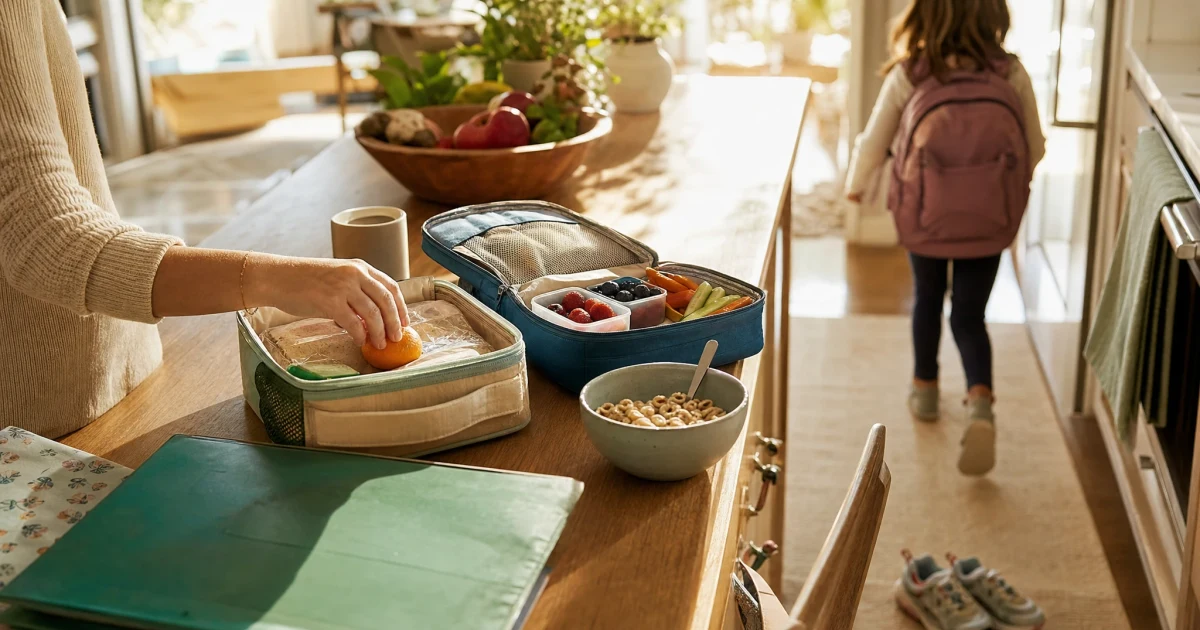
Here's the school-morning system that's still working in November: a small ring of cards by the front door. Backpack. Teeth. Breakfast. Lunch. Water. Shoes. Forms. Ready spot. Each morning your kid moves a card from the "not yet" side to the "done" side, and walks out having finished the routine instead of having been told to finish it six times.
Most families start the school year with something nicer than a ring of index cards: a laminated chart with cheerful icons, maybe a sticker system taped on top. By the second or third week it's still on the wall, and it's already invisible: looked at once on day one, then ignored, while the actual moving pieces (who signed the field-trip slip, whose turn is drop-off) go back to living in one parent's head.
A nicer chart doesn't change that. What a school morning needs is something the family resets every night, not something printed once and admired.
Why the printable version quits by week three
A one-time printable fails for reasons that show up in almost every family's attempt:
- Too many steps for the kid's age. Twelve items is a chore list, not a routine a 5-year-old can hold in their head.
- Printed, but not placed where the routine happens. A chart taped up in the playroom doesn't help a kid getting dressed in the bedroom or grabbing a backpack in the mudroom.
- Nobody resets it. The chart tracks Monday, and by Wednesday every box is checked, or nobody remembers whether it was reset, so it stops meaning anything.
- It handles the routine, not the exception. The chart says "pack the backpack." It doesn't say the library book is due today, or that Dad has pickup because Mom's flight lands late.
Those aren't design problems you fix with better icons. Paper that gets reprinted or hand-checked doesn't survive contact with a real Tuesday. A system that resets itself, physically, every night, does.
Build the deck once
The deck is nine cards, each with one job:
- Backpack (packed, by the door)
- Teeth and hair (bathroom done)
- Breakfast (eaten, or grab-and-go in hand)
- Lunch (packed, or lunch money is in the folder)
- Water bottle (filled)
- Shoes and weather layer (on, and right for today)
- Forms (folder checked: permission slip, library book, payment, picture day)
- Ready spot (standing at the door, backpack on)
- Grown-up handoff (a grown-up has confirmed today's plan)
Nine sounds like a lot until you notice they're mostly things your kid already does. The deck doesn't teach a new routine. It makes the existing one visible enough to run without a parent narrating it.
We built the deck as a one-page printable so you don't have to redraw it: nine cut-out cards, one task each, with the night-before reset on the same page.
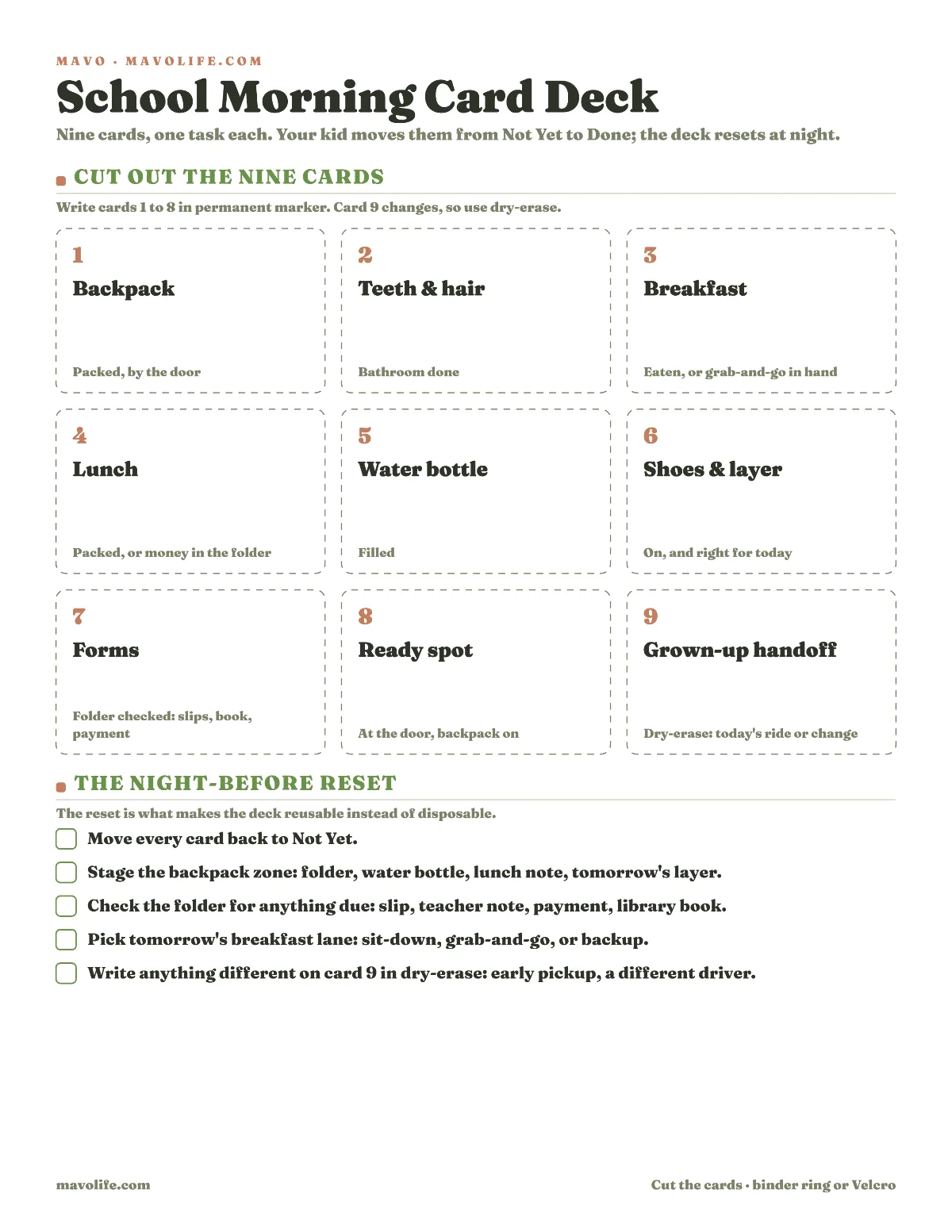
Download the printable card deck (PDF)
Or build the cards your way: the free visual schedule maker lets you pick the steps, rename them into your family's words, and print custom picture cards in about a minute.
To build it:
- Print the deck and cut it out, or write one task per index card. Use a picture or icon plus a short word if your kid is a pre-reader, a permanent marker for cards 1 through 8, and a dry-erase marker for the grown-up handoff card, since that one changes night to night.
- Punch a hole in the corner of each card and put them on a binder ring, or laminate them and back each one with a small Velcro dot. Ring-bound cardstock is faster to build tonight; laminated cards survive a backpack, a car, and a lot of little hands.
- Set up two zones at kid height, right on the path to the door: a "Not Yet" side and a "Done" side. Two envelopes taped to the wall work. Two halves of a felt board work. Two labeled clips work. ("Not Yet" reads as a sequence a kid is moving through, not a judgment on what they haven't done. Any two words that mean "still needs attention" and "finished" work in your house.)
- Hang it on the actual route out the door, not a room they pass through once a week.
Build this once. It shouldn't need to change again until the school year does.
The night-before reset
The deck only works if someone resets it before bed. This is the real planning moment, not the morning scramble:
- Flip every card back to "Not Yet."
- Stage the backpack zone: folder, water bottle, lunch note or lunch money, tomorrow's weather layer.
- Catch the loose paper. Check the folder for a permission slip, a teacher note, a payment, or a library book that's due.
- Keep assignments and due dates separate with the homework chart printable.
- Pick tomorrow's breakfast lane: sit-down, grab-and-go, or a backup if the morning is tight.
- Write anything different on the "Grown-up handoff" card: an early pickup, a different driver, a practice that moved.
Five minutes at night buys back the ten minutes of narrating you'd otherwise spend at 7:40 a.m. This is also what decides whether tomorrow's deck can be trusted. A deck that isn't reset just shows yesterday's "Done" cards, which teaches a kid to stop looking at it.
How a kid actually runs it
In the morning, the routine doesn't start with a parent's voice. It starts with the deck.
A kid walks to the "Not Yet" side, does the first card, moves it to "Done," and does the next one. Picture cards mean there's no reading required, which matters most for pre-readers and kids who do better with a visual sequence than a spoken one. The physical move (a card leaves one side, lands on the other) is the whole trick: it turns "did I do that yet?" into something a kid can see instead of something they have to remember or ask about.
The adult on morning duty still has a job. It's just a smaller one: point at the deck instead of listing the steps out loud. "What's your next card?" gets a kid moving faster than "did you brush your teeth, do you have your backpack, where are your shoes," because the second version keeps the whole routine in the parent's mouth instead of the kid's hands.
The deck handles the routine. It doesn't handle Tuesday.
The nine cards are the same every school morning, which is exactly why they work. They're also the same every school morning, which is exactly what they can't do: know that today is different.
Say Tuesday is library-book day, Dad has pickup because Mom's flight lands at 6, and the field-trip slip in the folder is actually due tomorrow, not next week. The deck doesn't know any of that. The "Grown-up handoff" card is the prompt, not the answer: it tells a kid to check with a grown-up, but a grown-up still has to know the exception, and know it early enough to write it on the card the night before.
That's the part worth keeping in a shared family plan instead of one parent's memory. Forward the school email, or snap a photo of the picture-day flyer, and Mavo turns it into a plan item with a real deadline instead of staying unread in an inbox. Put a name on today's drop-off and pickup with Who's Handling It, so a swap is visible to both parents instead of a text at 7 a.m. If practice moves or an early-release day shows up in a school email, forward it and Mavo updates the calendar event for you to approve, instead of retyping it by hand. Covered status means the parent who isn't doing drop-off can glance at the shared plan and see the morning is actually handled, instead of asking.
None of that replaces the deck. The deck is still the thing taped to your wall. Mavo is where "what's different about tomorrow" lives long enough for whoever writes the handoff card to actually know it.
Where the deck still breaks down
A card deck fixes the two biggest failure points, but it isn't magic:
- Too many cards for a brand-new routine. If nine feels like a lot to start, use four: backpack, breakfast, shoes, ready spot. Add the rest over a couple of weeks.
- Wrong location. If it's not on the actual path to the door, even a beautiful deck gets walked past every morning.
- No reset happened. If the "Done" side is still full at 7 a.m., the deck didn't get flipped back the night before, and it's telling yesterday's story instead of today's.
- Days that don't fit the pattern. Half days, no-school days, and sick days need their own answer, not a forced fit into the regular nine.
A few things families ask
What age does this work for? Most families start around preschool or kindergarten, once a kid can recognize pictures and follow a short sequence. Older kids run the full nine cards on their own; younger kids usually need the four-card version and more pointing from an adult at first.
If the routine is for a child about to start school, use the first day of kindergarten checklist for the one-time entrance, drop-off, and pickup plan, then come back to this deck for the mornings that repeat.
Laminated cards or a ring of paper ones? Either works. Laminated cards hold up longer and pair well with a dry-erase marker for the "Grown-up handoff" card. Cardstock on a binder ring is faster to build tonight.
What about weekends or half days? Don't force the regular nine cards onto a day that doesn't need them. Skip the deck, or swap in a smaller three- or four-card version, so the system doesn't get tied to a routine that doesn't apply that day.
If you're also sorting out who's driving and picking up, the babysitter and grandparent handoff template covers the same handoff idea for an evening instead of a morning. And if the exceptions on your handoff card keep coming from the school inbox, a simple system for turning school emails into dates and to-dos catches them before they turn into a Thursday-morning surprise.
A deck of nine cards won't remember Tuesday's schedule change for you. It will get a kid out the door on the seven mornings that look exactly like every other morning, which turns out to be most of them.