Home systems · July 18, 2026 · 7 min read
Family Declutter Day: A Realistic One-Day Plan
Plan a family declutter day with realistic room blocks, clear owners, and a free fillable sheet for keep, donate, sell, and discard decisions.
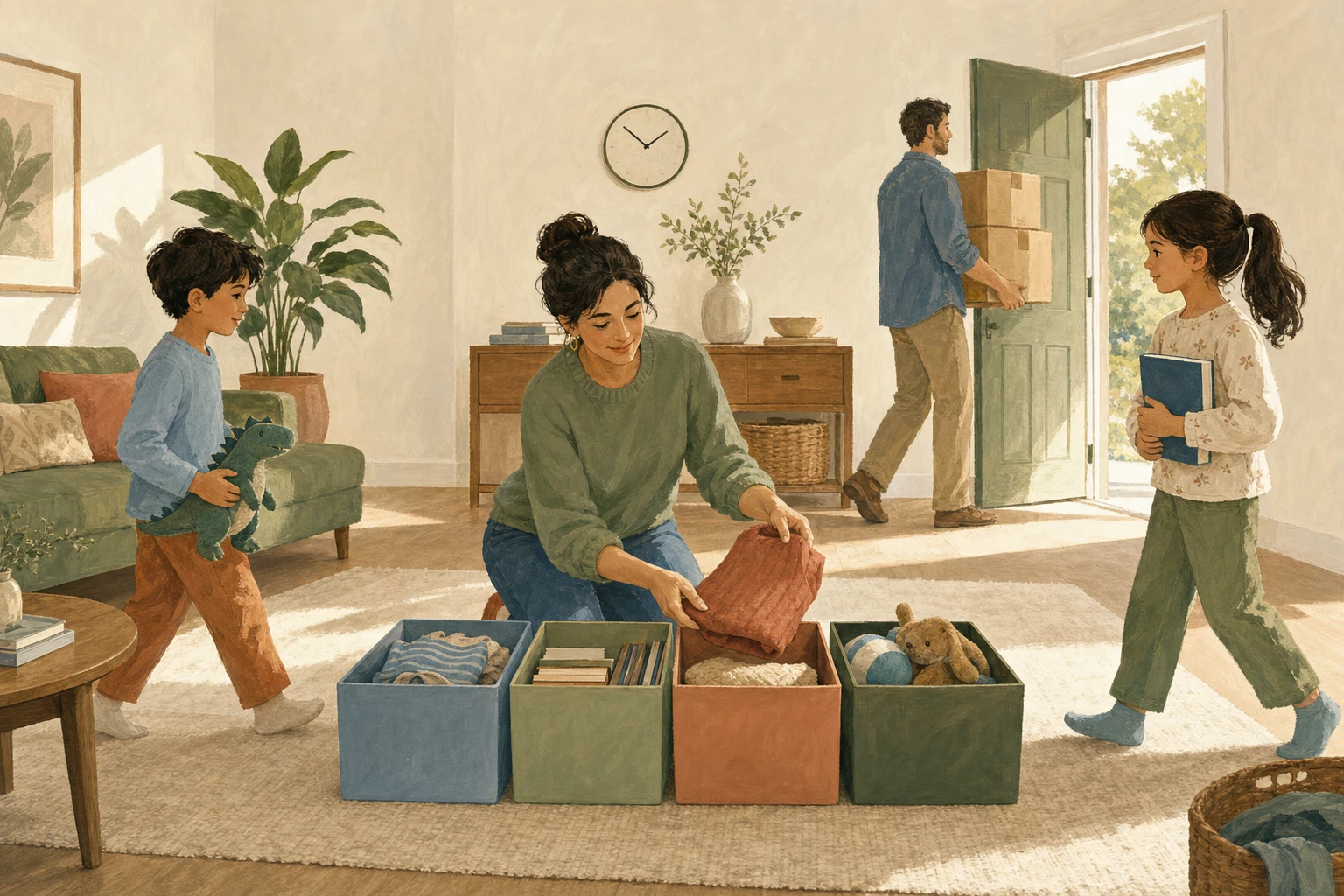
Before anyone opens a drawer, line up four empty destination containers and one small adult review tray. Then ask the question that keeps a Saturday project from swallowing the weekend: what would count as a successful declutter day by dinner?
If the answer is "the whole house, finished," the day can turn into six half-sorted piles and a car that never makes it to the donation drop-off. Give the day a smaller promise: finish the spaces you choose, put every kept item back, and give every outgoing container a person and a next stop.
That still gets a lot done. You won't reach every drawer, but you'll leave the house easier to live in at the end of the day instead of harder.
Set the finish line before the first drawer opens
Choose two to four spaces that fit the hours and people you've actually got. A space can be a whole room, but it can also be the coat closet, the toy shelf, the kitchen counter and junk drawer, or the garage wall by the door. Write one visible finish line for each one.
Good finish lines sound like this:
- Coat closet: the floor is clear, every coat fits on a hanger, and the donation bag is loaded into the car.
- Toy shelf: sets are together, keepers fit on the shelf, and the adult sorter has decided where every outgoing toy goes.
- Kitchen landing spot: papers are filed or recycled, things that belong elsewhere are returned, and the counter is ready for Monday morning.
"Declutter the basement" is too open-ended for one block. "Clear the two shelving units beside the stairs" tells everyone where to stop.
Put sentimental items, personal papers, and anything that belongs to someone who isn't there in the adult review tray. Leave medications, chemicals, sharp tools, and anything else that could hurt someone secured where it is, then write it on the plan for an adult to review separately. Children shouldn't handle or combine those items. They can help carry and return ordinary things, while an adult makes every decision about what leaves the house.
When a keeper needs a stable home, an adult can add its location to the family emergency binder index without copying the paper or its sensitive details.
Map the day in blocks
A declutter day needs a stop time as much as a start time. This sample uses four one-hour room blocks, with ten-minute handoffs between them and a real lunch break. Shorten it, start later, or use only two blocks if that's the day your family has. If one adult is working with the kids, plan for one or two spaces and make that adult the sorter. Everyone else can be a runner or returner.
| Time | What happens | Finish before moving on |
|---|---|---|
| 8:45 | Set up the four destination containers and adult review tray | Everyone knows their first job |
| 9:00 | Room block 1 | Kept items are home and containers reach the handoff spot |
| 10:10 | Room block 2 | The room's written finish line is met or the next step is noted |
| 11:20 | Move donations, discard items, and sell items to their next staging place | No loose piles stay in the room |
| 11:40 | Lunch and a full stop | Nobody sorts through the break |
| 12:30 | Room block 3 | Same closeout as the morning blocks |
| 1:40 | Room block 4 | Stop when the timer ends, even if one shelf remains |
| 2:50 | Close every outgoing handoff | Donations are loaded, sell items have an owner, and discard items are handled |
| 3:30 | Walk the finished spaces and stop | Unfinished work becomes a named next step, not a floor pile |
The ten-minute handoffs are part of the work. Skip them and the keep container migrates to the hallway, the donation box sits by the door for three weeks, and the sell pile becomes a new category of clutter with better intentions.
Give everyone a job they can finish
The adult sorter owns the decisions. That person stays near the four destination containers and adult review tray, answering the questions that would otherwise stop the room every thirty seconds.
Other adults can lead a room, return kept items, load donations, photograph sell items, or take a full container to its next stop. If there are two adults, don't make both of them sort. You don't need two people answering the same question. One sorter and one closer keeps decisions moving while the finished work actually leaves the room.
Give children concrete runner jobs:
- Bring books, toys, or clothes from the selected space to the adult sorter.
- Match loose game pieces, shoes, or building sets before the adult decides what happens next.
- Return kept items to a shelf, drawer, basket, or hook that already has a home.
- Choose a few favorites to recommend keeping, with the adult making the final outgoing decision.
- Carry a full keep basket to the room where its contents belong.
"Help with the playroom" invites a hundred questions. "Bring every book from the floor to this basket" gives a kid a job with an end.
Use the family declutter day plan
The fillable sheet holds the finish line, four room blocks, the lead and helper for each space, and the keep, donate, sell, and discard handoffs. Fill it on a computer or print it and write by hand.
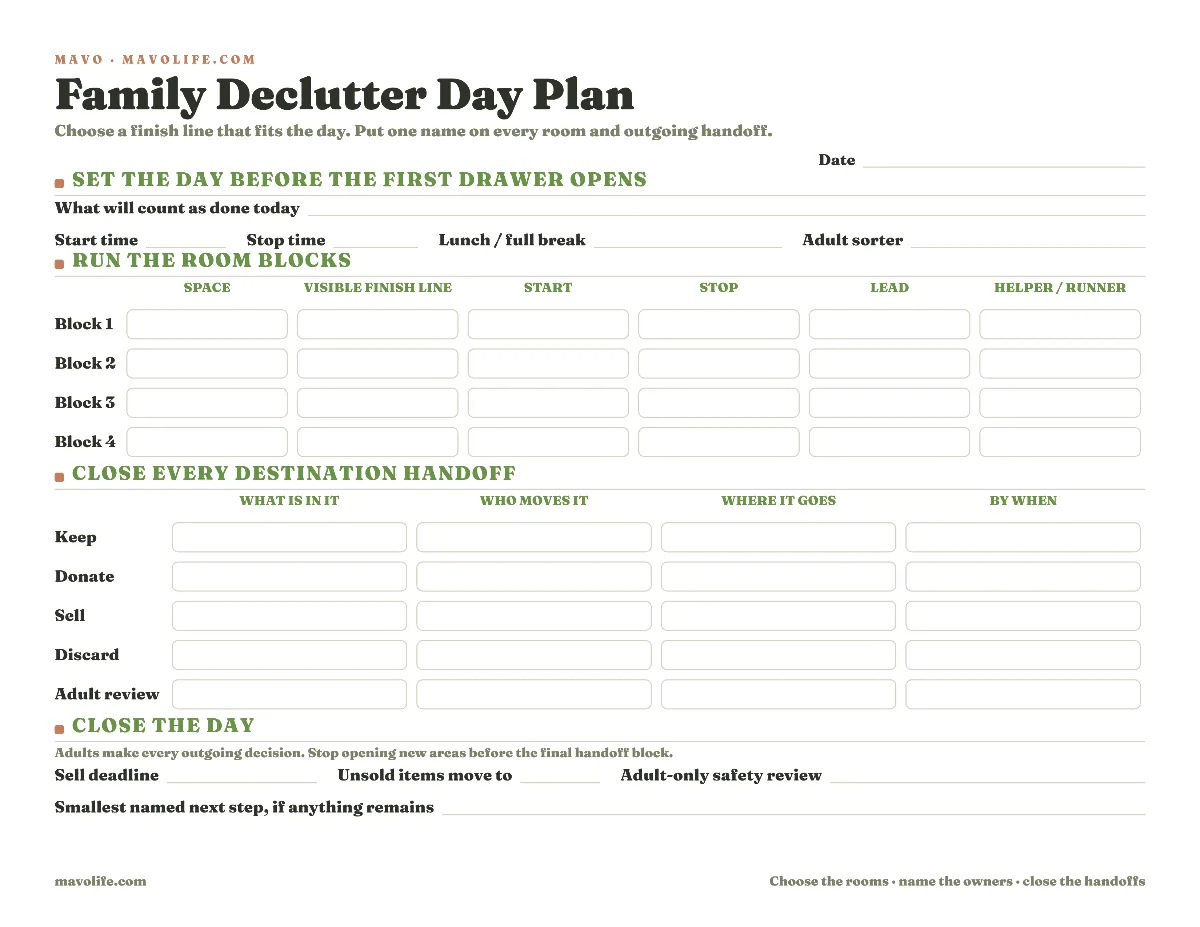
Download the fillable family declutter day plan (PDF)
Fill the destination section before you start. "Donate" isn't a destination by itself. Name who loads it, where it goes, and when it leaves. For sell items, name who will photograph and list them, plus the date when anything unsold moves to the donation plan. Give the adult review tray an owner and a date too. Those two deadlines keep the sell container and review tray from becoming permanent furniture.
Run each room the same way
Begin by reading that room's finish line out loud. Put the four destination containers and adult review tray at the edge of the space, not in the middle of the walking path, and start with what is already visible. You don't need to empty every drawer onto the floor to make the room meaningfully better.
As each ordinary item comes up, it gets one next move:
- Return it to the home it already has.
- Put it in the keep container because it belongs in another room.
- Bring it to the adult sorter for a donate, sell, or discard decision.
- Put it in the adult review tray because the owner isn't present or the choice needs more time.
When the timer ends, stop opening new areas. Spend the last ten minutes returning keepers and moving the containers to their named handoff spots. If the finish line isn't met, write down the smallest next step: "top two closet shelves, Sunday at 10, Alex." That closes the room for today without pretending the remaining work disappeared.
If one room runs long, don't borrow time from every room after it. Cut a later block or turn the unfinished part into the next named session. When the stop time arrives, close the containers and send each one to the person and place already written on the plan.
Keep the handoffs visible after the sheet comes down
Paper is enough to run the day. If your family wants the room blocks and outgoing jobs on the phones you already carry, put them in a shared Mavo list and assign who's handling each task. On Sunday, the list can show Alex on the remaining closet shelf, Sam on the donation drop-off, and nobody yet on the sell photos. That makes the open handoff visible without asking the person who wrote the sheet to recite it.
This is the same reason a mental load checklist puts names beside the things one parent has been tracking. You can also browse the home reset guides when the next household project needs a finish line of its own.
If you already use a weekly family meeting, take two minutes there to pick the spaces, date, and adult sorter. The Saturday plan is much easier to start when nobody is negotiating the finish line at 8:15.
For a slower daily rhythm, try the 30-day declutter challenge. It keeps the work to one small area a day, while this page is for a single project day with several room blocks and shared handoffs.
For a slower seasonal rhythm, use the free 12-month decluttering calendar. It follows household changeovers through the year, while this page stays focused on a single project day.
Decide whether selling is worth the extra handoff
Either can work. The day plan only asks you to name the owner and deadline. If nobody wants the job of listing, answering messages, and arranging the handoff, move the item to the donation decision instead of building a hopeful sell pile.
When the last timer rings, load donations into the car, move the sell container to its named owner, put the review tray on that adult's desk, and return the keep container. Then stop. Three finished spaces and no anonymous piles make a useful day, even when the rest of the house waits.
If you're sorting before a move, the new house essentials list helps you decide which ordinary belongings are already at the new place, which to bring, and which can wait after the outgoing piles are handled.