50 kid trivia questions
Pick a topic and play ten questions: animals, space, our world, everyday objects, or words and numbers. Each round has a question sheet with room to write and a separate host answer key. You can also read all 50 questions below and open the answers when you need them.
Download all five rounds and answer keys (PDF)
Free, no email or account. Ten US Letter pages, or download one question sheet and its key below. These are fixed PDFs for printing and handwriting.
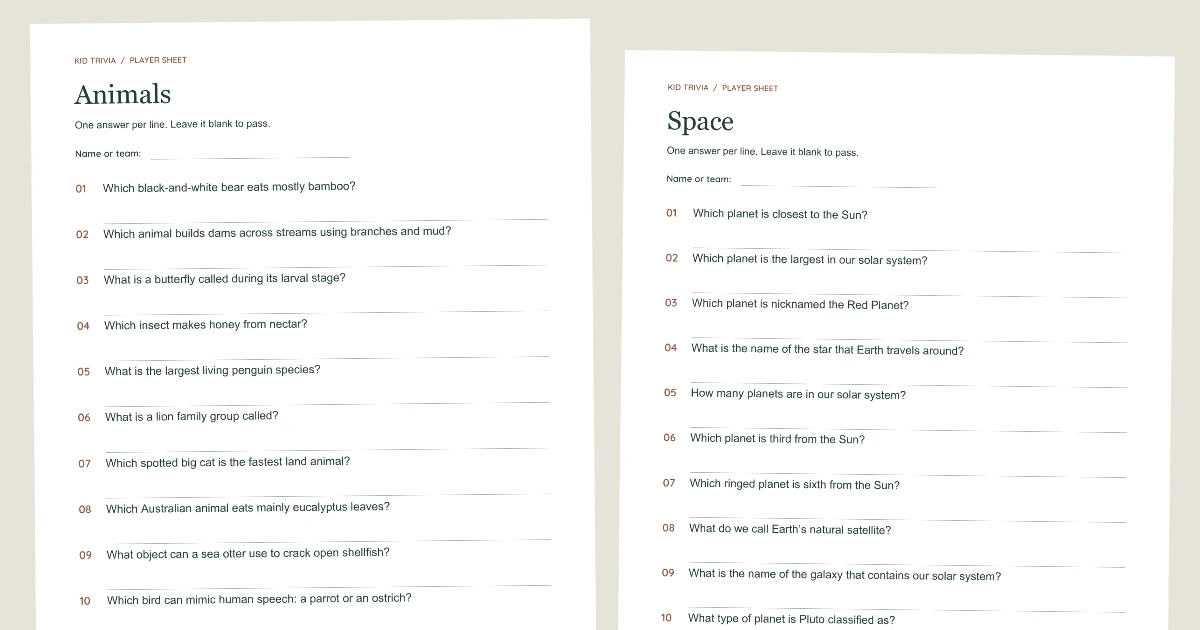
Run one round
Choose someone to read the questions and check the key. Everyone else can play alone or in teams. For a written round, give each player or team a question sheet and a pencil. Keep the answer pages out of view.
- Read each question aloud. Agree on a pause before starting; 20 seconds per question is one option, and you can give more time.
- Write one answer, or leave the line blank to pass. If you play aloud, let each player or team offer an answer before revealing it.
- After ten questions, open the key together. Give one point for each correct answer, including the listed alternatives. A wrong answer or pass scores zero. Spelling doesn’t change a clearly recognizable answer.
The highest total wins the round; tied totals share the win. Or skip scores and reveal each answer after everyone has had a turn. The host can change for the next topic if that person hasn’t read its answer key yet.
Want to join in without a host? Everyone can use a question sheet, then open the answer key together after all ten. On one phone, keep the answer disclosure closed until you’re ready.
Round 1 · 10 questions
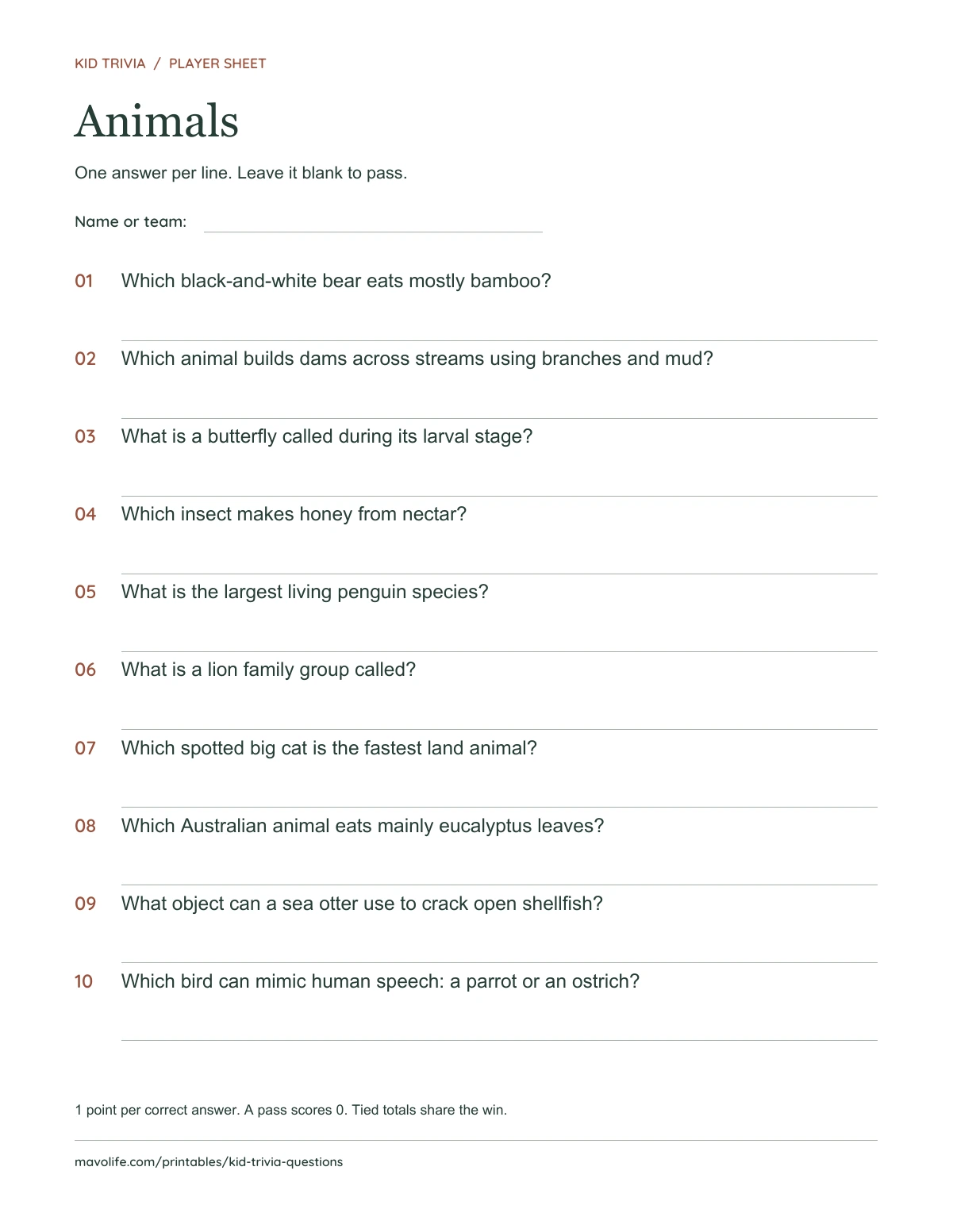
Animals
- Which black-and-white bear eats mostly bamboo?
- Which animal builds dams across streams using branches and mud?
- What is a butterfly called during its larval stage?
- Which insect makes honey from nectar?
- What is the largest living penguin species?
- What is a lion family group called?
- Which spotted big cat is the fastest land animal?
- Which Australian animal eats mainly eucalyptus leaves?
- What object can a sea otter use to crack open shellfish?
- Which bird can mimic human speech: a parrot or an ostrich?
Show animals answers and sources
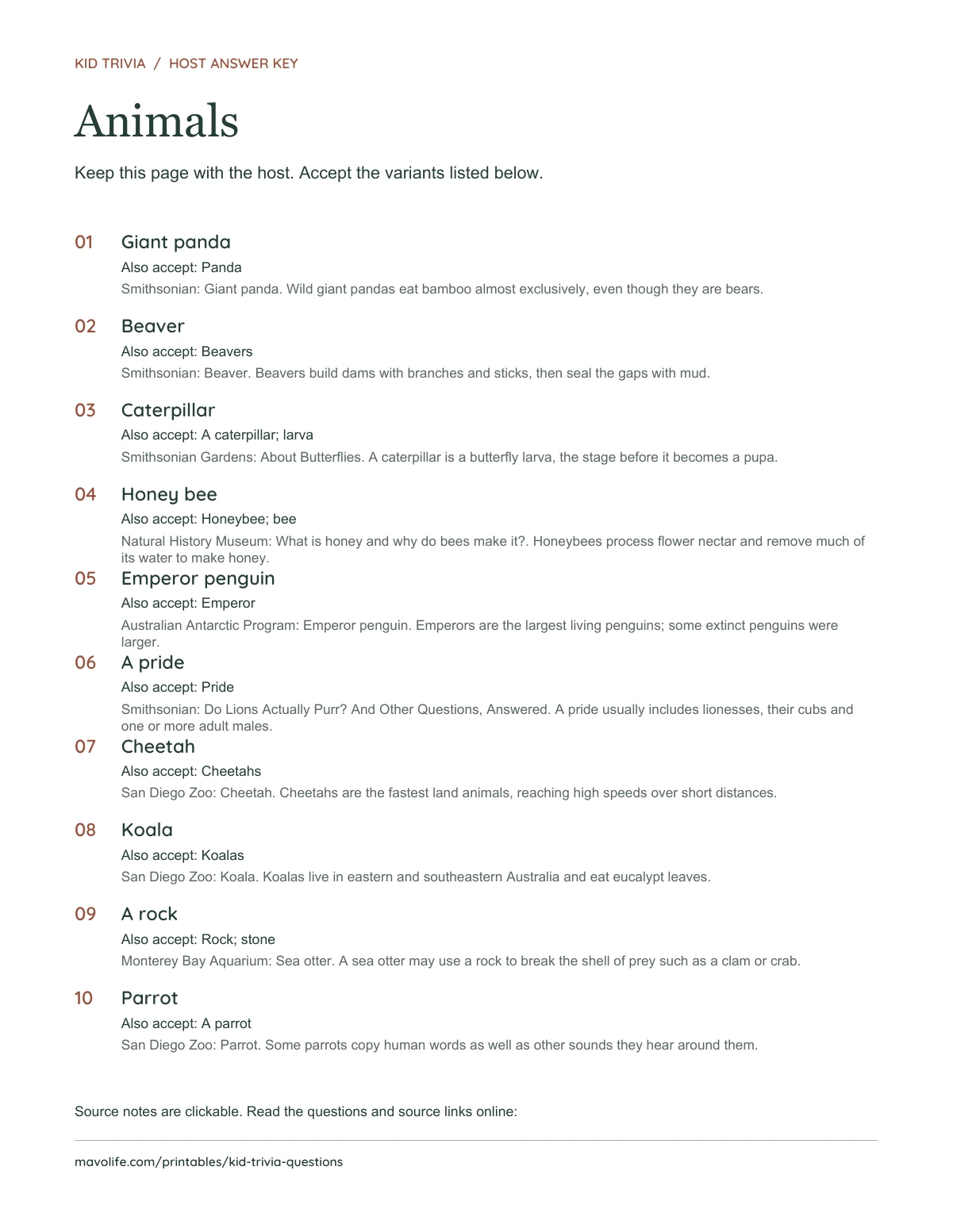
- Giant panda. Also accept: Panda.
Wild giant pandas eat bamboo almost exclusively, even though they are bears. Smithsonian: Giant panda.
- Beaver. Also accept: Beavers.
Beavers build dams with branches and sticks, then seal the gaps with mud. Smithsonian: Beaver.
- Caterpillar. Also accept: A caterpillar; larva.
A caterpillar is a butterfly larva, the stage before it becomes a pupa. Smithsonian Gardens: About Butterflies.
- Honey bee. Also accept: Honeybee; bee.
Honeybees process flower nectar and remove much of its water to make honey. Natural History Museum: What is honey and why do bees make it?.
- Emperor penguin. Also accept: Emperor.
Emperors are the largest living penguins; some extinct penguins were larger. Australian Antarctic Program: Emperor penguin.
- A pride. Also accept: Pride.
A pride usually includes lionesses, their cubs and one or more adult males. Smithsonian: Do Lions Actually Purr? And Other Questions, Answered.
- Cheetah. Also accept: Cheetahs.
Cheetahs are the fastest land animals, reaching high speeds over short distances. San Diego Zoo: Cheetah.
- Koala. Also accept: Koalas.
Koalas live in eastern and southeastern Australia and eat eucalypt leaves. San Diego Zoo: Koala.
- A rock. Also accept: Rock; stone.
A sea otter may use a rock to break the shell of prey such as a clam or crab. Monterey Bay Aquarium: Sea otter.
- Parrot. Also accept: A parrot.
Some parrots copy human words as well as other sounds they hear around them. San Diego Zoo: Parrot.
Preview both animals pages (includes answers)
Round 2 · 10 questions
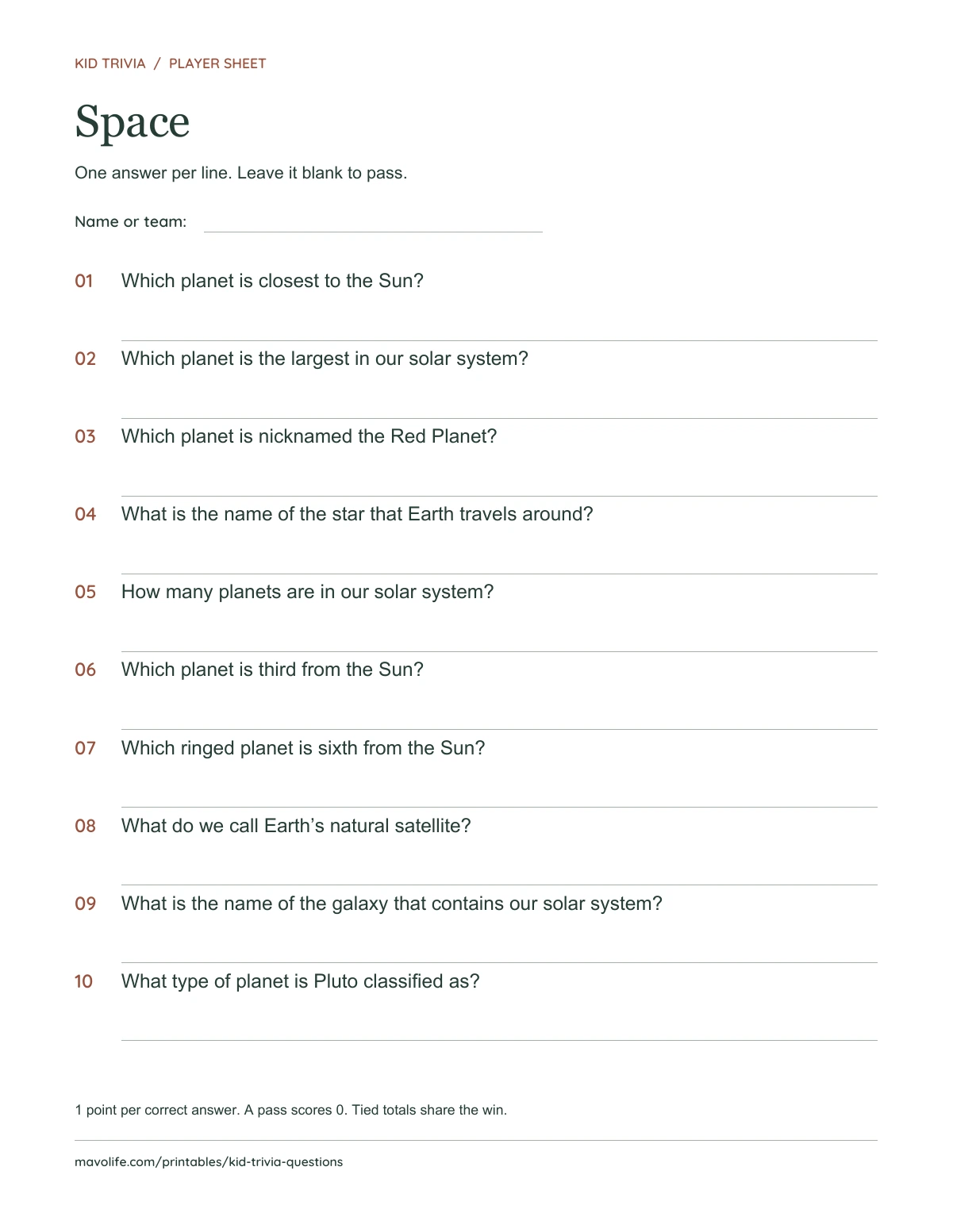
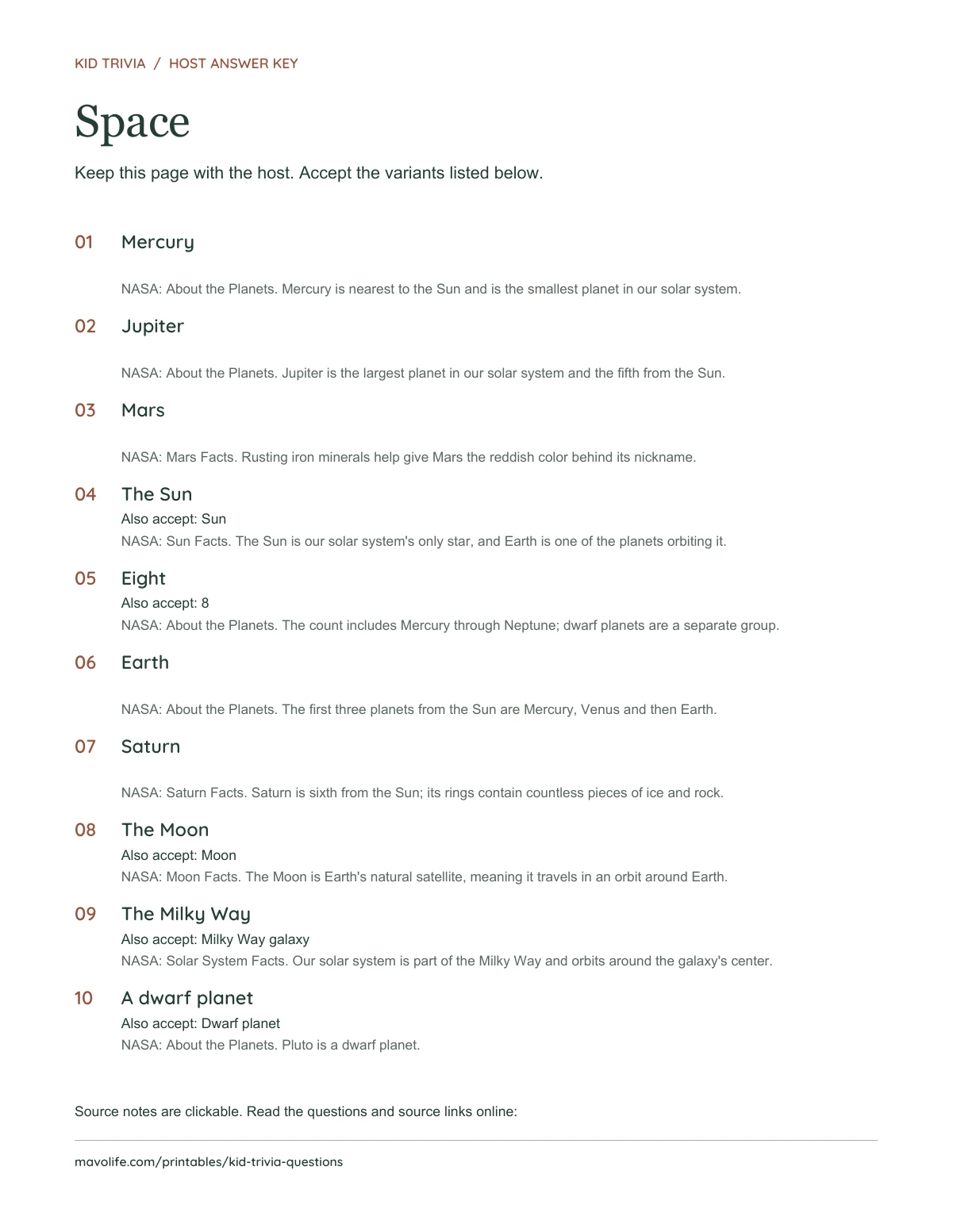
Space
- Which planet is closest to the Sun?
- Which planet is the largest in our solar system?
- Which planet is nicknamed the Red Planet?
- What is the name of the star that Earth travels around?
- How many planets are in our solar system?
- Which planet is third from the Sun?
- Which ringed planet is sixth from the Sun?
- What do we call Earth’s natural satellite?
- What is the name of the galaxy that contains our solar system?
- What type of planet is Pluto classified as?
Show space answers and sources
- Mercury.
Mercury is nearest to the Sun and is the smallest planet in our solar system. NASA: About the Planets.
- Jupiter.
Jupiter is the largest planet in our solar system and the fifth from the Sun. NASA: About the Planets.
- Mars.
Rusting iron minerals help give Mars the reddish color behind its nickname. NASA: Mars Facts.
- The Sun. Also accept: Sun.
The Sun is our solar system's only star, and Earth is one of the planets orbiting it. NASA: Sun Facts.
- Eight. Also accept: 8.
The count includes Mercury through Neptune; dwarf planets are a separate group. NASA: About the Planets.
- Earth.
The first three planets from the Sun are Mercury, Venus and then Earth. NASA: About the Planets.
- Saturn.
Saturn is sixth from the Sun; its rings contain countless pieces of ice and rock. NASA: Saturn Facts.
- The Moon. Also accept: Moon.
The Moon is Earth's natural satellite, meaning it travels in an orbit around Earth. NASA: Moon Facts.
- The Milky Way. Also accept: Milky Way galaxy.
Our solar system is part of the Milky Way and orbits around the galaxy's center. NASA: Solar System Facts.
- A dwarf planet. Also accept: Dwarf planet.
Pluto is a dwarf planet. NASA: About the Planets.
Preview both space pages (includes answers)
Round 3 · 10 questions
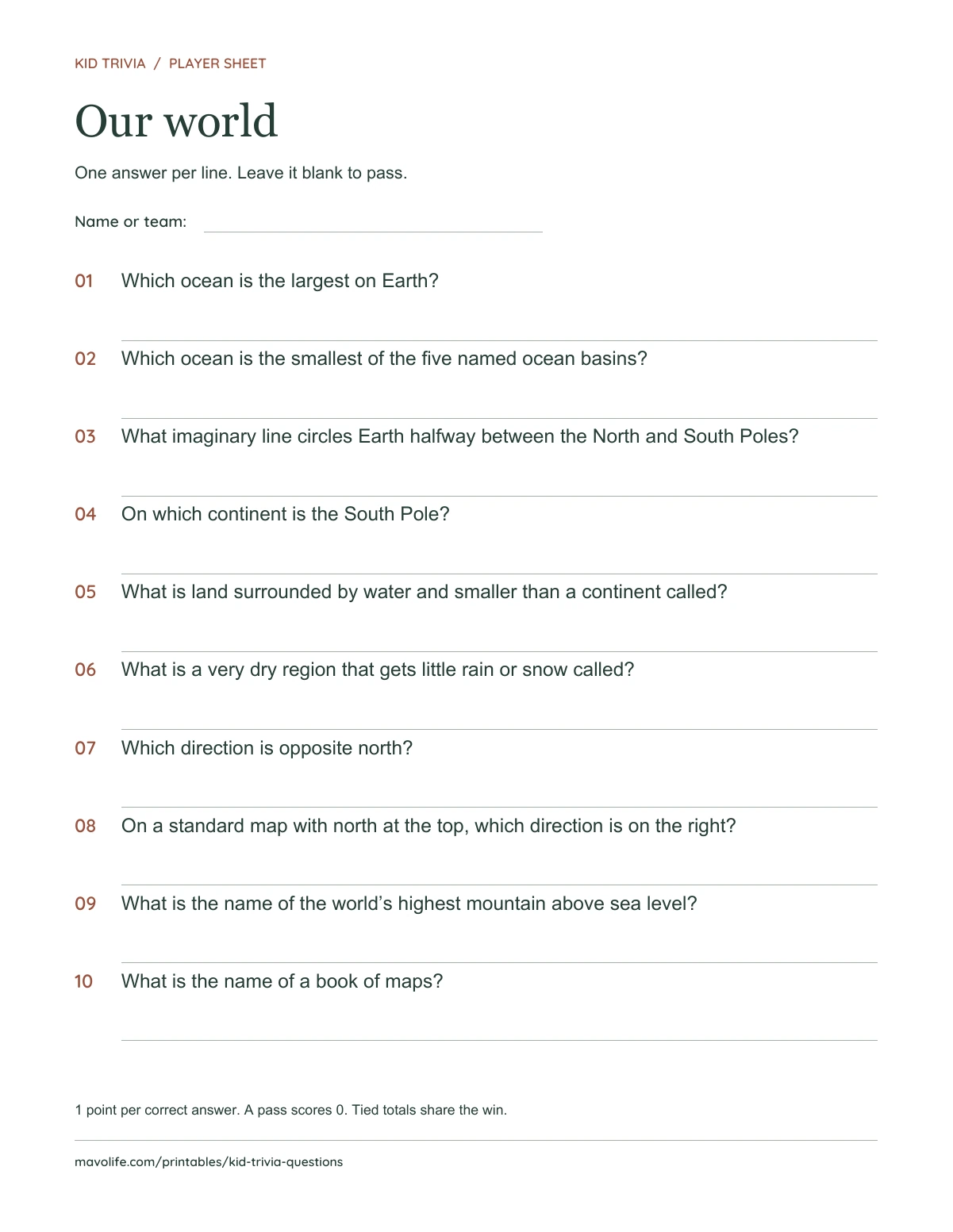
Our world
- Which ocean is the largest on Earth?
- Which ocean is the smallest of the five named ocean basins?
- What imaginary line circles Earth halfway between the North and South Poles?
- On which continent is the South Pole?
- What is land surrounded by water and smaller than a continent called?
- What is a very dry region that gets little rain or snow called?
- Which direction is opposite north?
- On a standard map with north at the top, which direction is on the right?
- What is the name of the world’s highest mountain above sea level?
- What is the name of a book of maps?
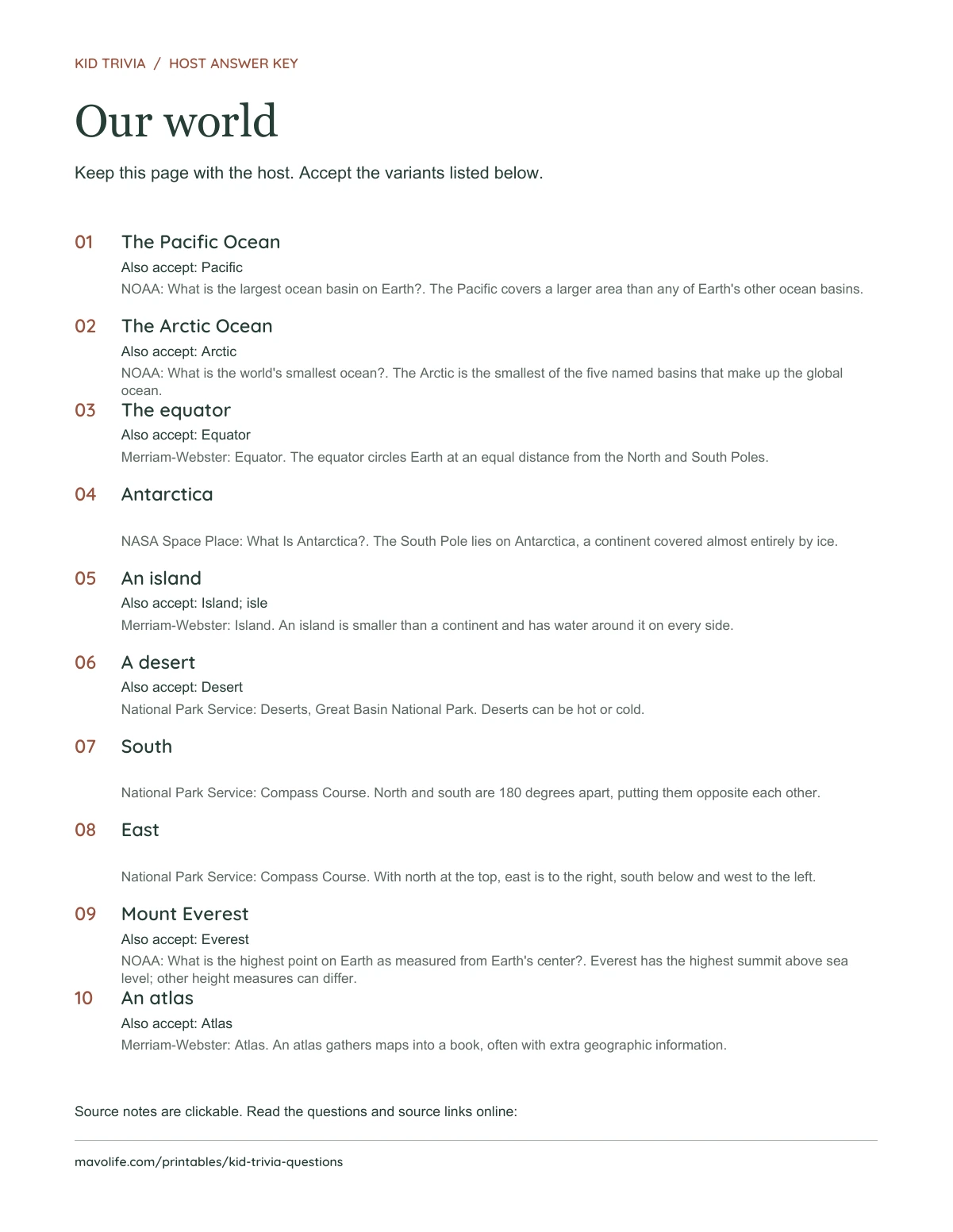
Show our world answers and sources
- The Pacific Ocean. Also accept: Pacific.
The Pacific covers a larger area than any of Earth's other ocean basins. NOAA: What is the largest ocean basin on Earth?.
- The Arctic Ocean. Also accept: Arctic.
The Arctic is the smallest of the five named basins that make up the global ocean. NOAA: What is the world's smallest ocean?.
- The equator. Also accept: Equator.
The equator circles Earth at an equal distance from the North and South Poles. Merriam-Webster: Equator.
- Antarctica.
The South Pole lies on Antarctica, a continent covered almost entirely by ice. NASA Space Place: What Is Antarctica?.
- An island. Also accept: Island; isle.
An island is smaller than a continent and has water around it on every side. Merriam-Webster: Island.
- A desert. Also accept: Desert.
Deserts can be hot or cold. National Park Service: Deserts, Great Basin National Park.
- South.
North and south are 180 degrees apart, putting them opposite each other. National Park Service: Compass Course.
- East.
With north at the top, east is to the right, south below and west to the left. National Park Service: Compass Course.
- Mount Everest. Also accept: Everest.
Everest has the highest summit above sea level; other height measures can differ. NOAA: What is the highest point on Earth as measured from Earth's center?.
- An atlas. Also accept: Atlas.
An atlas gathers maps into a book, often with extra geographic information. Merriam-Webster: Atlas.
Preview both our world pages (includes answers)
Round 4 · 10 questions
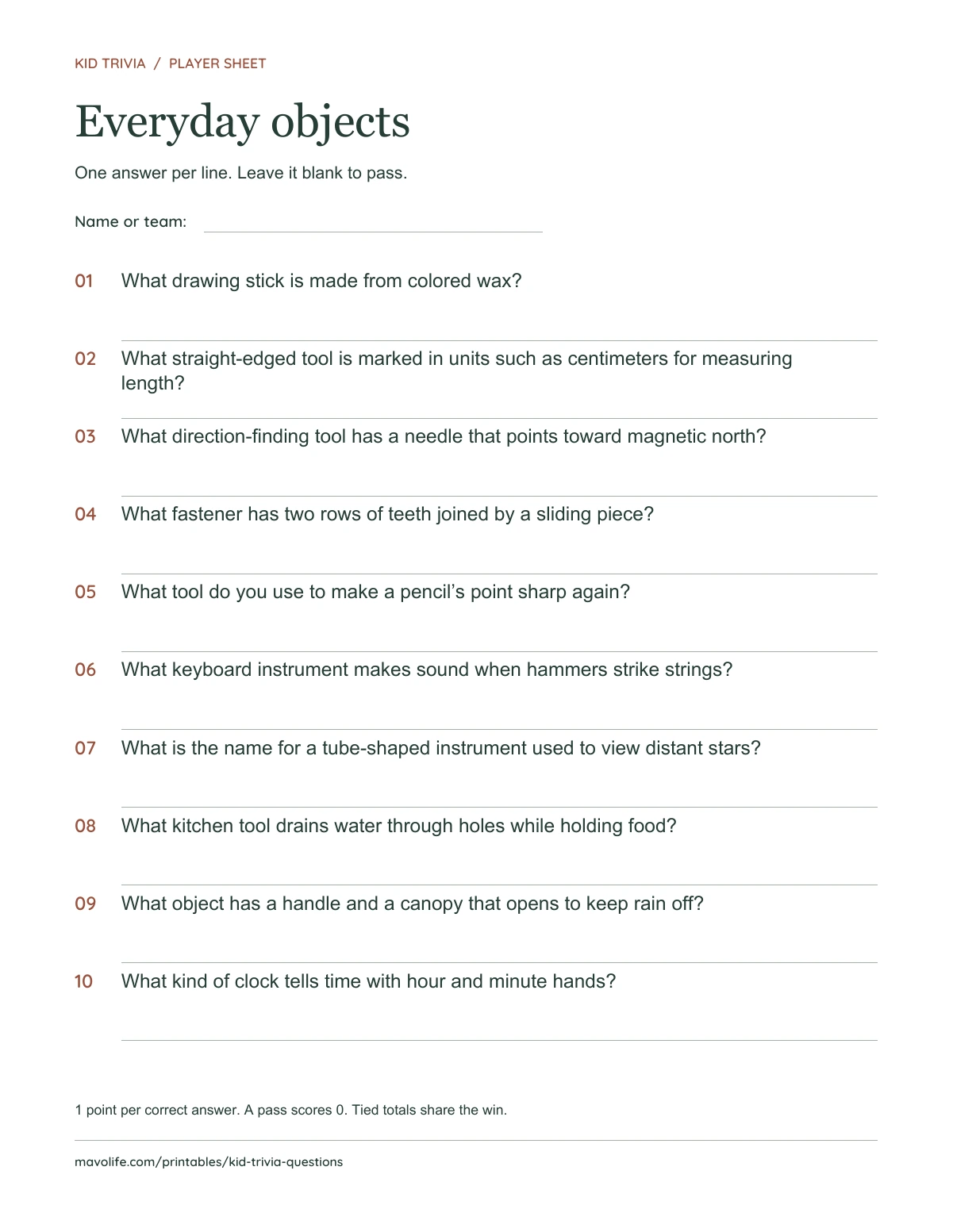
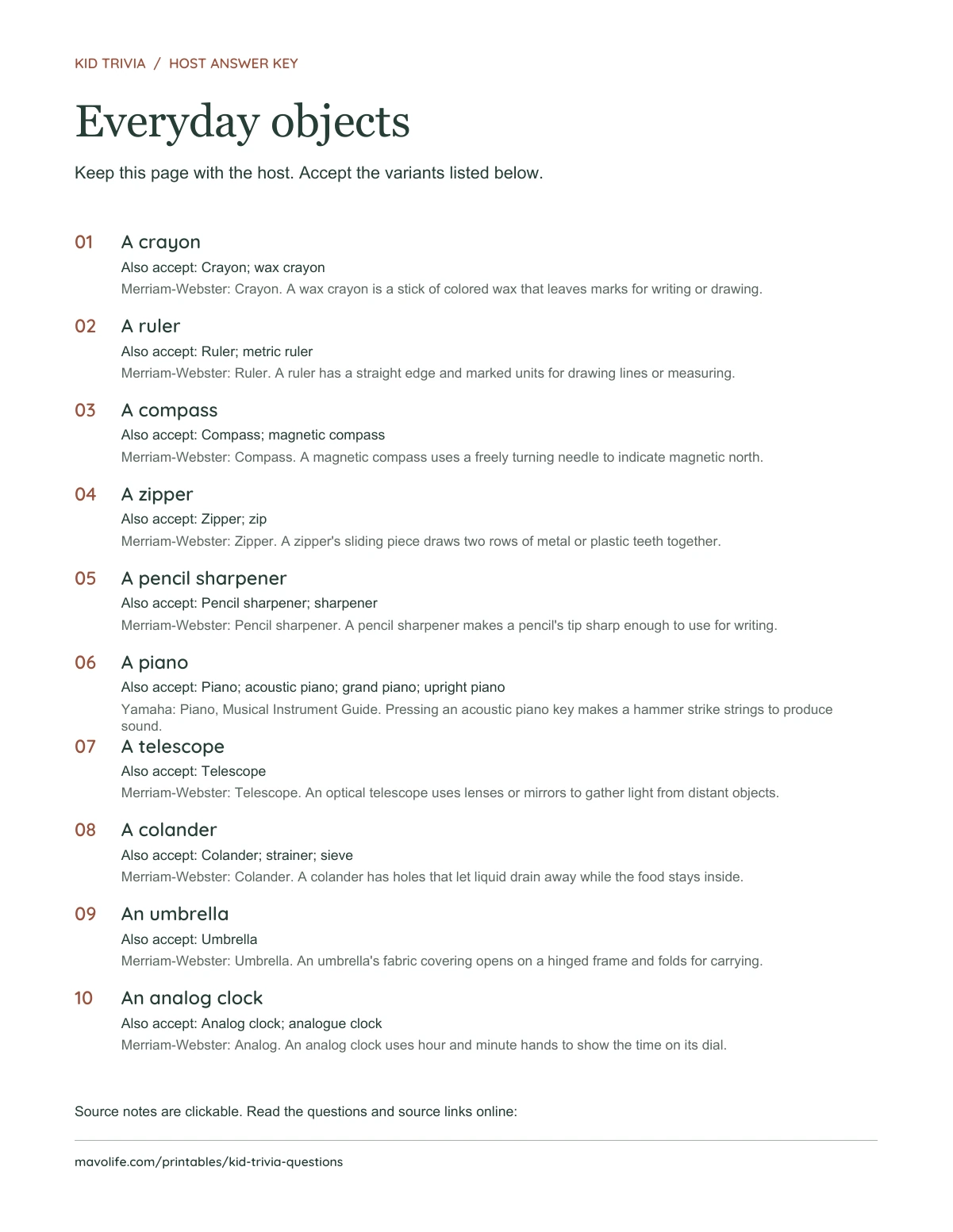
Everyday objects
- What drawing stick is made from colored wax?
- What straight-edged tool is marked in units such as centimeters for measuring length?
- What direction-finding tool has a needle that points toward magnetic north?
- What fastener has two rows of teeth joined by a sliding piece?
- What tool do you use to make a pencil’s point sharp again?
- What keyboard instrument makes sound when hammers strike strings?
- What is the name for a tube-shaped instrument used to view distant stars?
- What kitchen tool drains water through holes while holding food?
- What object has a handle and a canopy that opens to keep rain off?
- What kind of clock tells time with hour and minute hands?
Show everyday objects answers and sources
- A crayon. Also accept: Crayon; wax crayon.
A wax crayon is a stick of colored wax that leaves marks for writing or drawing. Merriam-Webster: Crayon.
- A ruler. Also accept: Ruler; metric ruler.
A ruler has a straight edge and marked units for drawing lines or measuring. Merriam-Webster: Ruler.
- A compass. Also accept: Compass; magnetic compass.
A magnetic compass uses a freely turning needle to indicate magnetic north. Merriam-Webster: Compass.
- A zipper. Also accept: Zipper; zip.
A zipper's sliding piece draws two rows of metal or plastic teeth together. Merriam-Webster: Zipper.
- A pencil sharpener. Also accept: Pencil sharpener; sharpener.
A pencil sharpener makes a pencil's tip sharp enough to use for writing. Merriam-Webster: Pencil sharpener.
- A piano. Also accept: Piano; acoustic piano; grand piano; upright piano.
Pressing an acoustic piano key makes a hammer strike strings to produce sound. Yamaha: Piano, Musical Instrument Guide.
- A telescope. Also accept: Telescope.
An optical telescope uses lenses or mirrors to gather light from distant objects. Merriam-Webster: Telescope.
- A colander. Also accept: Colander; strainer; sieve.
A colander has holes that let liquid drain away while the food stays inside. Merriam-Webster: Colander.
- An umbrella. Also accept: Umbrella.
An umbrella's fabric covering opens on a hinged frame and folds for carrying. Merriam-Webster: Umbrella.
- An analog clock. Also accept: Analog clock; analogue clock.
An analog clock uses hour and minute hands to show the time on its dial. Merriam-Webster: Analog.
Preview both everyday objects pages (includes answers)
Round 5 · 10 questions
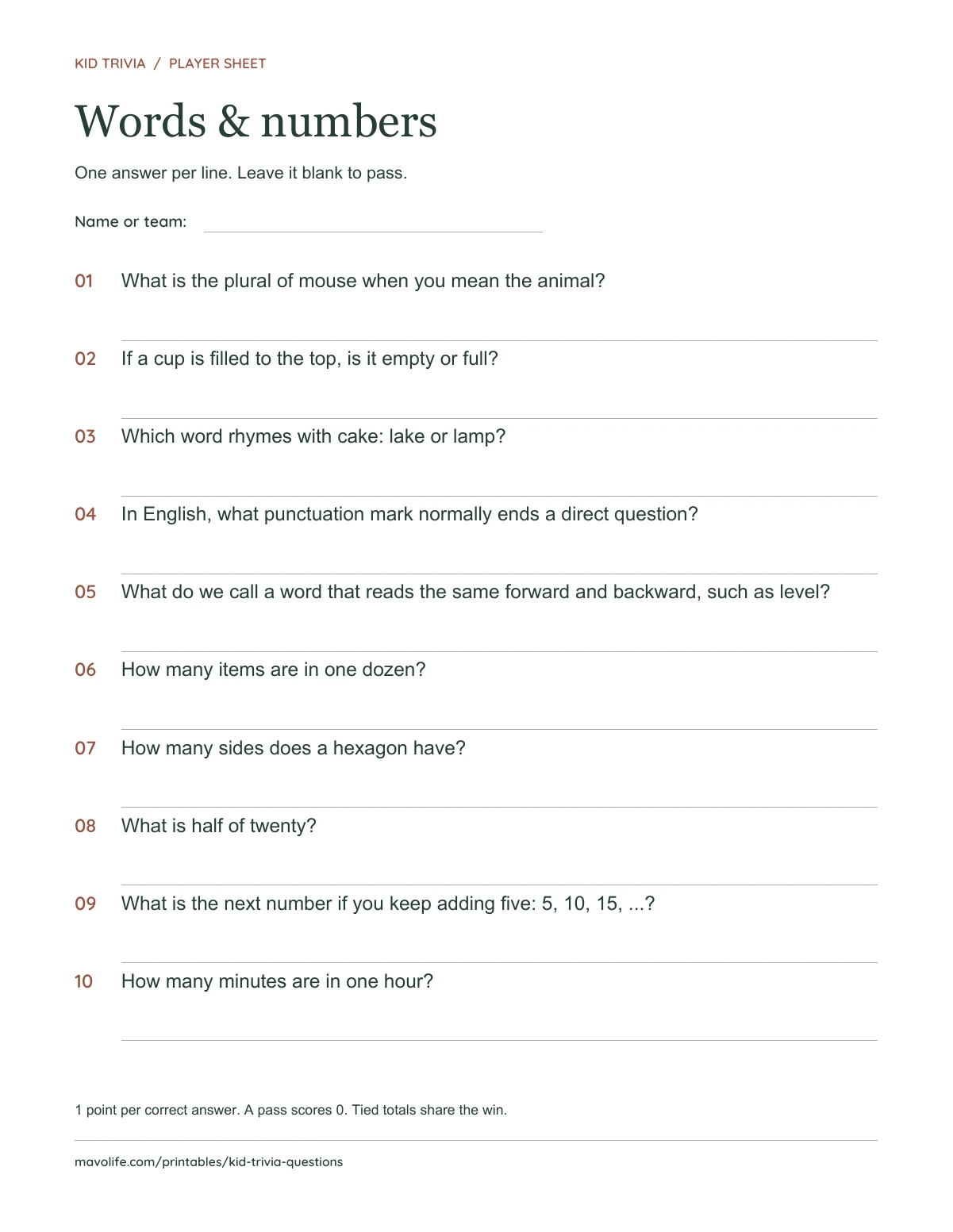
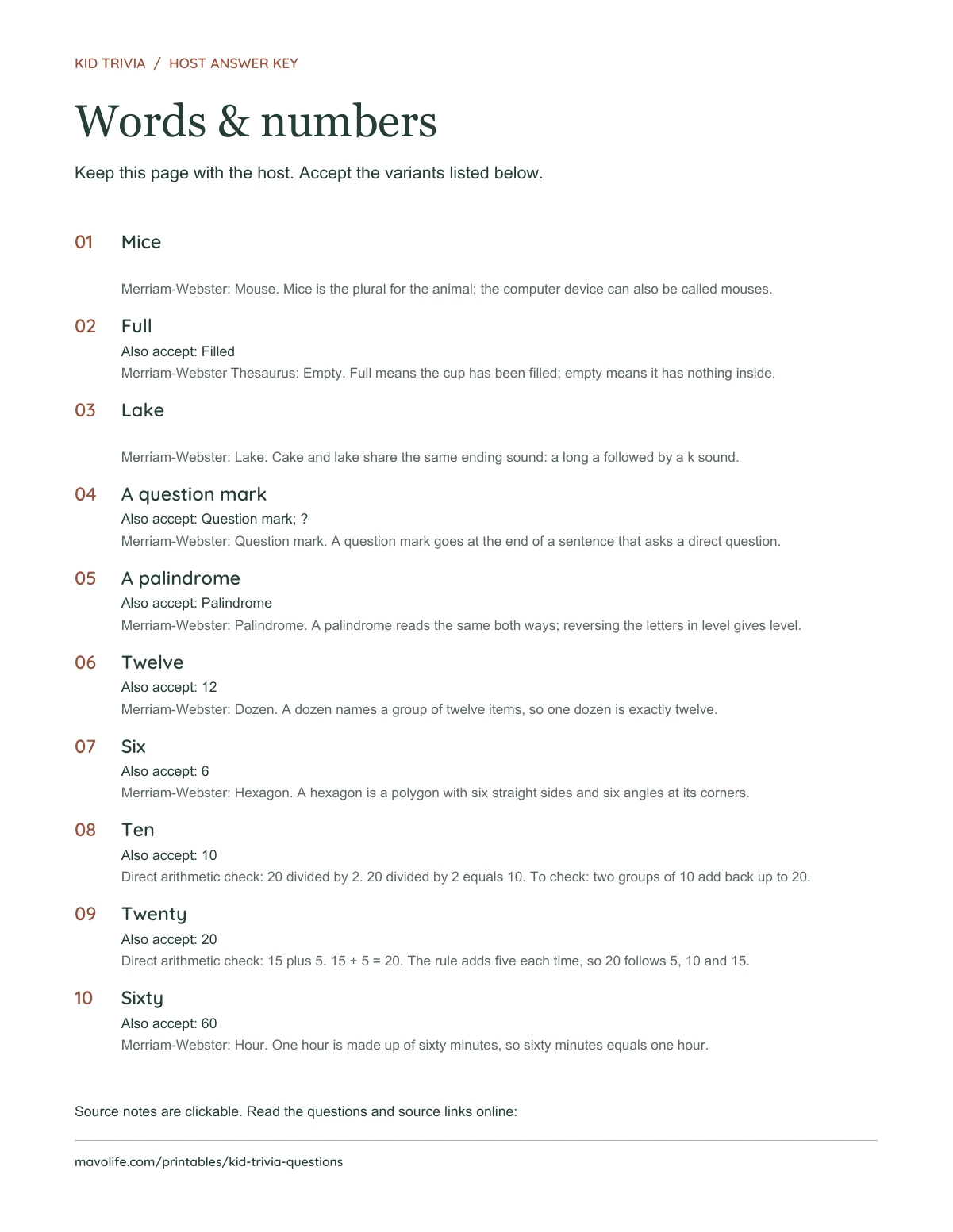
Words & numbers
- What is the plural of mouse when you mean the animal?
- If a cup is filled to the top, is it empty or full?
- Which word rhymes with cake: lake or lamp?
- In English, what punctuation mark normally ends a direct question?
- What do we call a word that reads the same forward and backward, such as level?
- How many items are in one dozen?
- How many sides does a hexagon have?
- What is half of twenty?
- What is the next number if you keep adding five: 5, 10, 15, ...?
- How many minutes are in one hour?
Show words & numbers answers and sources
- Mice.
Mice is the plural for the animal; the computer device can also be called mouses. Merriam-Webster: Mouse.
- Full. Also accept: Filled.
Full means the cup has been filled; empty means it has nothing inside. Merriam-Webster Thesaurus: Empty.
- Lake.
Cake and lake share the same ending sound: a long a followed by a k sound. Merriam-Webster: Lake.
- A question mark. Also accept: Question mark; ?.
A question mark goes at the end of a sentence that asks a direct question. Merriam-Webster: Question mark.
- A palindrome. Also accept: Palindrome.
A palindrome reads the same both ways; reversing the letters in level gives level. Merriam-Webster: Palindrome.
- Twelve. Also accept: 12.
A dozen names a group of twelve items, so one dozen is exactly twelve. Merriam-Webster: Dozen.
- Six. Also accept: 6.
A hexagon is a polygon with six straight sides and six angles at its corners. Merriam-Webster: Hexagon.
- Ten. Also accept: 10.
20 divided by 2 equals 10. To check: two groups of 10 add back up to 20.
- Twenty. Also accept: 20.
15 + 5 = 20. The rule adds five each time, so 20 follows 5, 10 and 15.
- Sixty. Also accept: 60.
One hour is made up of sixty minutes, so sixty minutes equals one hour. Merriam-Webster: Hour.
Preview both words & numbers pages (includes answers)
Print only the round you want
The individual question and answer downloads are one page each. Print a question page for every player or team, then one answer key for the host. Use single-sided printing so answers don’t appear on the back of a player’s sheet.
For the full ten-page file, questions are on pages 1, 3, 5, 7, and 9; the matching answers follow on pages 2, 4, 6, 8, and 10. Choose US Letter paper and Actual size or 100%. On A4, use Fit and check the first copy; the writing spaces will be slightly smaller. The pages work in black and white.
The question text is fixed, and the answer lines aren’t type-in fields. For a round without a printer, read from this page and answer aloud or write the numbers on ordinary paper.
Animal and space answers link to zoos, museums, and science agencies; other notes link to the relevant reference or explain the calculation. The keys name accepted alternatives where wording may differ. No movie, television, or music knowledge is needed.
Save a round for later
For a game where everyone chooses their own answer, try the Would You Rather question cards. For drawing and guessing rounds, browse the printable holiday party games.