Caregiver handoffs · July 10, 2026 · 7 min read
Which one of us is staying home today?
Decide keep home or send, split the day so nobody loses all of it, and print a card with the numbers you dial, your usual split, and the doses off the bottle.
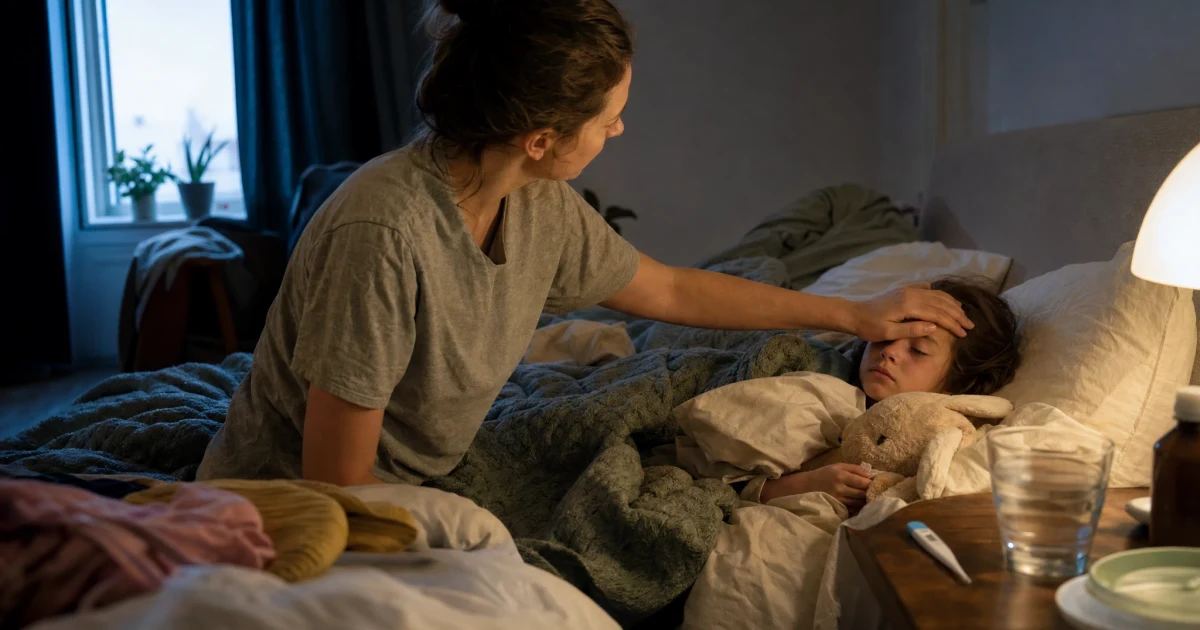
You know before you touch her forehead. She's up too early and too quiet, standing at your side of the bed, and the thermometer is only there to make it official.
Then the negotiation starts, and it's the same one every time. You have the thing that can't move. Your partner has calls stacked until three. School starts in ninety minutes, one of you is about to hand back a day you already spent, and whoever's job sounds less urgent out loud is usually the one who eats it.
Those aren't decisions either of you is good at making with a warm kid on your hip. You're both fine at them on a Tuesday night when nobody's sick. So make them then: where your keep-home line is, who takes the first half of the day, who you call when neither of you can. One card, filled in once, kept where you can grab it.
Keep home or send
Standing at the bed, you're the worst possible judge of this. You're tired, she's warm and clingy, and somewhere behind your eyes a meeting is arguing for itself. So borrow a rule instead of building one on the spot.
Most schools and pediatricians draw the keep-home line around a few clear signals. The American Academy of Pediatrics' school guidance says to keep a child home for a fever above 101°F in the past 24 hours, or vomiting or diarrhea in the past 24 hours, and to follow your own school's policy, which may set the line a little differently. A fever generally starts at 100.4°F (38°C). Add the things that obviously spread, like pink eye, strep, or a cough that's clearly getting worse, plus the days a kid is too wiped out to take part in anything.
The send-anyway list is shorter than the fear makes it feel: a mild runny nose or a lingering cough with no fever and normal energy, allergy symptoms they get every spring, one symptom that's already fading while they act like themselves.
The gray zone is where the arguing happens. Sore throat, no fever. A headache. A stomach that hurts on a test day. Two questions usually settle it: can they take part in a normal day, and would you be comfortable if another kid showed up with exactly this? When it's still a coin flip, keep home and call the doctor's office when it opens. They'll tell you more in ninety seconds than a group text will in an hour.
The sick day plan card
Everything on it is a thing you already know on a calm evening: the school's absence line, the nurse line after hours, who you call when neither of you can be home, who usually takes which half of the day, and the dose for each kid. Fill it in once and keep the card somewhere you can grab it fast. Nothing on it belongs to one particular sick day, which is why it's still right the next time.
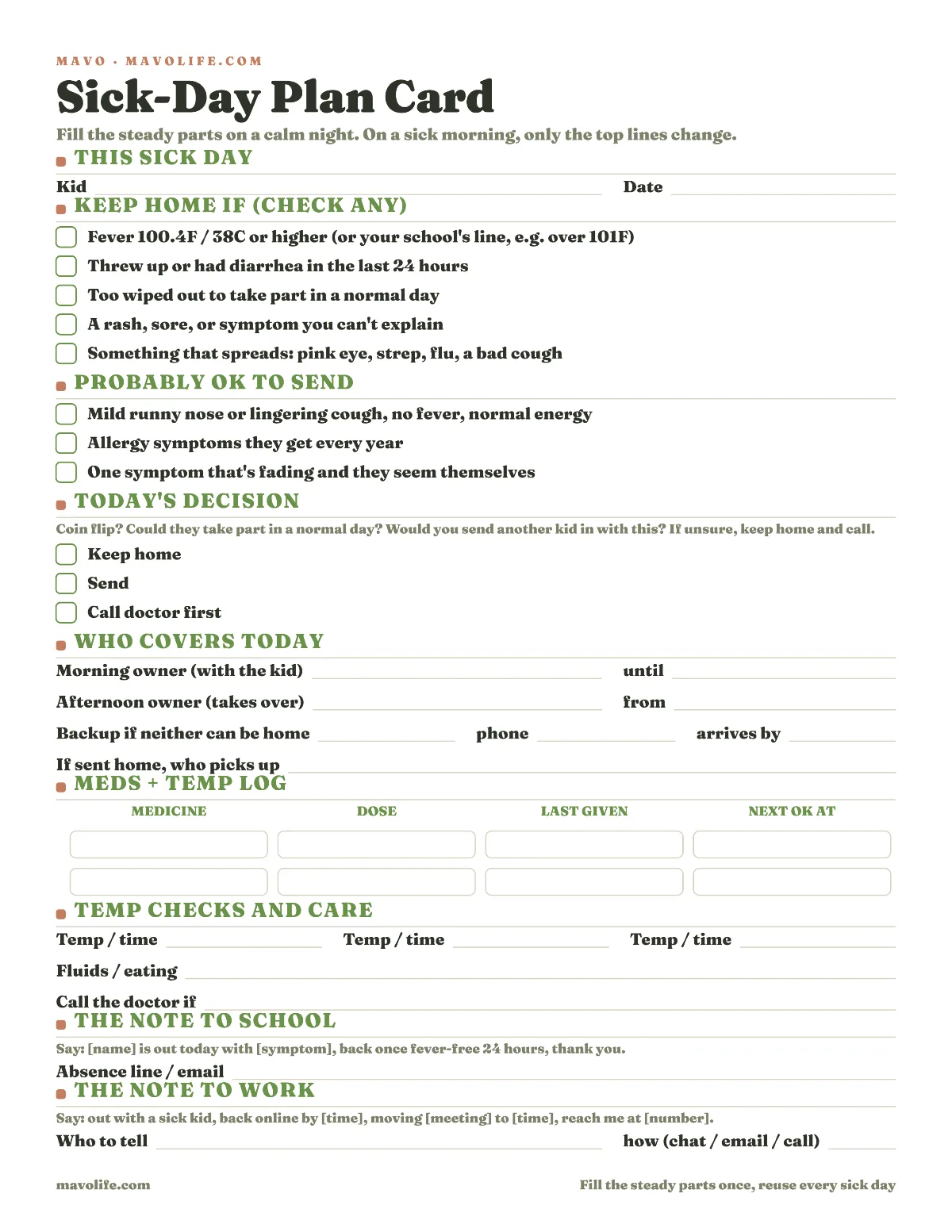
Download the printable sick-day plan card (PDF)
Fill it in for real. The dose boxes are blank on purpose: write the actual dose off the label or from your pediatrician, not a number you half-remember. The last box in that row is the one thing you touch on a sick day, in pencil, when you give a dose. Two doses of the same fever medicine an hour apart, because you each gave one without saying so, is the exact mix-up it prevents.
Nobody has to lose the whole day
A sick day has two shifts, and the fastest way to lose a full workday to it is to leave both unspoken. One of you takes the morning, which is the first stretch with her, the call to the doctor's office, and the first dose. The afternoon is a different job: the handoff, the nap watch, and reading whether she's getting better or worse. Sometimes it's the same parent all day. Often it's a swap at lunch, so you each give up half a day instead of one of you giving up all of it. Put your usual version on the card, and the only thing left to say at seven in the morning is whether today is one of the days it doesn't fit.
If it's your week alone because your partner is traveling, the split still helps. A grandparent or a neighbor who can take two hours in the middle is the difference between losing the day and losing the morning.
Then there's the day neither of you can be home. That's what the backup caregiver line is for. A grandparent, a neighbor, a sitter who does sick days: decide who that is before you need them, because "who can we even call" is a miserable thing to research with a kid crying in the next room. If your backup is really a pickup problem, because she's at school and someone has to go get her, that's its own small plan, and it helps to have sorted out who's authorized to grab her ahead of time. The same goes for the ordinary week this sick day just wrecked: if you already know who owns which drop-off and pickup across your two work calendars, today's answer is usually sitting in it.
If the day lives in Mavo, give each shift a name with Who's Handling It. The morning and the afternoon show as Covered once someone's on them, and anything still without a name sits in Needs Attention. It answers the question you'd otherwise text five times: who's got her right now?
The note to school and the note to work
Two messages still have to go out, and they land at the worst moment: one to school, one to work, both while you're holding a kid who wants the phone gone.
The school note is short and nearly identical every time: who's out, the symptom, when you expect her back. The work note is the one people rewrite four times. How much to say, who to tell, what to move. Neither is worth ten minutes on a morning you don't have ten.
Ask Mavo AI for both. Tell it the symptom and when you'll be back online, and it writes the two notes in the chat for you to fix and send. It doesn't send them. The kid health sheet you already keep holds the details a good draft leans on, like the pediatrician's name, so the school note comes out specific instead of generic.
And when the visit summary says keep her home tomorrow too, forward it. Mavo drafts the updates to tomorrow's plan, including who's handling it, and waits for you to approve them. Tomorrow gets settled while today is still going.
Questions that come up on a sick morning
When should I actually call the doctor?
When you're unsure, that alone is reason enough for a quick call to the nurse line. Sooner if there's a high or stubborn fever, any fever in a baby, trouble breathing, signs of dehydration (very little peeing, no tears when crying, a dry mouth), a stiff neck, a rash that doesn't fade when you press it, or a kid who's hard to wake or unusually out of it. You know your kid's normal. A doctor would rather field the "probably nothing" call than miss the other kind.
When can they go back?
The common rule is fever-free for 24 hours without fever-reducing medicine, plus no vomiting or diarrhea for 24 hours. Nationwide Children's puts it plainly: back to school after 24 hours fever-free without antipyretics, which is the medical word for the medicine that brings a fever down. The catch is the "without medicine" part. If the fever only stays down because you dosed at six in the morning, the 24 hours hasn't started yet. Check your own school's policy too, since some are stricter.
What if neither of us can be home at all?
That's the day the backup caregiver line stops being optional. When it's genuinely no-adult-available, split the day into the smallest coverable pieces: one parent takes the morning from home and joins calls muted, the other takes the afternoon, a grandparent covers the two-hour gap in the middle. A sick day rarely needs one person for eight straight hours. It needs the next few hours covered, and then the next few.
Fill the card in on a night when nobody's sick, doses copied straight off the bottle. Then the next time she's standing at your side of the bed too warm and too quiet, the morning starts with one of you holding her instead of the two of you negotiating over her head.