Caregiver handoffs · July 8, 2026 · 7 min read
Nobody else knows his dose or our pharmacy
One page per kid with allergies, doses, providers, insurance and who to call, plus a card for the camp bag so the next adult isn't calling you for the dose.

The camp nurse calls in the middle of your Tuesday. She has the medication form in front of her, the number on it doesn't match the number on the bottle, and she needs somebody to read the label out loud. You know the answer. That's the problem. You're the only one who does.
The rest of it lives in the same place. What the allergy does to him and what the plan is, the pediatrician's number, which pharmacy, the member number on the insurance card, whether the sports physical ever got booked. One parent's head, one parent's phone, and a folder of PDFs from last spring. Everyone else in your kid's life is working from whatever they were told once.
So write it down once, per kid, and keep it somewhere the whole house can find it. One page. Not a binder.
This is the health page, and it holds facts that stay true no matter who is watching. Tonight's plan (dinner, bedtime, where you'll be, which cup doesn't leak) belongs on a separate babysitter and grandparent handoff sheet.
What goes on the sheet
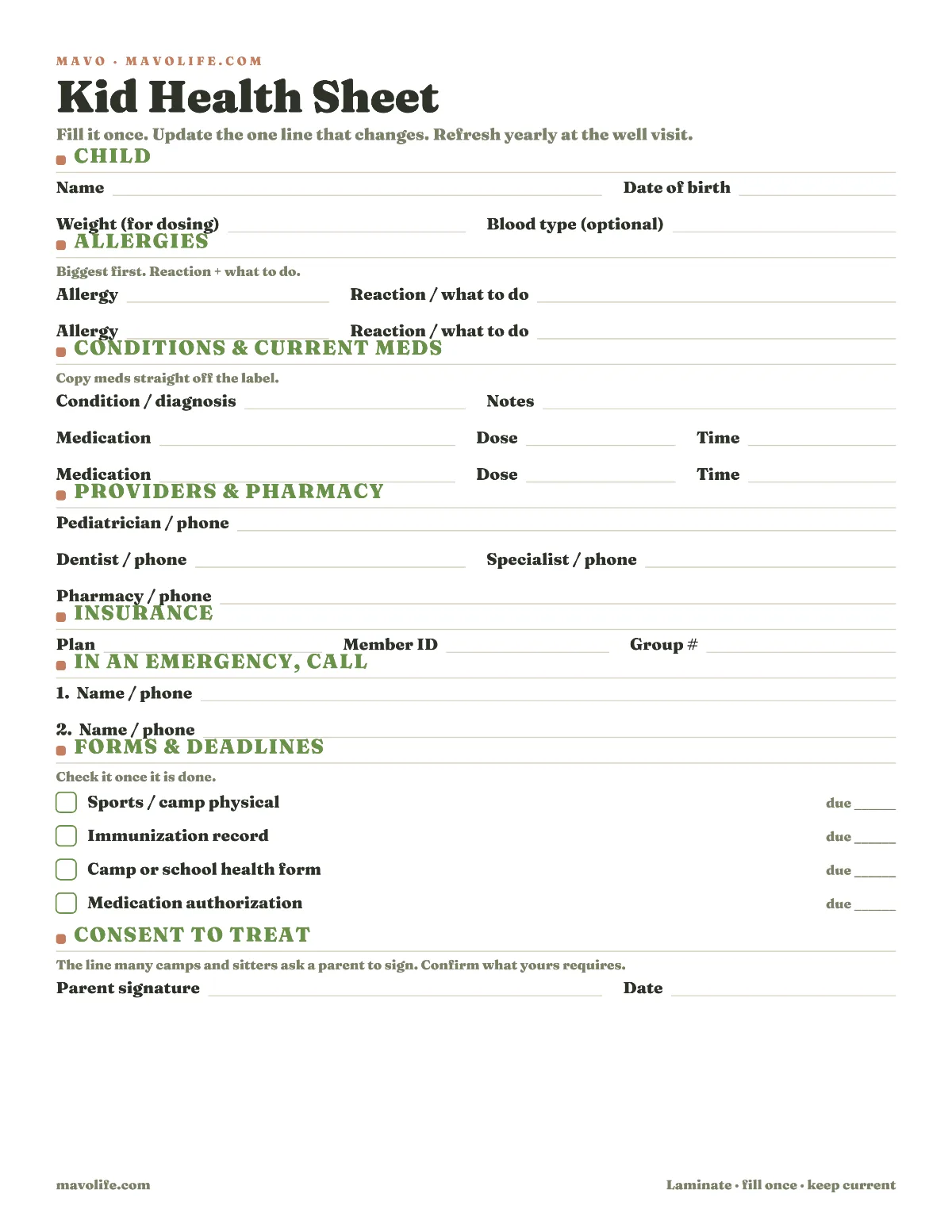
Six blocks, one page, all of it the stuff an outside adult would otherwise have to call you about:
- Child facts. Full name, date of birth, and current weight (weight is what camps and clinicians use for dosing), plus blood type if you know it.
- Allergies and reactions. Each allergy, what the reaction looks like, and what the plan is. It sits at the top of the sheet, right under the child's name and weight, where a hurried adult looks first.
- Conditions and current meds. Any ongoing condition, plus each current medication with its dose and the time it's given. Write it exactly as the label reads so there's no guessing.
- Providers and pharmacy. Pediatrician, dentist, any specialists, and the pharmacy, each with a phone number. This is what turns "call the doctor" into an actual phone call.
- Insurance and IDs. The plan name, the policy or member number, and the group number. The thing every intake desk asks for and no one has handy.
- Emergency contacts. Two people to call in order, with the number for each, so nobody has to decide who to try first.
Keep it to one page. A tired adult has to find the answer in about ten seconds, so anything that isn't needed in a handoff or at an intake desk stays off. There's no consent-to-treat signature on it, because this is the copy you laminate and update with a marker, and a signature you can wipe off is not one. The summer paperwork deadlines stay off too: those forms arrive one at a time, weeks apart, so a due-date chart on the fridge reads as current long after it isn't.
The sheet, ready to print
We made it as a real one-page printable so you don't have to lay it out yourself. Print it once, slip it into a laminating pouch or a page protector, and keep a wet-erase marker beside it. Fill it in once, then update the single line that changes when a med, a dose, or a provider changes.
Download the printable kid health sheet (PDF)
The card that travels with your kid
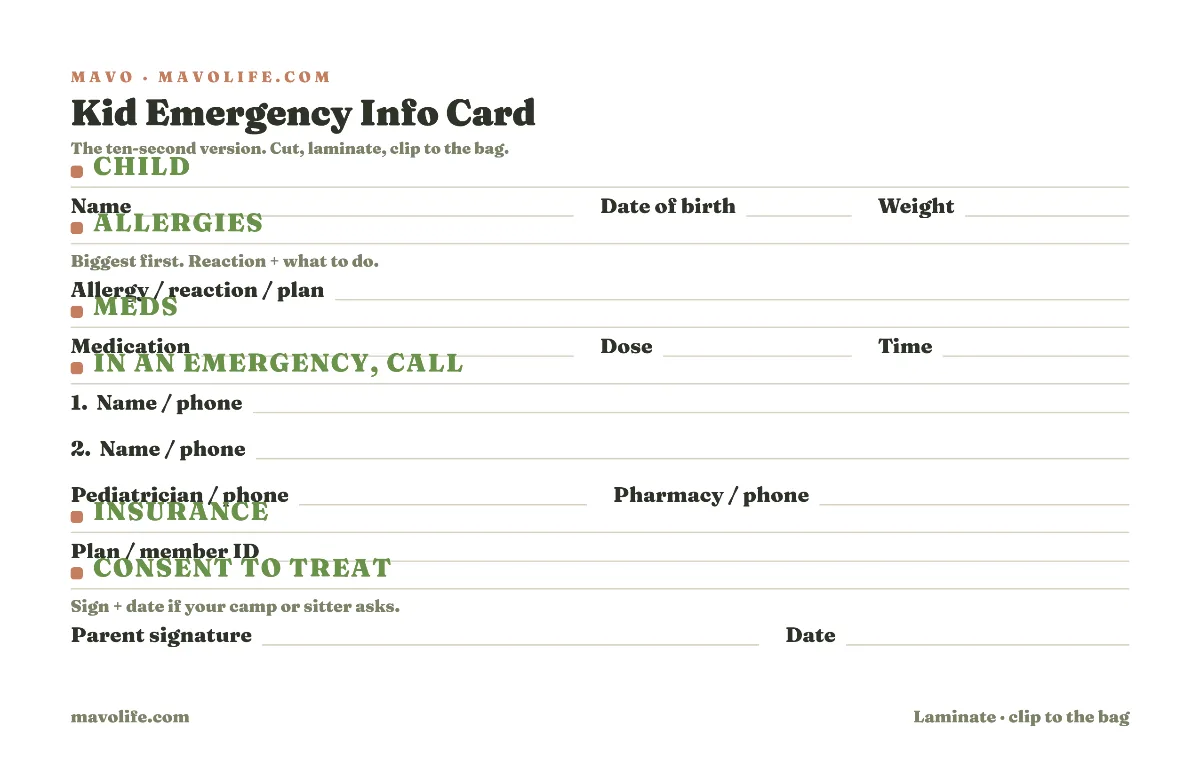
The full sheet is for you: everything, in one place, kept current. What goes in the bag is shorter. It holds only the facts that change what the next adult does in the first minute. Name, date of birth, and weight, because a camp nurse doses by weight. Allergies first and biggest, with the reaction and what to do about it. The current med, its dose, and the time it's given. Two people to call, in order. The pharmacy, the specialists, and the insurance ID stay on the full sheet. If your kid takes more than one medication, the card has room for one line, so the full sheet goes in the bag too.
Download the printable emergency info card (PDF)
Print the card, cut it out, and laminate it (or use a luggage-tag sleeve). Make three: one clipped inside the camp or activity bag, one on the fridge, one in the glovebox or wallet. When a med or contact changes, reprint just the card. It's small and cheap to redo, and it should always match the full sheet.
Build it once, keep it current
A printed form dies because nobody updates it. A health sheet is built to be kept, not reprinted:
- Make it reusable on day one: print the sheet into a laminating pouch with a wet-erase marker, or copy it onto a small dry-erase board on the fridge.
- Fill it in once, from the labels and cards you already have. Don't reconstruct it from memory; copy the med names and doses straight off the bottles and the insurance card.
- Update the one line that changed, when it changes: a new prescription, a dose change, a new specialist, a new pharmacy.
- Refresh the whole sheet once a year at the well-child visit, when you're already getting the physical and the updated shot record anyway.
That's the entire maintenance cost. One build, small edits, one annual pass, and it's ready for every form and every handoff in between.
If your kid goes between two homes
Print two and fill them in on the same day, from the same bottles and the same card. Then pick one parent to own the updates for both copies. A page nobody owns goes stale inside a month, and the stale one is always the copy the other house is reading from when the pharmacy asks.
If your kid has no allergies and takes nothing, the page is mostly providers, insurance, and who to call. Print it anyway. That's still the version people ask you for in August.
Where it breaks down
A page on the fridge is good at facts that hold still. It is bad at two things.
Deadlines are the first. A camp health form or a medication authorization doesn't arrive as a task with a due date. It sits in an inbox until it's late, and the physical that has to happen first never gets booked.
Distance is the second. The card in the glovebox is only as current as the last time somebody rewrote it, and the coach, the sitter, or the other parent is going off what they heard in June.
Both of those are about dates and names, not medical facts, and that part can live in a shared plan.
- Turn the paperwork into dated items. Photograph the camp health form, the immunization record, or the after-visit summary, and Mavo reads it into your shared plan with due dates and reminders, so "wait, did we send that form?" stops being a 9 p.m. discovery.
- Put a name on the health to-dos. The physical to book, the refill to pick up, the form to hand back: each one gets an owner and a reminder on a calendar the whole household can see, with covered status for anything that still needs someone. If the physical loses whoever was going to book it, Mavo can flag it to the family instead of assuming somebody remembered.
- Keep everyone on one version. Forward the reschedule from the pediatrician's office and Mavo drafts the event update for you to approve, so nobody drives to Thursday's old time.
- Draft the note you keep meaning to send. Ask Mavo to write the email to the school nurse or the records request, in chat, and then read it and send it yourself.
Mavo is family coordination, not a medical record, and it doesn't give medical advice. The dose and the allergy stay on the page you print and keep in the house. What Mavo is good for is the calendar side of health: what's due, who has it, and what changed since last week.
The small card is what belongs in the bag next to the packing side of the summer camp command sheet.
Quick questions parents ask
Isn't this a privacy risk to leave on the fridge? Keep the full sheet where your household sees it and use the short emergency card for handoffs, with only what a caregiver needs to act. Skip anything you wouldn't want a houseguest to read, like full policy numbers, on the fridge copy, and keep those on the sheet in the binder.
One sheet per kid, or one for the family? One per kid. Allergies, meds, and providers are individual, and a caregiver shouldn't have to hunt through a combined page in a hurry. Print one per child and clip them together.
What if the facts change mid-summer? Wipe the line that changed and rewrite it. That's what the laminating pouch is for, and if the change also moves a date or a task, put it in the shared plan too so the sitter and the other parent aren't working off the old version.
Do I really need the insurance number on it? On the full sheet, yes. The card in the bag skips it, since a member number doesn't change what a caregiver does in the first minute. It's the single most-asked-for, least-remembered fact at any intake desk, and having it turns a stressful lobby into a two-minute check-in.