Pickup & drop-off · July 10, 2026 · 6 min read
The parent with the flexible job does every pickup
Nobody negotiated that. It accumulated, one Tuesday at a time. A printable weekly roster for splitting drop-off and pickup on purpose, backups included.

It got settled by whichever job bends. One of you can move a meeting, so that parent took Tuesday pickup. Then Thursday, because Thursday was hard too. Then early release, half days, and the call from the nurse, until nobody was asking anymore because everyone already knew the answer.
None of that was a negotiation. It accumulated, and it only goes one direction. Writing the week down won't make the split even. It does put the trade somewhere you can both look at it, while there's still room to change it.
The week below is ten cells: five morning drops and five afternoon pickups. Don't fill them Monday through Friday in order, or the flexible parent has most of them again by Wednesday. Start by shading the cells one of you can't make. Those are the anchors. Assign the rest around them, add backups where a small delay would break the day, then read the whole week before you call it done.
The finished schedule may not look even day by day. It should still have one clear owner and a named fallback for every morning and afternoon.
Start with what neither of you can move
Write the hard constraints beside the week before either parent claims a turn. A day on site. The commute that crosses dismissal. A standing late shift, recurring travel, a school cutoff neither of you can reliably reach.
Now fill the owner cells around those anchors. If one parent can't leave on Tuesdays, the other owns Tuesday pickup. If both of you could handle Wednesday morning, still pick one. "Either of us" looks generous on Sunday and becomes a negotiation in the school parking lot.
Four rules that keep this honest:
- One name in every drop-off and pickup cell. The backup is next in line, not a second current owner.
- Trade whole slots when you can. "You take Wednesday pickup, I've got Thursday" is easier to remember, and easier to write down, than two partial handoffs.
- Count the entire week before deciding the arrangement works. Morning drops, afternoon pickups, travel days, early releases, not just the slot that annoys you most.
- Redo the anchors when work changes. The job that bends this year may not bend next year.
Some weeks have a day neither parent can cover. Better to find that on a Sunday than on a Tuesday. Aftercare, a grandparent, a sitter, or another standing arrangement goes in that cell, written out. Left blank, it becomes something one of you improvises on the day.
The week on one page
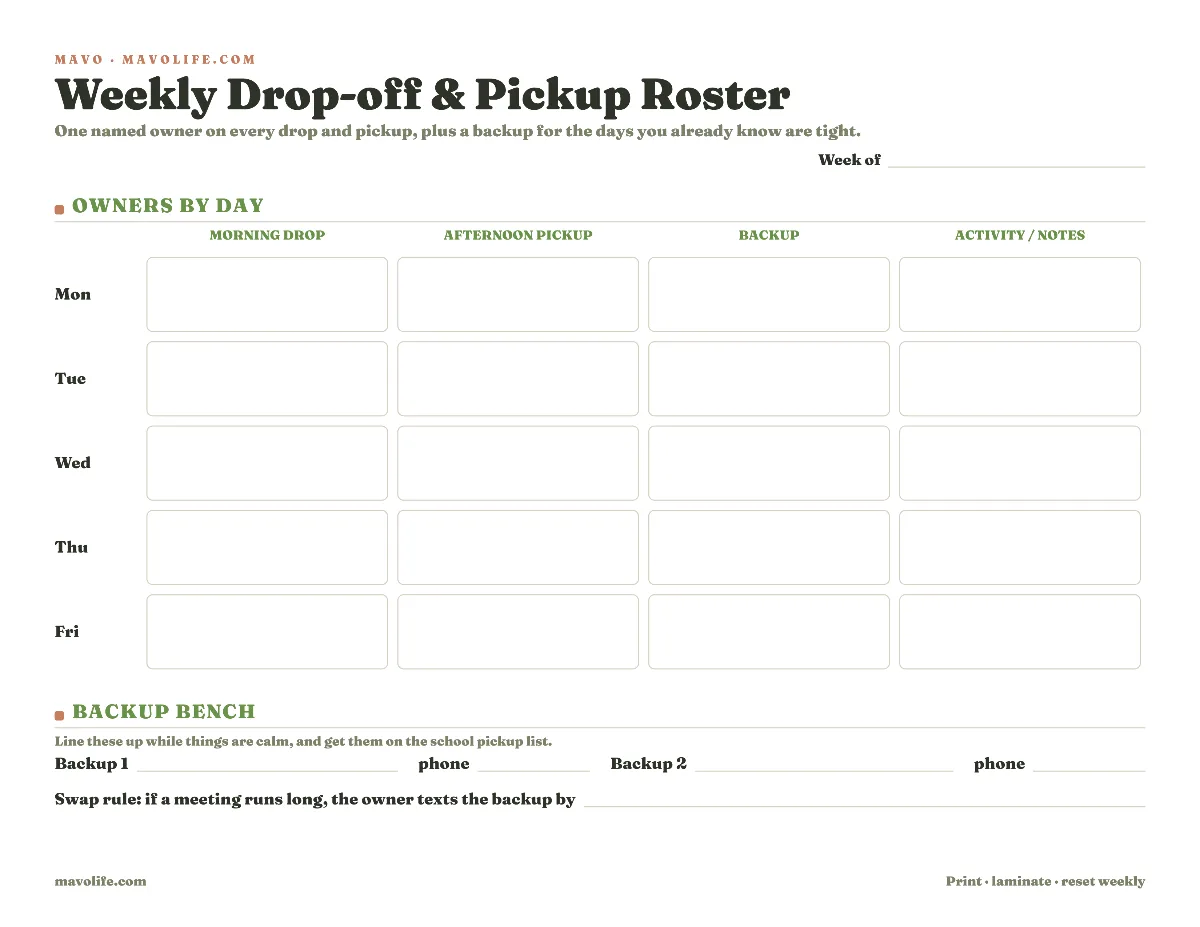
The printable puts the morning drop and the afternoon pickup side by side, with room for a backup and for whatever makes the day tight. Fill the constraint column first. Then the two owner columns. Then backups on the days with the least room for delay.
Download the printable pickup roster (PDF)
The note column is where the schedule stops pretending every weekday is the same. Write "early release," "straight to practice," "late shift," "parent traveling." Four words beside a name will tell you more on Wednesday morning than any amount of color-coding.
If your kids land in different places after the bell, this roster still answers who drives. An after-school coverage map shows where each kid ends up, when that stop ends, and what had to be in the bag.
Then read the filled grid twice. Across each day, to check that morning and afternoon are both covered. Down each parent's column, to see what the week asks of each of you. A schedule can be perfectly clear and still lean on one person's flexibility four days out of five. The grid won't tell you whether that's fair. It will at least put the question somewhere you can both see it.
Backups belong on the tight days
Not every slot needs one. A parent whose last meeting ends well before dismissal is fine on Monday without a name in that column. A Thursday with travel, a late shift, or a narrow commute is a different story.
The backup can be the other parent, a grandparent, a sitter, a neighbor, or a friend already making the same run. Two things have to be true before the name goes on the roster:
- The person has agreed to be the fallback for that specific slot.
- Your school or program will release your child to them.
Those are separate problems, and schools vary enough that you have to ask. Keep the weekly roster at the level of who's covering, and handle authorization on its own. A backup pickup plan covers the school's procedure and the ordered call list, and includes a request you can send.
For a day you already know is tight, a reminder often helps more than another name. In Mavo, a pickup carries one responsible person plus any notes you add, and you can set a reminder for it. The family can see whether it's Covered or still Needs Attention. The adults still decide the schedule and confirm any change.
Once you both need to see the same week
A work calendar can explain why a parent is unavailable. It can't say who is available and responsible, which is the one thing the other parent needs to know by Wednesday afternoon.
An early-release entry is the usual example. It's right about the date and the time, and silent about the ride. Add one owner to that pickup. If the day is tight, put the agreed backup on the roster and keep the school's requirements with the backup plan.
Mavo can carry the same assignment on the shared family calendar. Each pickup has one responsible person, and Covered or Needs Attention makes an empty slot obvious. It won't weigh two careers against each other, and it won't notice that a meeting is running long. It holds the current answer where both of you can check it, including on the day one of you takes over at the last minute.
Questions that come up
Our weeks aren't symmetrical. One of us travels.
Mark the travel days as constraints and build around them. If one parent is gone Tuesday through Thursday, the at-home parent or outside care covers those pickups. The traveling parent might take Monday and Friday pickups plus more morning drops, but don't force a numerical trade that makes the week harder for everyone. Agree on the whole-week split, and redo it when the travel pattern changes.
Something changes and we need to swap today.
The current owner asks the named backup and waits for an explicit yes. Then update that day's owner wherever the family keeps the schedule. The standing week stays as it is, and only the dated pickup changes.
What if pickup involves more than the two of us?
A grandparent can own Mondays. A sitter can cover the late-shift day. Aftercare can be the named destination until a parent arrives. Keep one current owner per slot. When several households take recurring driving turns, a carpool schedule template defines the shared ride, its riders, and the rotation.
Before the roster goes on the fridge, count how many cells belong to the parent whose job is the flexible one. If that's most of the hard days, the week has told you what the next conversation is about. Change the assignments, pay for some outside care, or agree that something else evens it out. Then put one unmistakable name in every cell.