Caregiver handoffs · July 10, 2026 · 6 min read
Your parents have the kids all week. Tuesday is swim day.
You're gone all week, so nobody walks in at night to see what drifted. Grandparents need the week laid out day by day, and a place to look numbers up.

Monday usually goes fine. It's still running on the conversation you had at the door, the one where you walked your parents through the whole week while looking for your charger.
Then the week starts spending it. Tuesday is swim day and the towel stays home. Wednesday the medicine question arrives as a photo of the bottle, sent to you between meetings. By Thursday nobody is sure whether early release is this week or next, and the only person who knows is boarding a plane.
It helps to sort the facts by how long each one stays true. Some belong to the whole stretch: parent numbers, the house address, the pharmacy, the door code. Some repeat every day: wake-up, breakfast, medicine instructions, screens, bedtime. The rest belong to one named day: Tuesday camp, Thursday's appointment, the Wednesday carpool, Friday's different pickup.
The two printable sheets below split along that line. One holds the week and its dated changes. The other keeps contacts, current health information, and house notes somewhere a person can grab them. Nothing has to be written down seven times.
Why a week is different from an evening
For one evening, the plan and the contacts fit on the same page, which is what the one-page babysitter and grandparent sheet is for. An evening also ends. Someone walks back in, sees the kitchen, and fixes whatever drifted.
A week gets no such correction. Your parents run Monday's plan, then Tuesday's, then Wednesday's, with nobody checking the work in between. So the week needs a sequence of its own: where the children go each day, who handles pickup, what dinner is, and what differs from the ordinary rhythm. It also needs a separate place to look things up, because the pediatrician's number doesn't need to appear seven times, and Friday's early release shouldn't sit next to the Wi-Fi password.
The American Academy of Pediatrics says regular, predictable, consistent routines help children. Write the repeated shape down once, then make the exceptions easy to spot. A medicine, health, pickup, or authorization detail still has to be checked against the current clinician instructions, the label, and whatever the school, camp, or provider requires. Printing something on a reference sheet doesn't keep it current.
The week at a glance, one row per day
Use the top block for what repeats during this stretch: wake and out-the-door times, breakfast, current medicine instructions, screen cutoff, bedtimes, and wind-down. Use the Monday-to-Sunday grid for school or camp, pickup and driver, dinner, evening plans, and anything different that day.
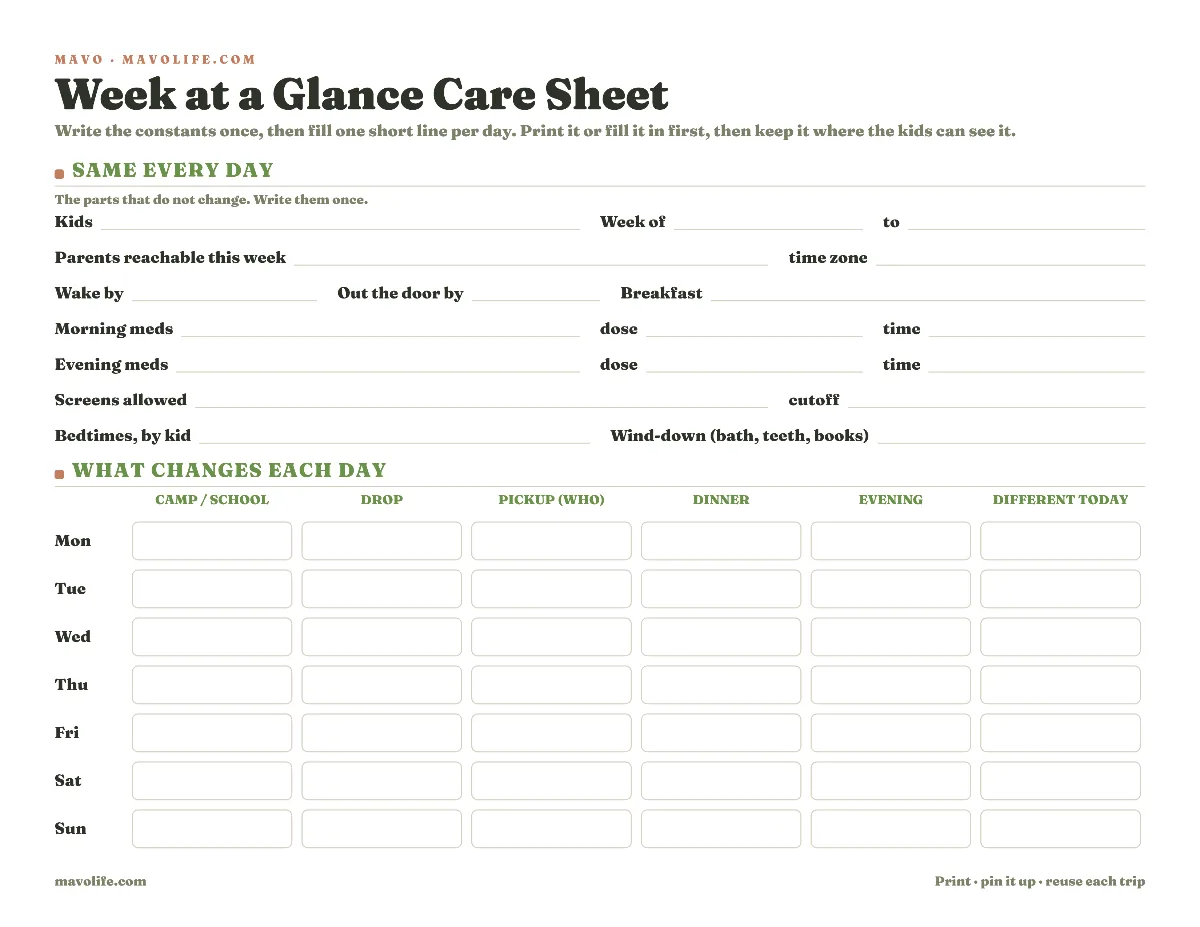
Download the printable week care sheet (PDF)
Put a name beside every pickup, including the days the grandparent drives. Then use "different today" for the exception that shouldn't be copied into the rest of the week: a half day, dress-down day, birthday party, or an item that has to go in the backpack.
A Tuesday row might read: camp, morning drop-off, afternoon pickup, grandparent driving, chili from the freezer for dinner, and swim day under "different today" with a towel and wet bag. That last part never survives a long paragraph of instructions, and it's the one a kid feels at 3 p.m. in wet clothes.
If care happens at the grandparent's house, the daily structure holds, but check which supplies and house notes travel with the children. If they're staying in your house, write down what a guest can't infer: which entrance everyone uses, the pet routine, which car seat goes in which vehicle.
For school, camp, or aftercare pickup, confirm the authorization and identification process with that provider, and record what applies to this week. The sheet itself does not grant pickup authority.
Who to call, and the house notes
The second printable is the lookup sheet for the whole stretch. It holds the best parent number for this week, a backup adult nearby, a trusted neighbor, the clinician or after-hours line, the dentist or orthodontist, the pharmacy, current health information, and the house details someone may need in a hurry.
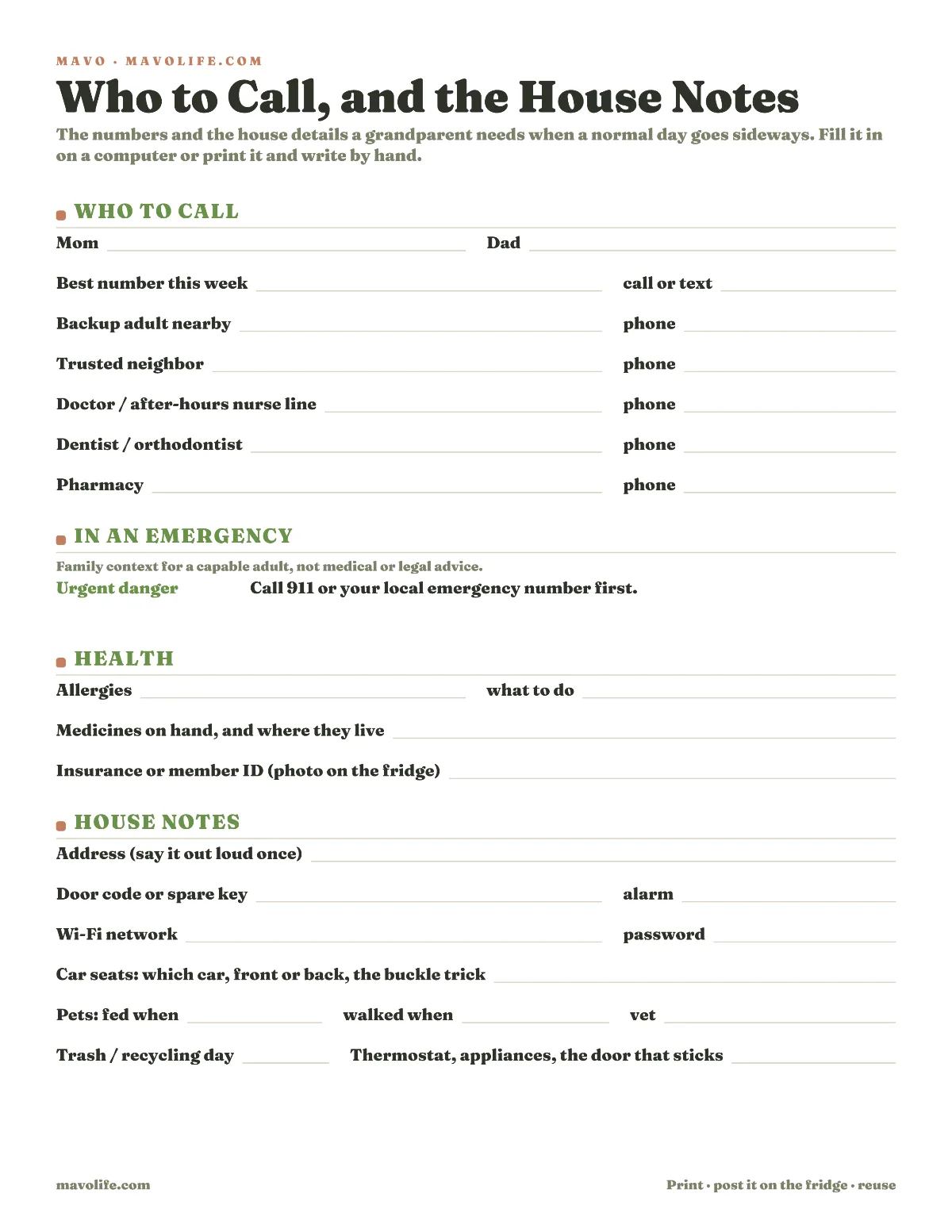
Download the printable contacts and house notes (PDF)
Copy medicine names, doses, timing, and instructions from the current label and clinician plan. Don't write a new dosing rule from memory. For a fuller health record, use the one-page kid health sheet and review it for this week rather than assuming last spring's copy is still right.
Formal medical or pickup authorization varies by provider and jurisdiction. Check with the school, camp, clinician, insurer, or appropriate local guidance about what is required. A signed family note may be useful context in some circumstances, but this printable isn't proof of legal sufficiency. In immediate danger, call 911 first.
There is a pleasing bit of household archaeology in this sheet: the door that sticks, the appliance with one non-obvious button, the pet who must be fed before anyone opens the back door. None of that is about a grandparent's judgment. Every house has rules that live nowhere except in repeated use, and nobody reverse-engineers them in three days.
When something changes after you've gone
The printables are a snapshot you reviewed before leaving. If Friday's pickup moves on a Wednesday, change the day, not the reference sheet.
In Mavo, pickups, appointments, and activities sit on the shared family calendar with one person handling each, and a Covered or Needs Attention status. A grandparent without a Mavo sign-in can still be part of the family and listed as going to an event, though the person responsible for an event has to be an adult who has been invited and signed in. Keep the paper packet available either way.
If you want the week visible from the road, your Family Game Plan can send you a look at what's coming up and who's handling it, in Mavo, by email, or by push.
Use the shared plan for the facts that moved: the rescheduled appointment, the changed pickup owner, the activity that got canceled. It doesn't grant medical or pickup authority, and it isn't the source for a clinician's instructions or a school's requirements.
When one parent stays home and the other travels, the solo-parent travel-week plan covers that arrangement instead.
Hand over the packet while you're still home
Put the two sheets together and walk through the first day out loud. Ask the grandparent to point to the pickup place and the driver, the current source for medicine instructions, and the person to call if neither parent answers. If any of those takes more than a few seconds to find, fix the sheet now, while you can still explain it.
Then pick one physical home for the packet and one place where later changes will show up. You'll know it's ready when Monday can run off those two answers without a call asking you to translate the page.