School emails · July 10, 2026 · 5 min read
"I signed it. Did it ever go back?"
Signing the slip is the easy half. The part that fails is the trip back to school. Here is the one line to write while the slip is still in your hand.

A slip comes home folded inside a math worksheet. You sign it at the counter that night, feel briefly competent, and put it down. On Thursday it surfaces under a stack of mail with your signature already on it, and the bus for the aquarium leaves Monday at 8:15.
Slips never arrive in a batch you can sit down and clear. One comes home in September for the pumpkin farm. Nothing for six weeks. Then two land in the same week in November, and one of them wants eight dollars in cash, which no wallet in this house has held since 2019.
So there's nothing here to maintain. A permission slip chart would sit empty from October to February, and a sheet that sits empty comes off the fridge by Halloween. Whatever works has to fit inside the thirty seconds the slip is in your hand, because that's the only time a slip has your full attention.
The start-of-year packet is a different animal: nine forms in one backpack, cleared in one sitting, and the back-to-school paperwork checklist is built for it. This page is for the ones that come alone, all year, with three days' notice.
One line, written before you put the slip down
Anywhere you'll look again works: the notes app, the shared calendar, a sticky on the fridge. The only rule is that you write it while the paper is still in front of you, because the version of you who walks away is not coming back to do it.
Zoo trip, Emma. Back by Fri 11/14. $8 cash. Ben signs, then take-back folder.
The date to write down is the return deadline, not the trip. Schools print both and bold the wrong one.
Write the fee even when there isn't one; a dash means there's nothing to chase. Money is the most common reason a signed slip stays home. Anyone can sign a form at 9pm, but cash means somebody stops at an ATM tomorrow, and the line should say who.
If you have more than one kid, the name goes first. Two slips from two schools in the same week look identical from across the kitchen, and the one you're holding is never the one you think.
The last piece, where the slip goes next, is the piece everybody skips, and it decides whether the form ever sees the school again. If your kitchen runs on paper, a printable version of this whole routine waits at the bottom of the page.
Where the signed slip waits
Don't trust the backpack with a signed slip. It's a swamp down there: a library book, a granola bar in an advanced state of decay, and your form, which will surface on the wrong day.
Give it one spot and use that spot every time: a clip on the fridge, or a folder by the door that holds school paper heading out and nothing else. Unsigned slips wait there too, in the open, where you'll see them. If the backpack is truly the only place a form will travel, give it a folder of its own, so checking is a look instead of a dig.
If your school takes forms through a website, the parking spot is the portal, and you can usually finish while the phone is already out. Slips that arrive as email attachments have this problem plus the email itself; school email is its own job.
Either way, a checkmark records what your house did. A teacher's desk is outside its jurisdiction, so if the school sends a confirmation, keep that with the slip; it's the only proof that exists.
The reminder should name the step that's left
"Return photo form" is a useless reminder. By the time it goes off, you've forgotten which half you did. "Sign photo form, $12, take-back folder" picks the job up exactly where you dropped it.
The day before is fine for a signature. It's not enough for a fee you have to go get, a chaperone form that wants a background check attached, or a slip that has to travel to the other parent's house and come back. Across two households, give it the weekend.
Or take a picture and let Mavo write the line
The line can write itself. Take a photo of the slip while it's still in your hand and send it to Mavo. It reads the trip, the return date, and the fee into plan items you check before saving. Look hard at the date it pulled, because slips like to bury the deadline in a paragraph about sack lunches.
Who's Handling It puts one name on the slip, so the question of who finds eight dollars gets answered in the kitchen instead of rediscovered on Sunday night. Needs Attention lists the slips nobody has claimed, the same question the mental load checklist asks about the rest of the house. The reminder goes out however your family has notifications set up, and it names the step that's left, not just the form.
Mavo doesn't sign anything, and it can't hand a form to a teacher. Somebody still has to carry the paper.
The whole thing, for one slip
- Write the line before you put the slip down: what it is, the return deadline, the fee, who's handling it, where it goes next.
- Park the signed slip in one spot that isn't the backpack.
- Set a reminder that names the step still left, early enough to cover a fee or a second household.
- Check it off when it leaves the house, not when you sign it.
The slip that ruins a Friday morning was signed a week earlier. It was done at your house the whole time. It just never left.
The fridge version
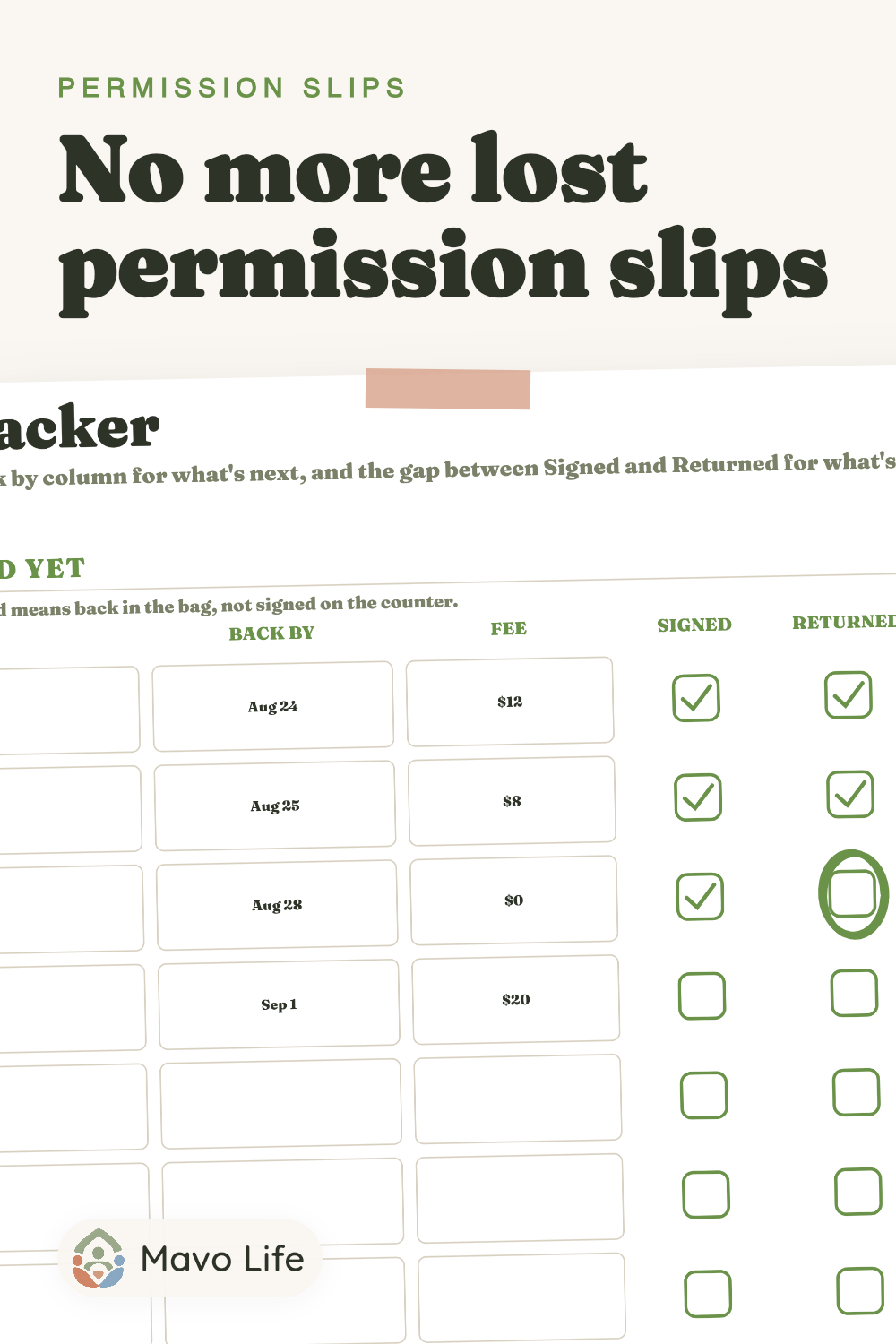
Some kitchens run on paper, and a slip is paper anyway. If yours does, the one-page grid below gives each slip a row: the slip and which kid it belongs to, the date it has to be back, the fee, and a box each for signed and returned.
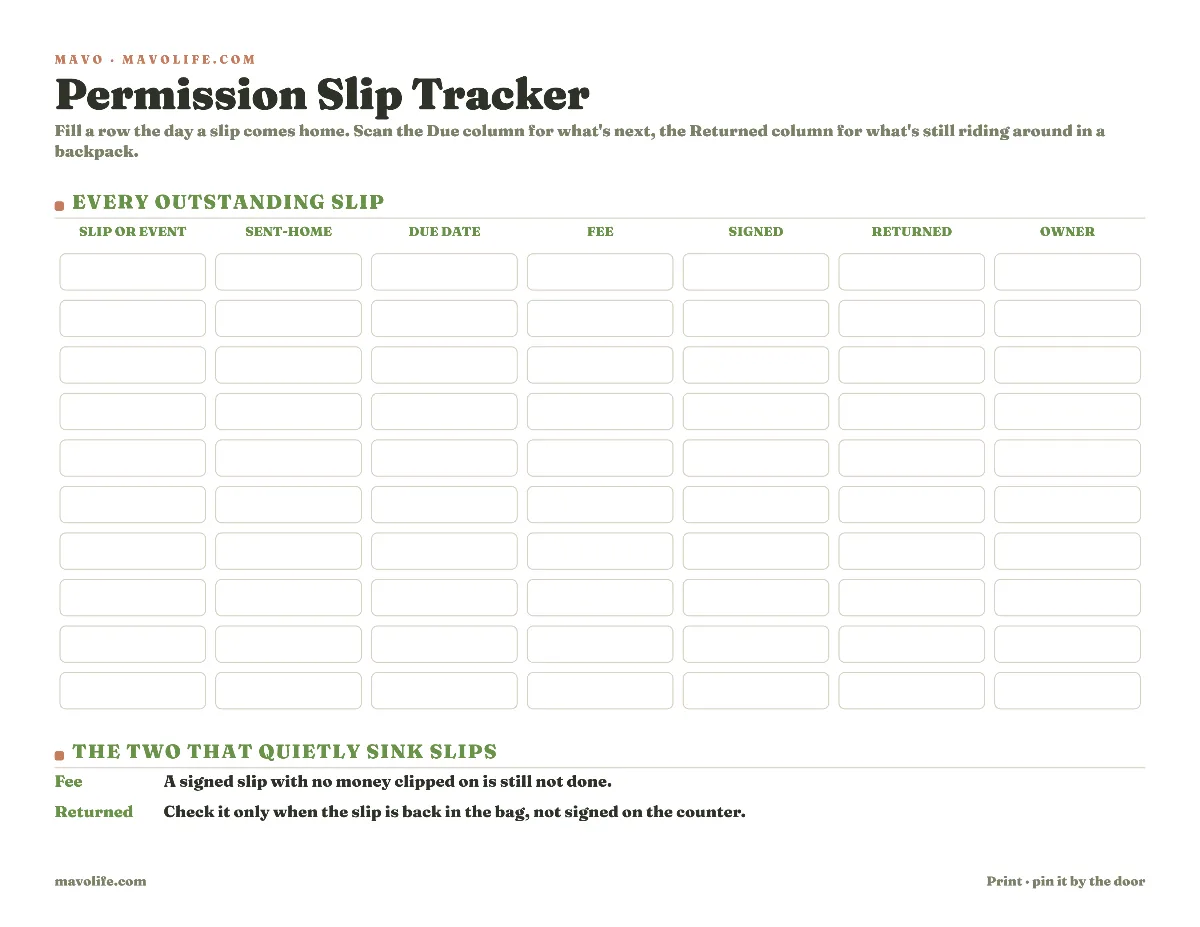
Download the printable permission slip tracker (PDF)
Print it for a multi-kid September, or one of those stretches when something comes home every week, and recycle it in June without a second thought. Keep it where the school paper lands and fill in the row while the slip is out; if you have to go find the sheet first, you won't. If one line in the notes app is already working, you don't need the sheet at all.